Effects of lemongrass (Cymbopogon citratus) on blood profile and uric acid levels of rats
DOI:
https://doi.org/10.29244/avl.10.1.23-24Keywords:
erythrocytes, lemongrass, leukocytes, rats, uric acidAbstract
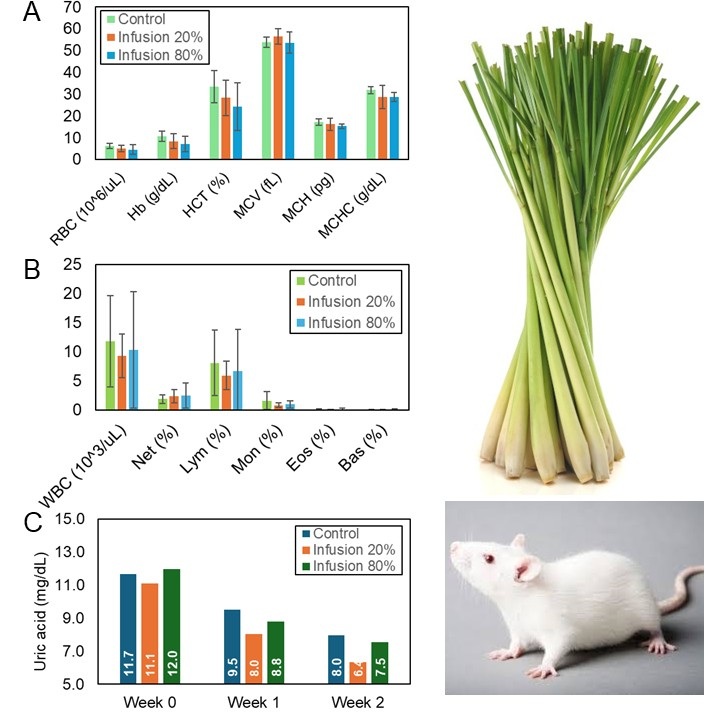
Lemongrass (Cymbopogon citratus) is a medicinal plant with antioxidant and antimicrobial properties. This study evaluated the effects of 20% and 80% lemongrass infusion on haematological profiles and uric acid levels in Sprague Dawley rats. Thirty rats were assigned to three groups: control, 20% infusion, and 80% infusion groups. The results showed no significant differences (P>0.05) in haematological parameters, although fluctuations in erythrocyte and leukocyte indices occurred. The 80% infusion reduced erythrocyte parameters, suggesting potential hypochromic macrocytic anaemia, while the 20% infusion reduced leukocyte counts and uric acid levels. These findings indicate that lemongrass infusion has immunomodulatory and anti-hyperuricemic effects, although higher concentrations may affect erythrocytes.
References
Adeneye AA, Agbaje EO. 2007. Hypouricemic effect of aqueous leaf and methanol seed extract of Cymbopogon citratus in rats. Journal of Ethnopharmacology. 112(1): 134-139. https://doi.org/10.1016/j.jep.2007.03.034 | PMid:17513076
Alagawany M, El-Saadony MT, Elnesr SS, Farahat M, Attia G, Madkour M, Reda FM. 2021. Use of lemongrass essential oil as a feed additive in quail's nutrition: its effect on growth, carcass, blood biochemistry, antioxidant and immunological indices, digestive enzymes and intestinal microbiota. Poultry Science. 100(6):101172. https://doi.org/10.1016/j.psj.2021.101172 | PMid:33951594 PMCid:PMC8111249
Al-Janabi AA, Alsalami MS, Noaman AI. 2023. The effect of lemongrass, Cymbopogon citratus, on some physiological parameters in male Awassi lambs. Iranian Journal of Ichthyology. 10:47-54.
Ariska SB, Utomo D. 2020. Kualitas minuman serbuk instan sereh (Cymbopogon citratus) dengan metode foam mat drying. Teknologi Pangan: Media Informasi Dan Komunikasi Ilmiah Teknologi Pertanian. 11(1): 42-51. https://doi.org/10.35891/tp.v11i1.1903
Ekpenyong CE, Daniel NE, Antai AB. 2015. Bioactive natural constituents from lemongrass tea and erythropoiesis boosting effects: potential use in prevention and treatment of anemia. Journal of Medicinal Food. 18(1):118-27. https://doi.org/10.1089/jmf.2013.0184 | PMid:25162916
Howarto MS, Wowor PM, Mintjelungan CN. 2015. Uji efektifitas antibakteri minyak atsiri sereh dapur sebagai bahan medikamen saluran akar terhadap 16 bakteri Enterococcus faecalis. Jurnal e-GiGi. 3(2):432-438. https://doi.org/10.35790/eg.3.2.2015.9835
Rahayu H, Roslizawaty, Amiruddin, Zuhrawaty, Karmil TF. 2017. Jumlah eritrosit kadar hemoglobin dan nilai hematokrit kambing kacang betina di Kecamatan Koto XI Tarusan Kabupaten Pesisir Selatan. Jurnal Ilmih Peternakan. 1(2):101-108.
Shah G, Shri R, Panchal V, Sharma N, Singh B, and Mann AS. 2011. Scientific basis for the therapeutic use of Cymbopogon citratus, stapf (Lemon grass). Journal of Advanced Pharmaceutical Technology & Research. 2(1): 3-8. https://doi.org/10.4103/2231-4040.79796 | PMid:22171285 PMCid:PMC3217679
Tavares F, Costa G, Francisco V, Liberal J, Figueirinha A, Lopes MC, Cruzb MT, Batista MT. 2015. Cymbopogon citratus industrial waste as a potential source of bioactive compounds. Journal of the Science of Food and Agriculture. 95: 2652-2659. https://doi.org/10.1002/jsfa.6999 | PMid:25389117
Yasir Al-Awadi DH, Ali Al-Nadawi NA. 2020. Effect of adding different levels of lemon grass leaves (Cymbopogon citratus) to the diet or its extract into drinking water on some blood parameters for broiler chickens (Ross 308). InJournal of Physics: Conference Series. IOP Publishing, 1664(1):012114. https://doi.org/10.1088/1742-6596/1664/1/012114
Downloads
Published
Issue
Section
License
Copyright (c) 2026 CC-BY-SA

This work is licensed under a Creative Commons Attribution-ShareAlike 4.0 International License.
All articles published in this journal are licensed under a Creative Commons Attribution-ShareAlike 4.0 International License (CC BY-SA 4.0).
This license permits use, distribution, reproduction, and adaptation in any medium, including for commercial purposes, provided the original work is properly cited, a link to the license is given, and any changes made are indicated. Any derivative work must be distributed under the same license or a compatible license.