Temperament profiles and social compatibility in captive female long-tailed macaques (Macaca fascicularis)
DOI:
https://doi.org/10.29244/avl.10.1.25-26Keywords:
animal welfare, behavior, temperament, Macaca fascicularisAbstract
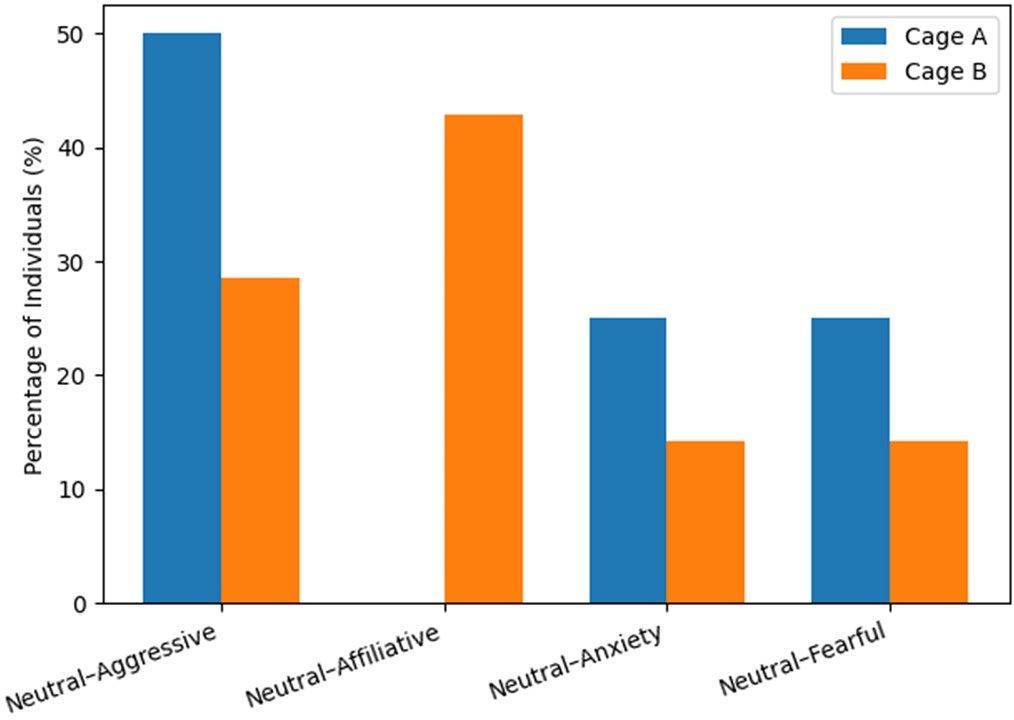
Long-tailed macaques (Macaca fascicularis) may exhibit agonistic behavior when housed in groups due to individual incompatibility, which can negatively affect social stability and animal welfare in captive settings. Temperament assessment has been proposed as a useful approach for evaluating individual compatibility prior to grouping. This study aimed to identify the temperament profiles of individual female long-tailed macaques housed at the Primate Research Center, IPB University. Temperament assessment was conducted on 11 adult females divided into two cage groups using the human intruder test in the profile phase. Behavioral responses were categorized into five temperament types. The results showed that four individuals exhibited neutral–aggressive temperament, three neutral–affiliative, two neutral–anxious, one neutral–fearful, and one fearful–neutral temperament. Comparative analysis indicated that cage group B displayed a higher proportion of affiliative-oriented individuals and greater overall compatibility than cage group A.
References
Bethell EJ, Cassidy LC, Brockhausen RR, Pfefferle D. 2019. Toward a standardized test of fearful temperament in primates: a sensitive alternative to the human intruder task for laboratory-housed rhesus macaques (Macaca mulatta). Frontiers in Psychol. 10(1051) : 1-17
Coleman K, Lutz CK, Worlein JM, Gottlieb DH, Peterson E, Lee GH, Novak MA. 2015. The correlation between alopecia and temperament in rhesus macaques (Macaca mulatta) at four primate facilities. Am. J. Primatol. 79(1) : 1 – 10
Ernita R, Setia TM, Dewi FN, Darusman HS. 2021. Long-tailed macaques (Macaca fascicularis) as model animals and the ethics of their use. Gunung Djati Conference Series. 6: 309–315
Fedurek P, Slocombe KE, Hartel JA, Zuberbühler K. 2015. Chimpanzee lip-smacking facilitates cooperative behaviour. Scientific Reports. 5(13460):1–7. [diakses 12 Oktober 2024]. doi: 10.1038/srep13460
Schapiro SJ. 2017. Handbook of Primate Behavioral Management. Bocaraton (US): CRC Press
Downloads
Published
Issue
Section
License
Copyright (c) 2026 CC-BY-SA

This work is licensed under a Creative Commons Attribution-ShareAlike 4.0 International License.
All articles published in this journal are licensed under a Creative Commons Attribution-ShareAlike 4.0 International License (CC BY-SA 4.0).
This license permits use, distribution, reproduction, and adaptation in any medium, including for commercial purposes, provided the original work is properly cited, a link to the license is given, and any changes made are indicated. Any derivative work must be distributed under the same license or a compatible license.