The formulation of halal market concept in Indonesia
DOI:
https://doi.org/10.29244/hass.2.2.15-17Keywords:
Consumer behavior, Halal governance, Halal product, Halal traditional market, NVivoAbstract
This study aims to conceptualize halal traditional markets (Pasar Rakyat) in Indonesia as multidimensional socioeconomic systems grounded in Islamic principles. Although halal industry has experienced growth in sectors, such as food, pharmaceuticals, and cosmetics, the governance framework for public markets remains underdeveloped. Using a qualitative exploratory approach, this current study analyzed 54 academic articles published between 2015 and 2025 through thematic coding using NVivo 15 Plus software. The results showed that there were 5 dominant thematic domains centered around the keywords of halal, market, products, Muslim, and Islam, reflecting the intersection of religious values, consumer behavior, institutional regulation, and socio-cultural identity. These indicated that halal market extended beyond product compliance to include ethical transactions, institutional regulations, and cultural representation. Traditional markets, particularly in Indonesia, played a significant role in the daily lives of Muslim communities but were often overlooked in halal development strategies. This study contributes to academic and policy discourse by proposing a more integrated and contextual understanding of halal market that is consistent with religious values and modern economic demands. However, the scope is limited to secondary data and literature analysis, which may not fully capture practical challenges in the field. Future studies are advised to include empirical investigation and stakeholder perspectives to strengthen these insights.
Introduction
The concept of halal in Islam comprises every aspect of human life, including economic activities and marketplace conduct. According to (Statistik, 2024-07), Muslim population in Indonesia is approximately 87.2% of the total population, and the country holds vast potential to develop a comprehensive halal ecosystem. The increasing awareness among consumers regarding the importance of shariah-compliant products has positioned halal not merely as a religious label, but also as a lifestyle and market standard (I. et al., 2019). Despite the growth of the industry in sectors such as food, pharmaceuticals, and cosmetics, the concept of halal market, which is defined as a structured public marketplace adhering to Shariah principles, remains underdeveloped and fragmented in Indonesia (Peristiwo, 2020).
Public markets (Pasar Rakyat) serve as essential nodes for economic interactions between producers and consumers. However, these markets often lack clear halal zoning, consistent enforcement of certification, and awareness among sellers and buyers regarding the required practices (Hasan & Pasyah, 2022). Consequently, many vendors operate without proper certification or understanding of consumer protection laws, and the lack of government outreach has exacerbated the inconsistency in the application of standards (W. et al., 2023). This situation challenges the establishment of a unified framework for halal market governance in Indonesia and raises concerns regarding consumer trust, food safety, and regulatory gaps. Therefore, this study aims to formulate a holistic and contextual concept of halal market in Indonesia that integrates halal certification, Shariah-based transaction ethics, market management, and monitoring mechanisms. By combining perspectives from policymakers, scholars, and practitioners, this current study seeks to construct a governance framework suitable for Indonesia's cultural diversity and economic structure (R. et al., 2025). The implications of religiosity, consumer behavior, and institutional responsibility in ensuring halal assurance across traditional markets were also explored.
Based on existing literature, there is a gap in the conceptualizationof halal market as an integrated socio-economic system. While previousstudies often focus on halal products or consumer perceptions, little attention has been given to the governance of traditional markets wherehalal practices directly intersect with daily Muslim life.This studycontributes by extending the discourse from product-level compliancetoward governance structures that reflect ethical, institutional, and culturaldimensions of halal market.
The current study is also consistent with global trends where halal is increasingly observed not only as a religious obligation but also as a quality benchmark in international trade (L. et al., 2025). Indonesia's status as the country with the largest Muslim population provides both responsibility and opportunity to lead in innovation (Rafiqah, 2024). Focusing on Pasar Rakyat, which often sells livestock-based products such as beef and chicken but is overlooked in national halal strategies, this study emphasizes the urgency of regulatory and developmental efforts to protect both consumers and producers.
2. Materials and Methods
2.1 Data Types and Sources
This study applied a qualitative exploratory approach through thematic analysis of the literature to understand the conceptual development of halal market in Indonesia. The data consisted of 54 national and international academic journal articles published between 2015 and 2025. Articles were selected based on their relevance to halal market development, Islamic economics, halal certification, and Muslim consumer behavior. Sources were obtained from scholarly databases such as Scopus, ScienceDirect, and Google Scholar in both English and Bahasa Indonesia to capture local and global perspectives. All articles were downloaded in PDF format for further processing.
2.2 Data Processing and Analysis Methods
Data were analyzed using NVivo 15 Plus software with a thematic coding approach.
The process began with inductive open coding, where relevant text excerpts were manually marked and assigned to thematic nodes such as Halal Market, Islamic Marketing, Muslim Consumer Behavior, Stakeholders, Challenges, Strategies, and Development. New sub-nodes were added as needed to reflect more nuanced patterns during coding. Furthermore, coding was performed manually by the study team to ensure contextual accuracy with careful sentence-by-sentence analysis. After the coding phase, NVivo 15 Plus tools, such as word frequency queries, word clouds, and coding matrices, were used to identify dominant themes and their relationships. These patterns served as the foundation for constructing a conceptual framework of halal market suitable for Indonesian context.
3. Result an Discussion
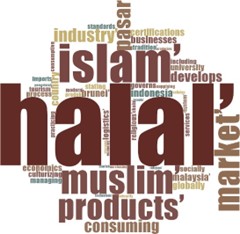
The word frequency analysis revealed that the most dominant terms across the literature corpus were halal, market, products, Muslim, and Islam. These frequently occurring words confirmed the centrality of religious values and compliance in defining halal traditional markets. The recurring appearance of products and markets also showed that the discourse was heavily anchored in economic and consumption contexts, particularly in traditional retail environments.
Figure 1.Word cloud visualization of halal market
In addition to religious and economic elements, the word cloudindicated other prevalent concepts, such as industry, logistics, certifications,and consumption, reflecting the structural and operational characteristics ofhalal market. These terms were consistent with results from (A. & N, 2020); (W. et al., 2023), which emphasized the importance ofregulation, standardization, and traceability in halal supply chains.
Geographical and institutional references, such as Indonesia, Malaysia, and Brunei, along with terms such as university and development, suggested the influential role of Southeast Asian nations and academic institutions in advancing halal market ecosystems. The appearance of words such as culturizing, managing, and socially further supported the view that halal market functioned not only as economic entity but also as cultural expression of Muslim identity, consistent with the results of (D. & A, 2021) and (M. et al., 2024).
The presence of tourism, logistics, services, and standards impliedan expansion of halal concept beyond food products, comprising severalsectors, including hospitality, transportation, and certification services.These results were consistent with the study by (Ramya, 2022) and (E, 2020), who demonstrated that consumer behavior in halal market wasshaped by both religious motivations and perceptions of quality, cleanliness,and ethical sourcing practices.
The proportional size of each box represented the frequency ofthe occurrence of each keyword (Figure 2).Halal dominated thevisualization, followed by Islam, market, Muslim, and products, reaffirmingtheir conceptual prominence.Medium-sized boxes such as industry,consumption, certification, and logistics supported the notion that halalmarket was viewed not only as religious construct but also as component ofintegrated economic systems. Terms such as Indonesia, Malaysia, Brunei,and universities suggested the significance of regional and institutionaldrivers in shaping halal ecosystems. The combination of both visualizationsconfirmed 5 dominant domains in the literature, namely (1) the Islamicfoundation of halal practices; (2) Muslim consumer and product focus;(3) certification, supply chain, and logistical structures; (4) regional development in Southeast Asia; and (5) market modernization and culturaladaptation. These results provided a foundation for subsequent thematiccoding and model development.
The results validated that halal traditional markets represented amultidimensional system integrating religious values, consumer behavior,governance,and cultural identity.Beyond product compliance,these markets comprised certification, supply chains, and institutionalframeworks, positioning it as both economic hubs and cultural expression.In Indonesia, their relevance was reinforced by ongoing modernization,regulation, and digital transformation, providing a solid foundation for furtherconceptual development.
The results of the word frequency analysis demonstrated that discourseon halal traditional markets extended far beyond religious compliance. Whileprevious studies had predominantly framed halal market in theological orritualistic contexts, these results emphasized their evolution into integratedsocioeconomic systems.The prominence of terms such as industry,logistics, and certification reflected a shift in scholarly attention towardinfrastructure, institutional support, and operational mechanisms thatensured halal integrity in supply chains.
Compared to earlier literature, which often focused solely on consumerperceptions or halal food products, this study indicated a broader andmore complex ecosystem.The frequent mention of Southeast Asiancountries, particularly Indonesia, Malaysia, and Brunei, emphasizedregional leadership in institutionalizing halal systems, not only throughregulation but also by innovation and education. This result reinforced thegrowing role of academic institutions and policy frameworks in shaping halalmarket practice.
A notable distinction in this study was the recurring presence ofsociocultural terms such as culturizing, managing, and socializing, whichwere rarely emphasized in previous studies. This suggested that halalmarket was increasingly being recognized as cultural expression rather thanmerely transactional venue. Consequently, this interpretation positionedhalal traditional markets as adaptive spaces that reflected communityvalues, governance models, and contemporary consumer expectations.
The results contributed to a more holistic understanding of halaltraditional markets as dynamic systems that operated at the intersectionof religion, economics, and culture.Furthermore, these affirmedthe necessity of developing conceptual models that captured themultidimensional nature of halal ecosystems. Future studies must explorestakeholder interactions, governance frameworks, and the impact ofdigital transformation on traditional halal market, particularly in emergingMuslim-majority economies.
Figure 2.Tree map of halal market
4. Conclusion and Limitations
4.1 Conclusion
In conclusion, this study provides an initial exploration of the conceptual landscape of halal traditional markets through word frequency analysis. The results confirm that halal market is not solely religious construct but is evolving into complex socio-economic systems embedded with cultural, regulatory, and institutional dimensions. The centrality of terms such as halal, market, products, and Muslim reflects both religious values and economic functions, while the presence of keywords including certification, logistics, and culturizing indicates the operational and cultural dynamics that shape halal ecosystems.
The results contribute to a more nuanced understanding of halal traditional markets, particularly in Southeast Asia, where regional leadership and academic engagement have been essential in shaping the discourse. This result emphasizes the importance of developing a more integrated conceptual framework that reflects the multidimensional nature of halal market.
4.2 Limitations
This study was limited to secondary data and literature-based thematic analysis, and could not fully capture practical, on-the-ground challenges. Future studies must extend these initial results by integrating stakeholder perspectives, institutional analysis, and empirical fieldwork. Moreover, further studies were needed to explore how digital transformation, urban governance, and consumer behavior intersect with the evolving nature of halal market systems.
Conflict of Interest
The authors declare no conflict of interest.
References
- W. Adhiwibowo, W. Widayat, A Syafei W.. Dual Blockchain Framework for Halal Food Safety and Traceability Concern with Internet of Things. International Conference on Technology, Engineering, and Computing Applications (ICTECA. 2023.
- Statistik B.P.S.] Badan Pusat. Agama di Indonesia, 2024. Internet. 2024. Publisher Full Text
- A. Baig M., N Ali S.. The Expanding Scope and Scale of Halal Market. Journal of King Abdulaziz University, Islamic Economics. 2020; 33(2)
- M. Bakhshi, H. Hanzaee K., M Amirshahi. Motivations fluidity: the effect of cultural factors on the formation of grocery shopping motivations. Journal of Islamic Marketing. 2024; 15(11)
- Hasan K.N.S., Pasyah T.. Challenges of Indonesian halal industry in the digital economicera. Sriwijaya Law Review. 2022; 6(2)
- R. Idris, P. Dato Musa, F. Sumardi S., H W.. The Halal Industry in Asia. 2025.
- D. Iner, A Baghdadi. Handbook of Contemporary Islam and Muslim Lives. 2021.
- L. Judijanto, D. Solihin, R. Nurnaningsih, P. Gastriani, O. Jakarta, S I.Pelita Nusa Bandung Barat, Banda Aceh S Tgk Chik Pante. Perkapalan Negeri Surabaya P. Bibliometric Analysis of Halal Industry Research in the Global Market. 2025; 3
- Peristiwo H.. Indonesian Food Industry on Halal Supply Chains. Food ScienTech Journal. 2020; 1(2)
- Rafiqah R.. Indonesia's Halal Industry Development Strategy; The Road Map Toward the Global Halal Hub Industry. Imara: Jurnal Riset Ekonomi Islam. 2024; 8(1)
- Ramya K.. Applying the theory of reasoned action to measure intent to purchase halal food. Journal of Cultural Marketing Strategy. 2022; 7(1)
- I. Vanany, M. Soon J., A. Maryani, M Wibawa B.. Determinants of halal-food consumption in Indonesia. Journal of Islamic Marketing. 2019; 11(2)
- W. Waspada, B. Madiong, F. Manne, K. Kasmawati, S Waspada. Daya Dukung Aparat Pemerintah Kota Makassar terhadap Implementasi Undang Undang No. 33 Tahun 2014 tentang Jaminan Produk Halal. Indonesian Journal of Legality of Law. 2023; 5(2)
- E Yarar A.. Halal advertising on YouTube: A case study of fast-food brands in Malaysia. Food Research. 2020; 4(1)
Copyright & License
© 2025.
This is an Open Access article under the terms of the Creative Commons Attribution-ShareAlike 4.0 International License (CC BY-SA 4.0), which permits unrestricted use, distribution and reproduction in any medium, provided the original work is properly cited.

References
Adhiwibowo W, Widayat W, Syafei WA. Dual Blockchain Framework for Halal Food Safety and Traceability Concern with Internet of Things. International Conference on Technology, Engineering, and Computing Applications (ICTECA). 2023. IEEE; p.1-6. https://doi.org/10.1109/ICTECA60133.2023.10490466
[BPS] Badan Pusat Statistik. Agama di Indonesia, 2024. [Internet]. 2024 [accessed 24 July 2025]. Available at: https://samarindakota.bps.go.id/id/statistics-table/1/MzI0IzE=/agama-di-indonesia-2024.html
Baig MA, Ali SN. The Expanding Scope and Scale of Halal Market. Journal of King Abdulaziz University, Islamic Economics. 2020;33(2):159-172.
Bakhshi M, Hanzaee KH, Amirshahi M. Motivations fluidity: the effect of cultural factors on the formation of grocery shopping motivations. Journal of Islamic Marketing. 2024;15(11):2988-3009. https://doi.org/10.1108/JIMA-02-2023-0047
Hasan KNS, Pasyah T. Challenges of Indonesian halal industry in the digital economic era. Sriwijaya Law Review. 2022;6(2):319. https://doi.org/10.28946/slrev.Vol6.Iss2.869.pp319-335
Idris R, Pehin Dato Musa SF, Sumardi WH. Challenges of Halal Food Ecosystems: The Case of Brunei Darussalam. In: The Halal Industry in Asia. Singapore: Springer Nature Singapore; 2025. p.333-351. https://doi.org/10.1007/978-981-96-0393-0_17
Iner D, Baghdadi A. Halal Food. In: Handbook of Contemporary Islam and Muslim Lives. Cham: Springer International Publishing; 2021. p.747-765. https://doi.org/10.1007/978-3-030-32626-5_91
Judijanto L, Solihin D, Nurnaningsih R, Prina Gastriani O, Jakarta I, Pelita Nusa Bandung Barat S, Tgk Chik Pante kulu Banda Aceh S, Perkapalan Negeri Surabaya P. Bibliometric Analysis of Halal Industry Research in the Global Market. 2025;3(1):51-60. https://doi.org/10.58812/wsiss.v3i01.1617
Peristiwo H. Indonesian Food Industry on Halal Supply Chains. Food ScienTech Journal. 2020;1(2):69. https://doi.org/10.33512/fsj.v1i2.6475
Rafiqah R. Indonesia's Halal Industry Development Strategy; The Road Map Toward the Global Halal Hub Industry. Imara: Jurnal Riset Ekonomi Islam. 2024;8(1):1. https://doi.org/10.31958/imara.v8i1.10977
Ramya K. Applying the theory of reasoned action to measure intent to purchase halal food. Journal of Cultural Marketing Strategy. 2022;7(1):107. https://doi.org/10.69554/PQVR5439
Vanany I, Soon JM, Maryani A, Wibawa BM. Determinants of halal-food consumption in Indonesia. Journal of Islamic Marketing. 2019;11(2):507-521. https://doi.org/10.1108/JIMA-09-2018-0177
Waspada W, Madiong B, Manne F, Kasmawati K, Waspada S. Daya Dukung Aparat Pemerintah Kota Makassar terhadap Implementasi Undang Undang No. 33 Tahun 2014 tentang Jaminan Produk Halal. Indonesian Journal of Legality of Law. 2023;5(2):496-501. https://doi.org/10.35965/ijlf.v5i2.2210
Yarar AE. Halal advertising on YouTube: A case study of fast-food brands in Malaysia. Food Research. 2020;4(1):157-163. https://doi.org/10.26656/fr.2017.4(S1).S34
Published
Issue
Section
License
Copyright (c) 2025 Aaliya Marcellina, Laily Dwi Arsyianti

This work is licensed under a Creative Commons Attribution-ShareAlike 4.0 International License.
How to Cite