The influence of halal labels and marketing mix on purchase decisions for Kopi Kenangan online food delivery in Jabodetabek area, Indonesia
DOI:
https://doi.org/10.29244/hass.2.2.11-14Keywords:
halal label, marketing mix, online food delivery, PLS-SEM, purchase decisionAbstract
Indonesia is increasing its coffee production and consumption rates annually, leading to the proliferation of coffee shops in Jabodetabek and prompting competitors to necessitate online food delivery. Therefore, this research aimed to determine the influence of the halal label and marketing mix comprising product, price, place, and promotion, on online food delivery purchasing decisions for Kopi Kenangan in Jakarta, Bogor, Depok, Tangerang, and Bekasi (Jabodetabek) Area, a metropolitan region including satellite cities and major business centers. The analysis used a quantitative method with purposive sampling, including 151 Muslim respondents aged 13–40 years who had purchased Kopi Kenangan products online. Data were analyzed using Structural Equation Modeling-Partial Least Squares (SEM-PLS). The results showed that product and promotion variables significantly influenced purchasing decisions for Kopi Kenangan products. In contrast, the halal label and location showed a positive but insignificant influence, and price exhibited a negative and insignificant influence.
1. Introduction
Indonesia is an agriculture-based agrarian country, prompting the agricultural sector to play an important role in national economic growth. Part of the sector is the plantation, which is also the largest contributor to agricultural exports (D. & S, 2021). This is evident in the contribution of the GDP of the plantation subsector of 3.94% in 2021, which ranks highest among the agriculture, hunting, livestock, and service industries, with the leading commodity being coffee. This is the most important commodity for Indonesia's economic activities and the country's export commodities with significant value in terms of generating foreign exchange.
Globally, Indonesia is the world's fourth-largest coffee-producing country, producing 6.9% in 2020 after Brazil produced 39.3%, Vietnam produced 16.5%, and Colombia produced 8.1% of the total world crop (Organization, 2019). According to (Organization, 2019), Indonesian coffee has increased in its production and consumption categories based on coffee exporting countries, as showed in (Table 1). Between 2017 and 2020, Indonesia's coffee production continued to increase, with only a decrease in 2018 by 0.37% from the previous year before rising the following year. Correlating with the production, coffee consumption also increased during the same year (Organization, 2019).
| Year | Production | Consumption |
|---|---|---|
| 2017 | 632,640 | 285,0000 |
| 2018 | 604,260 | 288,000 |
| 2019 | 696,000 | 288,360 |
| 2020 | 717,000 | 300,000 |
The increasing annual amount of coffee production and consumption has led to the evolution of various coffee shops in Indonesia, specifically in Greater Jakarta. In August 2019, the number of coffee shops reached more than 2,950 outlets, compared to 2016 when the number was around 1,000. The Janji Jiwa Coffee brand had 900 outlets, Kopi Kenangan with 868, Starbucks with 523, Fore Coffee with 177, and Kopi Kulo with 250 spread across Indonesia.
Coffee shops are a place to enjoy a wide variety and other non-alcoholicbeverages in a relaxed environment. Many provide additional amenitiessuch as televisions, music, reading materials, wireless internet, andattractive interior designs, making them increasingly popular among youngpeople in urban areas, specifically Greater Jakarta(Herlyana, 2012). Mostof these coffee shops are often used as study rooms, discussion forums, orplaces to hang out with colleagues while enjoying the coffee drinks offered(N. & N, 2017).
The large number of coffee shop businesses offers fierce competitionto meet consumer demand in making purchase decisions, requiringcompanies to be wise when choosing product marketing strategies(L. et al., 2022). Part of the strategies used is marketing throughonline food delivery.
Online food delivery is the process of managing customers and placing food product orders on digital platforms (J. & M, 2020).
The features of online food delivery service applications in Indonesia are GoFood, GrabFood, and ShopeeFood. The food products ordered can be prepared specifically for consumption or ready-to-eat meals. Cash-on-delivery and online platforms are two media to pay for online food delivery services (D. & A, 2022). Indonesia has the highest percentage of online food delivery application use in the world, at 74.4% (Social, 2021-10). This figure shows that 74.4% of internet users in Indonesia use the applications to order food.
In Indonesia, part of the coffee shops that uses a food delivery service partner is Kopi Kenangan, which is a food and beverage company operating under the auspices of PT. The Earth is blessed. The main business is the sale of processed coffee products and is one of the fastest-growing coffee chains in Indonesia, by carrying the grab-and-go concept. Currently, Kopi Kenangan has 868 outlets spread across 64 cities in Indonesia (Kenangan, 2023). In 2023, the majority of Kopi Kenangan outlets spread across Greater Jakarta with 278 outlets, including 166 in Jakarta, 16 in Bogor, 17 in Depok, 47 in Tangerang, and 32 in Bekasi. Kopi Kenangan outlets have increased rapidly with the spread in various cities in Indonesia within 6 years after the establishment in 2017. In 2023, Kopi Kenangan had 868 outlets in major cities (Kenangan, 2023).
Marketing companies are also essential for the sales of products and services and must use effective strategies to attract potential consumers (SAW, 2017). Marketing mix is a tactical instrument to manage product strategies, prices, venues, and promotions that companies run to optimize product demand (Kotler & Armstrong, n.d.). Food and beverages should meet the requirements of halal and thoyyib (permissible) according to the provisions of the holy book of the Qur'an and Hadith. In the Quran Surah An-Nahl verse 114, Allah has stated that every Muslim is obliged to eat halal food.
The Top Brand Award (2021) showed that Kopi Kenangan and Janji Jiwa were popular coffee shops with the public. Kopi Kenangan is in first place with a 39.9% in the Top Brand Award 2020 survey, and Kopi Janji Jiwa is in second place with 29.8%. In 2021, Kopi Kenangan was in second place with 36.7%, while Kopi Janji Jiwa was in first place with 39.6%. This showed that Kopi Kenangan experienced a decrease of 3.3% while Kopi Janji Jiwa increased to 9.7%. From these results of the survey, concerns about potential future declines in Kopi Kenangan's brand performance are raised. Accordingly, further research on factors such as halal labeling and the marketing mix is warranted to better understand consumer purchasing behavior toward Kopi Kenangan.
2. Materials and Methods
Purchasing decisions were described as part of a consumer's decision-making method when purchasing a good or service (Kotler & Pemasaran, 2014). According to (P. & Pemasaran, 2016), purchasing decisions were aspects that consumers used to acquire and consume traded goods. (G. & L, 2014)stated that the purchase decision was interpreted as the selection of several available alternatives. Purchase decision indicators by (Kotler & Armstrong, n.d.) also explained that purchase decisions had several indicators, including:
a. Product Selection Consumers buying products or for other purposes should decide.
Companies should also pay attention to consumers who were interested in buying the products or other desired alternatives.
b. Brand Selection Consumers should decide the brand to purchase. Each brand possessed its advantages and differences.
This quantitative analysis used primary and secondary data. Primary data were the main data used to determine the purchase decisions for Kopi Kenangan in Greater Jakarta, obtained from respondents' answers through questionnaires. Secondary data were obtained from several literature sources such as journals, articles, and books.
c. Time of Purchase
Consumers' decisions when selecting the time of purchase differed; for example, some made purchases directly but took a long time, while others bought online with relatively faster transactions.
d. Purchase Amount
Purchase Amount. Consumers decided how many products they wanted to buy. In this case, the company had to provide a corresponding number of products according to the different preferences of each consumer.
Online food delivery referred to the process of managing customer orders and placing food products on digital platforms (J. & M, 2020). Food delivery or Online Food Delivery (OFD) also referred to the process of using delivery services from restaurants to consumers, ordered through online smartphone applications (D. et al., 2023). According to (Lovelock & Perspektif, 2011), online food delivery services were the creation of websites that provided information, received orders, and even served as information-based service delivery channels. (Z & Report, 2023)found that Gen Z and millennials, comprising 57%, more often bought food from outside. Among these, 21% ordered food online with a minimum order of 2-3 times a month, and 25% ordered 2-3 times a week.
The marketing mix was a tactical marketing tool related to the company's efforts to obtain consumer responses targeted by the market. It contained items implemented by companies to maximize consumer product orders (Kotler & Armstrong, n.d.). (Kotler & Armstrong, n.d.) further categorized the marketing mix into four variables, commonly known as the 4Ps, namely Product, Place, Price, and Promotion.
a. Product
A product served as a combination of goods and services sold by the seller to the market (Kotler & Armstrong, n.d.).
b. Price
Price was the amount of money paid by consumers to obtain a product. The amount of money charged to consumers to obtain a product or service was exchanged for the benefit of having the product or service.
c. Place
A place was the location where a company conducted activities to create and deliver products to target customers (Kotler & Armstrong, n.d.).
d. Promotion
Promotion disseminated product or service information to target customers.
Promotion was a company's activity in conveying advantages to influence customers on the products or services offered to make purchase decisions.
The word Halal in Arabic implied "allowed".Etymologically, halalreferred to aspects that were allowed to be carried out or not restricted.Halal was defined as something permissible according to Islamic law(Al-Ghazali). Allah SWT commanded all the people to consume halaldrinks and food while paying attention to the goodness contained (halal)in whatever was consumed. In addition to the term halal, the word toyyibanalso existed, implying "good", which is of good quality, and not harmful tohealth.
According to the Law of the Republic of Indonesia Number 33 of 2014concerning halal product guarantees, products were goods or servicesrelated to food, beverages, medicines, cosmetics, biological and chemicalproducts, as well as goods with benefit value. Halal products have beenrecognized as halal according to Islamic law. These products did not containprohibited ingredients, such as carcasses, blood, haram animals (pigs), oralcohol used as additives. Halal products included medicines, food andbeverages, cosmetics, as well as other products that did not contain meator were sourced from pigs, did not contain raw materials sourced fromhuman blood or body, and were slaughtered animals through proceduresapplying Islamic law (LPPOM MUI 2023). Additionally, every place to store,sell, process, handle, and transport materials that contain other non-halalproducts should be cleaned following Islamic law, and all beverage and foodproducts must not contain khamr.
The hypotheses in this research regarding halal labels and themarketing mix variables, including product, price, place, and promotion, inrelation to online food delivery purchase decisions for Kopi Kenangan inGreater Jakarta were as follows.
H1: The halal label variable had a positive and significant effect on thedecision to purchase Kopi Kenangan online food delivery in Greater Jakarta.H2: Product variables had a positive and significant effect on the purchasedecision of Kopi Kenangan online food delivery in Greater Jakarta.H3: The price variables had a positive and significant effect on the purchasedecisions of Kopi Kenangan online food delivery in Greater Jakarta.H4: The location variables had a positive and significant effect on thepurchase decisions of Kopi Kenangan online food delivery in GreaterJakarta.H5: The promotional variables had a positive and significant effect on thepurchase decisions of Kopi Kenangan online food delivery in Jabodetabek
This quantitative analysis used primary and secondary data. Primarydata were the main data used to determine the purchase decisions for KopiKenangan in Greater Jakarta, obtained from respondents’ answers throughquestionnaires.Secondary data were obtained from several literaturesources such as journals, articles, and books.
The method used to determine respondents in this research wasthe nonprobability sampling method with purposive sampling, which wasa non-random sampling meeting predetermined criteria. The criteria forrespondents included people living in Greater Jakarta, being Muslim, havingpurchased products from coffee shops online, and being between 13 and40 years of age. The determination of the sample used a formula by (F. et al., 2014). According to (F. et al., 2014), the determination of the idealnumber of samples depended on the number of indicators multiplied by five(n x 5). The minimum number of samples was 26 indicators multiplied byfive, leading to 130 respondents. In this research, data were collected from151 respondents through the distribution of online questionnaires.
This research used the Structural Equation Modeling-Partial LeastSquares Analysis (SEM-PLS) method, which was a multivariate analysisthat combined factor analysis and multiple regression with the aim ofevaluating the relationship between variables in a model, namely betweenindicators and constructs or relationships between constructs (S. et al., 2014). Ghozali (2011), in (S. et al., 2022), argued that PLS wasapplied to explain whether there was a relationship between latent variables(prediction). The SEM-PLS analysis in this research was conducted usingSmartPLS 4 software. The two components of the model in the SEM-PLSequation methods were the structural or inner model and the measurementindicator or outer model. SEM-PLS was selected for this research becauseit was well-suited for analyzing complex models with multiple latent variablesand did not require strict assumptions about data distribution. Furthermore,it could be effectively applied to relatively small sample sizes while stillproducing accurate predictive results.The operational definitions andvariable indicators of purchase decision in this study can be found inAppendix S1.
3. Results
The respondents of this research were 151 people who were residentsof Greater Jakarta who embraced Islam, with an age range of 13-40 yearsand above. The results were obtained through the distribution of onlinequestionnaires in the form of Google Forms. The characteristics of therespondents included age, gender, domicile, occupation, monthly income,last education, frequency of consumers buying Kopi Kenangan products,types of online food delivery applications used to buy Kopi Kenanganproducts, and participation in Integrated Islamic-based education.
The respondents were dominated by 131 people or 86.8% of the total age category at the age of 21 to 30 years. In the gender category, male respondents made up the majority, totalling 86 people, or 57% of the total gender category. Based on the domicile category, many respondents were in Tangerang, with 35 people and a percentage of 23.2% of the total domicile category. In terms of the job category, the majority of respondents were students, totalling 76 people or 50.3%. For income categories, respondents were dominated by respondents who had an income of < IDR 2,000,000 per month, amounting to 71 people or 47%. The characteristics in the last education category were dominated by respondents who had the last high school education/equivalent. This was evidenced by the number of respondents to the last education of high school/equivalent, with 103 people or 68.2%. The results correlated with the characteristics of the respondents' employment status because the majority of respondents were still students. Based on the purchase frequency category, the majority of respondents in Greater Jakarta bought Kopi Kenangan products once a month, with 61.6% of the total. Regarding the online food delivery applications category, GoFood was the most widely used application feature by the respondents to buy Kopi Kenangan products, with 62 people or 41.1%. It was also described that the majority of respondents did not take the Integrated Islam-based education, namely 91 people or 60.3%.
The results of the research showed that Kopi Kenangan consumer respondents strongly agreed to the writing of halal labels and it was an important consideration when buying the products. Respondents agreed to always pay attention to the image of the halal label on each product. They also agreed that the images and writing of halal labels on the packaging of Kopi Kenangan correlated with the standards of LPPOM-MUI. Respondents in this research agreed to pay attention to products from Kopi Kenangan, as reflected in consumer statements regarding the choice of various types of drinks. They agreed that the products came from coffee beans and good-quality materials, the product design looked elegant and attractive, the Kopi Kenangan brand was well-known in Indonesia, the was made of safe materials, and the products had attractive characteristics.
Consumers agreed to the price list that was clearly stated on the product via online food delivery. The reason consumers were interested in buying Kopi Kenangan in terms of price was because there were frequent discounts, guarantees of errors in orders, time allowances when paying online through digital wallets, and payment systems that varied with debit, bank transfer, and digital wallets. Most consumers were given convenience in buying Kopi Kenangan products because the management had collaborated with the online driver application in each of its outlets. Consumers also selected Kopi Kenangan because they rarely ran out of products. Other research results showed that consumers agreed to Kopi Kenangan having many branches, making it easier for people to buy through online food delivery applications.
Consumers agreed to promotions through advertisements on social media to attract consumers to make purchases, and were further interested in buying Kopi Kenangan because there were discounts in the form of product and shipping costs. Consumers also agreed that promotions in the form of sponsorships could attract consumers to make purchases.
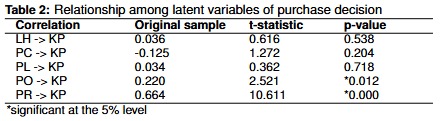
The Average Variance Extracted (AVE) value in this research was greater than 0.5, showing that all variables could adequately represent the model. The results of the cross-loading and Fornell-Larcker criterion also showed that all variables passed the discriminant validity test. Additionally, the composite reliability values met the required criteria, suggesting that all variables used were reliable. The purchase decision variable had an R-square value of 0.527, implying that the halal label, product, price, place, and promotion variables were able to explain 52.7% of the variance in purchase decisions, while the remaining 47.3% was explained by other factors outside the research. The coefficient of determination for the purchase decision variable was categorized as strong, as it exceeded the threshold value of 0.2 (F. et al., 2021).
| Correlation | Original sample | t-statistic | p-value |
|---|---|---|---|
| LH -> KP | 0.036 | 0.616 | 0.538 |
| PC -> KP | -0.125 | 1.272 | 0.204 |
| PL -> KP | 0.034 | 0.362 | 0.718 |
| PO -> KP | 0.220 | 2.521 | *0.012 |
| PR -> KP | 0.664 | 10.611 | *0.000 |
4. Discussion
Halal Label has an insignificant relationship to purchasing decisions asobserved from the p-value of 0.538 or > 0.05 and the t-statistical value of0.616 < 1.96 (t-table). Meanwhile, the direction of the relationship of thehalal label variable has a positive value reviewed from the original samplevalue by 0.036. With a positive original sample value, it can be interpretedthat higher awareness of the halal label led to more individuals makingdecisions to purchase Kopi Kenangan online food delivery. The test resultsshowed an insignificant influence, but this did not imply that halal labelswere not important in making purchase decisions. From the results of thequestionnaire that has been distributed, 90% of respondents picked to agreeand strongly agree in considering halal labels in to purchase decisions.Therefore, the data becomes homogeneous, prompting H1 to be rejected.
These results were consistent with the findings of (E. & A, 2022), who reported that halal labels had a positive but insignificant influence on purchase decisions. The author explained this by noting variations in consumers' knowledge of halal principles, implying that the presence of a halal label on products did not necessarily influence purchasing decisions.
The influence of products on coffee purchase decisions is significant with a p-value of < 0.05, which is 0.000, and a T-statistic of 10.611 > 1.96 (T-table). Meanwhile, the direction of the relationship of this product variable has a positive value. This can be observed from the original sample value of 0.664. With a positive original sample value, it is understood that a bigger effect of the product on a person leads to an increased purchase decision, prompting H2 to be accepted. The results of this research correlated with the opinion of (Intania et al., 2021), who analysed the factors of the marketing mix, namely product variables, price, place, promotion, process, people, and physical evidence of the purchase decision of Starbucks coffee in Jakarta. The research concluded that the product variables have a positive and significant influence on the purchase decision of Starbucks coffee in Jakarta.
The influence of price on coffee purchase decisions has a negative effect on the purchase decision variable. The original sample value of -0.125 shows the relationship between the two negative variables. On the other hand, the t-statistical value of 1.272 and the p-value of 0.204 imply that the relationship between the variables is not significant. The analysis shows that price does not have a significant effect on the purchase decision of Kopi Kenangan online food delivery, prompting H3 to be rejected. These results are supported by research by (Intania et al., 2021), who concluded that price variables have a negative and insignificant effect on the purchase decision of Starbucks coffee in Jakarta.
There is no evidence to prove that the influence of place on coffee purchase decision is significant, with a p-value of > 0.05 of 0.718 and a t-statistical value of 0.362 < 1.96 (t-table). Meanwhile, the direction of the relationship of the product quality variable has a positive value. This can be observed from the original sample value of 0.034. The research indicated that an increase in place variables was associated with a positive original sample value for purchase decisions of Kopi Kenangan, leading to the rejection of H4. In a publication by (D, 2023) on the influence of Product, Price, Promotion, Service, and Location on Kopi Kenangan purchase decisions among Development Economics students at Trisakti University, found that location exerted a positive but insignificant influence on purchase decisions.
The Effect of Promotion on Kopi Kenangan Purchase Decisions: The relationship between promotional variables and purchase decisions is significant with a p-value of < 0.05, which is 0.012, and a t-statistic of 2.521 > 1.96 (t-table). Meanwhile, the direction of the relationship of this product variable has a positive value. This can be observed from the original sample value of 0.220. The analysis confirmed that the greater the promotional variables affect a person, the more the person's purchase decision would also increase significantly with a positive original sample value, prompting H5 to be accepted. The results correlated with research conducted by (Intania et al., 2021), stating that promotions have a positive and significant influence on Starbucks purchase decisions in Jakarta because Starbucks was considered to have succeeded in attracting consumers to buy its products.
5. Conclusion and Recommendations
5.1 Conclusion
In conclusion, the results of the research showed that purchasing decisions for Kopi Kenangan through online food delivery services in Jabodetabek were significantly influenced by product and promotion variables. The halal label and location had a positive but insignificant effect, and price had a negative and insignificant effect. Consumers tended to place greater emphasis on product quality, menu variety, packaging, and the effectiveness of promotions such as discounts and social media advertisements as the main factors in the purchasing decisions. On the other hand, the halal label was still considered important but not a primary determinant, as price was not a dominant factor, and store availability only served as an additional value. These factors accounted for 52.7% of purchasing decisions, while the remaining 47.3% were influenced by other factors outside the research.
5.2 Recommendations
Based on the results of this research, several suggestions were offered. First, the analysis recommended that Kopi Kenangan management should establish clear policies regarding the inclusion of halal labels in online food delivery applications and focus on further improving product quality, pricing strategies, promotions, and outlet accessibility to remain competitive with other coffee brands, particularly through promotional efforts expanding market reach. Second, future research was motivated to explore different areas, periods, and additional independent or control variables to provide broader insights. Finally, the research suggested that religious leaders should play a more active role in raising public awareness about the importance of halal considerations in online purchasing.
Operational definitions and variable indicators of purchase decision
Operational definitions and variable indicators of purchase decision.
Conflict of Interest
The authors declare no conflict of interest.
References
- L. Adiningrum, F. Yunanda, T. Mulyaningsih A., S. Puspa, T.. Analisis Strategi Bisnis Kedai Kopi Coffee Latar. Jurnal Ekonomi Trisakti. 2022; 2(2)
- E. Agusty L., A Muttaqin A.. Analisis Pengaruh Label Halal, Kesadaran Halal, dan Persepsi atas Produk Halal dalam Pembelian Kosmetik Halal. Islamic Economics and Finance in Focus. 2022; 1(4)
- D Assadin S.. Analisis Faktor Pengaruh Keputusan Pembelian Kopi Kenangan oleh Mahasiswa Ekonomi Pembangunan Universitas Trisakti. Jurnal Ekonomi Trisakti. 2023; 3(1)
- Herlyana E.. Fenomena coffee shop sebagai gejala gaya hidup baru kaum muda. Thaqafiyyat. 2012; 13(1)
- F. Hair J., G. Hult, M. Ringle C., M. Sarstedt, P. Danks N., S Ray. Partial Least Squares Structural Equation Modeling (PLS-SEM) Using R: A Workbook. 2021.
- F. Hair J., C. Black W., J. Babin B., R Anderson. E. Multivariate Data Analysis. 2014; 7
- Intania H., Syarief N., Suharyati S.. Analisis marketing mix terhadap keputusan pembelianStarbucks Coffee di Jakarta. Konferensi Riset Nasional Ekonomi Manajemen danAkuntansi. 2021; 2(1):1457-1470.
- Organization I.C.O.] International Coffee. Historical data total production by all exportingcountries [internet. 2019. Publisher Full Text
- Kotler P., Pemasaran Armstrong G.Prinsip-Prinsip. Erlangga: Jakarta; 2014.
- P. Kotler, Pemasaran Armstrong G.Prinsip-prinsip. Edisi 13 Jilid 1. 2016.
- Kotler P., Pemasaran Armstrong G.Prinsip-prinsip. Erlangga;2016: Jakarta.
- Kotler P., Armstrong G.. Prentice Hall;2012: New Jersey.
- Kenangan Kopi. Outlets — Kopi Kenangan [internet. 2023. Publisher Full Text
- Pangan L.P.P.O.M.M.U.I.] Lembaga Pengkajian. Tentang Produk Halal [internet. 2023. Publisher Full Text
- Lovelock C., Perspektif Wirtz J.Pemasaran Jasa. Erlangga: Jakarta; 2011.
- D. Martauli E., S Gracia. Analisa komoditas unggulan sektor pertanian dataran tinggi Sumatera Utara. Jurnal AGRIFOR. 2021; XX(1)
- Z Populix Gen, Report Milenial. 2023.
- D. Putri N., A Hermawan. Anteseden dari loyalty pada food delivery apps di Jabodetabek. Jurnal Ilmiah Indonesia. 2022; 7(9)
- SAW Robiah F.Marketing Hebat Ala Rasulullah. 2017.
- S. Santoso, E. Statistik Multivariat, Revisi Jakarta Elex Media Komputindo. 2014.
- S. Sadewa A., A. Agustang, N Pertiwi. Model Pengelolaan Air Bersih Berbasis Masyarakat yang Berwawasan Lingkungan di Kota Makassar / Clean Water Management Model Based on Community-Based Environment. Jurnal Ilmiah Mandala Education. 2022; 8(2)
- D. Sulastriningsih R., S. Dewi, Y. Komalasari, P. Mauliana, R. Firmansyah, N Hunaifi. Analisis implementasi online food delivery (OFD) sebagai strategi pemasaran digital di Food Court Tjendana Food Point. Jurnal Ilmu Manajemen, Ekonomi dan Kewirausahaan. 2023; 3(2)
- G. Schiffman L., L Kanuk L.. Indeks: Jakarta; 2014.
- Index Top Brand. Komparasi Brand Index [internet. 2023. Publisher Full Text
- N. Utami H., N Kamilia. Persepsi Konsumen Thematic Coffee House terhadap Merek, Kualitas Produk dan Pelayanan serta Nilai Pelanggan Produk Kopi Lokal (Survei Konsumen Filosofi Kopi Jakarta Selatan). Jurnal Ilmu Sosial dan Humaniora. 2017; 6(1)
- Social We Are. Digital 2021: Global Digital Insights 2021 [internet. 2021. Publisher Full Text
- J. Zysman, M Nitzberg. Governing AI: Understanding the Limits, Possibility, and Risks of AI in an Era of Intelligent Tools and Systems. 2020.
Copyright & License
© 2025.
This is an Open Access article under the terms of the Creative Commons Attribution-ShareAlike 4.0 International License (CC BY-SA 4.0), which permits unrestricted use, distribution and reproduction in any medium, provided the original work is properly cited.

References
Adiningrum L, Yunanda F, Angelita T, Mulyaningsih S, Puspa T. Analisis Strategi Bisnis Kedai Kopi Coffee Latar. Jurnal Ekonomi Trisakti. 2022;2(2):391-404. https://doi.org/10.25105/jet.v2i2.14360
Agusty LE, Muttaqin AA. Analisis Pengaruh Label Halal, Kesadaran Halal, dan Persepsi atas Produk Halal dalam Pembelian Kosmetik Halal. Islamic Economics and Finance in Focus. 2022;1(4). https://doi.org/10.21776/ieff.2022.01.4.08
Assadin SD. Analisis Faktor Pengaruh Keputusan Pembelian Kopi Kenangan oleh Mahasiswa Ekonomi Pembangunan Universitas Trisakti. Jurnal Ekonomi Trisakti. 2023;3(1):259-268. https://doi.org/10.25105/jet.v3i1.15405
Herlyana E. Fenomena coffee shop sebagai gejala gaya hidup baru kaum muda. Thaqafiyyat. 2012;13(1):188-204.
Hair Jr JF, Hult GTM, Ringle CM, Sarstedt M, Danks NP, Ray S. Partial Least Squares Structural Equation Modeling (PLS-SEM) Using R: A Workbook. Springer Nature; 2021. https://doi.org/10.1007/978-3-030-80519-7
Hair JF, Black WC, Babin BJ, Anderson RE. Multivariate Data Analysis. 7th ed. Upper Saddle River: Pearson Education; 2014.
Intania H, Syarief N, Suharyati S. Analisis marketing mix terhadap keputusan pembelian Starbucks Coffee di Jakarta. Konferensi Riset Nasional Ekonomi Manajemen dan Akuntansi. 2021;2(1):1457-1470.
[ICO] International Coffee Organization. Historical data total production by all exporting countries [internet]. 2019 [accessed 13 October 2023]. Available from: http://www.ico.org/prices/po-production.pdf
Kotler P, Armstrong G. Prinsip-Prinsip Pemasaran. Edisi 15. Jakarta: Erlangga; 2014.
Kotler P, Armstrong G. Prinsip-prinsip Pemasaran. Edisi 13 Jilid 1. Jakarta: Erlangga; 2016.
Kotler P, Armstrong G. Principles of Marketing. 14th ed. New Jersey: Prentice Hall; 2012.
Kopi Kenangan. Outlets - Kopi Kenangan [internet]. 2023 [accessed 16 October 2023]. Available from: https://kopikenangan.com/outlets
[LPPOM MUI] Lembaga Pengkajian Pangan, Obat-obatan, dan Kosmetik Majelis Ulama Indonesia. Tentang Produk Halal [internet]. 2023 [accessed 18 October 2023]. Available from: https://halalmui.org/tentang-produk-halal/
Lovelock C, Wirtz J. Pemasaran Jasa Perspektif. Edisi 7. Jakarta: Erlangga; 2011.
Martauli ED, Gracia S. Analisa komoditas unggulan sektor pertanian dataran tinggi Sumatera Utara. Jurnal AGRIFOR. 2021;Vol XX No 1. https://doi.org/10.31293/agrifor.v20i1.5055
Populix. Gen Z & Milenial Report [internet]. 2023 [accessed 8 January 2023]. Available from: https://info.populix.co/product/consumer-trend-report/download?report=populix-popvoice-gen-z-and-millennials-report-q1-2023
Putri ND, Hermawan A. Anteseden dari loyalty pada food delivery apps di Jabodetabek. Jurnal Ilmiah Indonesia. 2022;7(9). p-ISSN: 2541-0849.
Robiah F. Marketing Hebat Ala Rasulullah SAW. Solo: PT Tiga Serangkai Pustaka Mandiri; 2017.
Santoso S. Statistik Multivariat Edisi Revisi. Jakarta: Elex Media Komputindo; 2014.
Sadewa AS, Agustang A, Pertiwi N. Model Pengelolaan Air Bersih Berbasis Masyarakat yang Berwawasan Lingkungan di Kota Makassar / Clean Water Management Model Based on Community-Based Environment. Jurnal Ilmiah Mandala Education. 2022;8(2). https://doi.org/10.58258/jime.v8i2.2828
Sulastriningsih RD, Dewi SWK, Komalasari Y, Mauliana P, Firmansyah R, Hunaifi N. Analisis implementasi online food delivery (OFD) sebagai strategi pemasaran digital di Food Court Tjendana Food Point. Jurnal Ilmu Manajemen, Ekonomi dan Kewirausahaan. 2023;3(2):293-304. https://doi.org/10.55606/jimek.v3i2.1740
Schiffman LG, Kanuk LL. Perilaku Konsumen. Jakarta: Indeks; 2014.
Top Brand Index. Komparasi Brand Index [internet]. 2023 [accessed 27 November 2022]. Available from: https://www.topbrand-award.com/komparasi_brand
Utami HN, Kamilia N. Persepsi Konsumen Thematic Coffee House terhadap Merek, Kualitas Produk dan Pelayanan serta Nilai Pelanggan Produk Kopi Lokal (Survei Konsumen Filosofi Kopi Jakarta Selatan). Jurnal Ilmu Sosial dan Humaniora. 2017;6(1):60. https://doi.org/10.23887/jish-undiksha.v6i1.9870
We Are Social. Digital 2021: Global Digital Insights 2021 [internet]. 2021 [accessed 15 October 2023]. Available from: https://wearesocial.com/uk/blog/2021/01/digital-2021-the-latest-insights-into-the-state-of-digital/
Zysman J, Nitzberg M. Governing AI: Understanding the Limits, Possibility, and Risks of AI in an Era of Intelligent Tools and Systems. SSRN Electronic Journal. 2020. https://doi.org/10.2139/ssrn.3681088
Additional Files
Published
Issue
Section
License
Copyright (c) 2025 Hana Thahira, Laily Dwi Arsyianti

This work is licensed under a Creative Commons Attribution-ShareAlike 4.0 International License.
How to Cite