
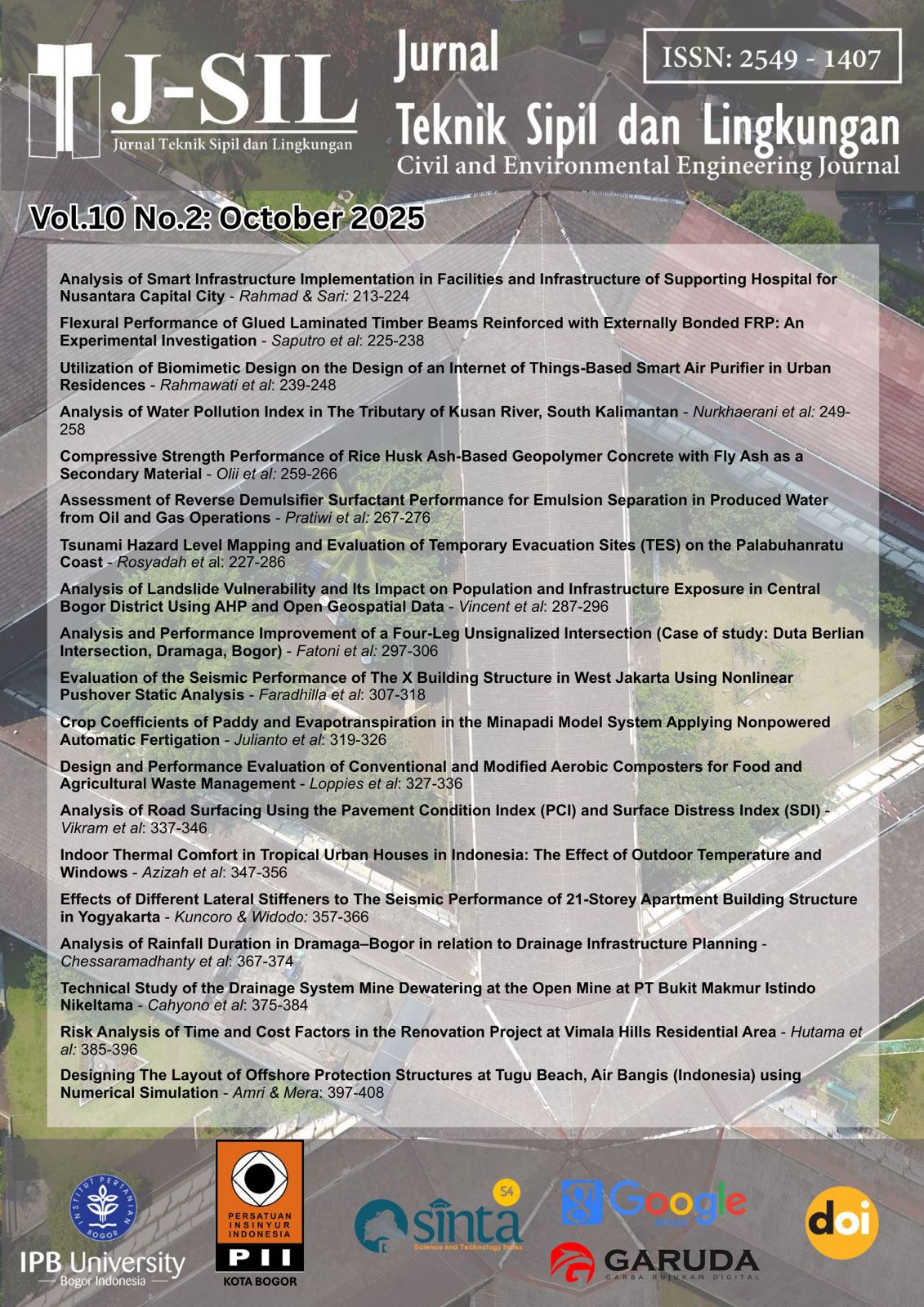
Analysis of Landslide Vulnerability and Its Impact on Population and Infrastructure Exposure in Central Bogor District Using AHP and Open Geospatial Data
DOI:
https://doi.org/10.29244/jsil.10.2.287-296Kata Kunci:
AHP, Central Bogor District, GIS, Landslide Vulnerability, Urban Disaster VulnerabilityAbstrak
Indonesia’s location at the convergence of three active tectonic plates makes it highly susceptible to various natural disasters, with landslides being among the most frequent and destructive, particularly in mountainous and densely populated urban areas. Central Bogor District in West Java represents a vulnerable area where steep topography, high rainfall intensity, and dense population heighten landslide risk. Despite recurrent landslide events, comprehensive vulnerability assessments integrating both physical and socio-environmental factors remain limited. This study aims to produce a spatially explicit landslide vulnerability map for Central Bogor District by utilizing open geospatial data and applying a GIS-based multi-criteria decision-making approach. The Analytical Hierarchy Process (AHP) was employed to assign weights to four primary physical parameters—rainfall, slope, lithology, and land cover—based on their relative contribution to landslide susceptibility. Supporting data were derived from Sentinel-1A imagery (InSAR), Landsat-8 classification, CHIRPS precipitation records, and official geological maps. These physical layers were then integrated with exposure indicators, including population density, infrastructure distribution, and accessibility data from OpenStreetMap. The results delineated three landslide vulnerability zones: high (49.87 ha), moderate (481.82 ha), and low (236.45 ha). High-risk zones, such as Gudang and Paledang Sub-districts, feature steep slopes, weak geological formations, and dense settlements. Overlay analysis also revealed a significant concentration of critical infrastructure within moderate-to-high vulnerability zones, highlighting exposure and potential service disruption during hazard events. The study underscores the critical value of combining open geospatial data with AHP-based weighting to inform targeted disaster mitigation, infrastructure planning, and resilient urban development. The resulting maps can guide policy and preparedness strategies to reduce landslide impacts in high-risk urban areas.
Referensi
[2] Tjandra K. Empat bencana geologi yang Paling Mematikan. Yogyakarta: UGM PRESS; 2018.
[3] Pramono J, Kusumastuti D, Choerudin A. The community participation in disaster mitigation to managing the impact of natural disasters in Indonesia. 2020.
[4] Badan Nasional Penanggulangan Bencana [BNPB]. Data dan Informasi Bencana Indonesia. Jakarta (ID): BNPB; 2024.
[5] Arsyad U, Barkey R, Wahyuni, Matandung KK. Karakteristik tanah longsor di Daerah Aliran Sungai Tangka. J Hutan dan Masyarakat. 2018;10(1):203–14.
[6] Hidayat R, Sutanto SJ, Hidayah A, Ridwan B, Mulyana A. Development of a landslide early warning system in Indonesia. Geosciences. 2019;9(10):451. doi:10.3390/geosciences9100451
[7] Bagal MG, Sorate DR, Desai PA. Geo-technical and geological study, management plan of landslide. J Adv Sci Technol. 2023;20(1):119–126. doi:10.29070/wc8dv634
[8] Pusat Vulkanologi dan Mitigasi Bencana Geologi [PVMBG]. Laporan pemeriksaan bencana gerakan tanah Kec. Bogor Tengah, Kota Bogor Provinsi Jawa Barat. 2022 [cited 2025 Aug 5]. Available from: https://geologi.esdm.go.id/
[9] Badan Penanggulangan Bencana Daerah [BPBD]. Kota Bogor. 2023 [cited 2025 Aug 5]. Available from: https://bpbd.kotabogor.go.id/
[10] Feng Q, Xu H, Wu Z, You Y, Liu W, Ge S. Improved Goldstein interferogram filter based on local fringe frequency estimation. Sensors. 2016 Nov 23;16(11):1976.
[11] Lang R, Shao G, Pijanowski BC, Farnsworth RL. Optimizing unsupervised classifications of remotely sensed imagery with a data-assisted labeling approach. Computers & Geosciences. 2008 Dec 1;34(12):1877-85.
[12] Saaty TL. Decision making with the analytic hierarchy process. Int J Serv Sci. 2008;1(1):83. doi:10.1504/IJSSCI.2008.017590
[13] Susanti PD, Miardini A, Harjadi B. Analisis kerentanan tanah longsor sebagai dasar mitigasi di Kabupaten Banjarnegara. J Penelit Pengelolaan DAS. 2017;1(1):49–59.
[14] Scarpelli G, Ferretti A, Mammoliti E, Ruggeri P, Sakellariadi E. Ground investigation: a tool for landslide risk mitigation of infrastructures. Procedia Struct Integr. 2024;62:530–537. doi:10.1016/j.prostr.2024.09.075
[15] Pollock W, Wartman J. Human vulnerability to landslides. GeoHealth. 2020;4(10):e2020GH000287. doi:10.1029/2020GH000287
Unduhan
Diterbitkan
Terbitan
Bagian
Lisensi
Hak Cipta (c) 2025 Jurnal Teknik Sipil dan Lingkungan

Artikel ini berlisensi Creative Commons Attribution-NonCommercial-NoDerivatives 4.0 International License.
Authors who publish with Jurnal Teknik Sipil dan Lingkungan, JSIL agree to the following terms:
a. Authors retain copyright and grant the journal right of first publication with the work simultaneously licensed under a Creative Commons Attribution License that allows others to share the work with an acknowledgment of the work's authorship and initial publication in this journal.
b. Authors are able to enter into separate, additional contractual arrangements for the non-exclusive distribution of the journal's published version of the work (e.g., post it to an institutional repository or publish it in a book), with an acknowledgment of its initial publication in this journal.
c. Authors are permitted and encouraged to post their work online (e.g., in institutional repositories or on their website) prior to and during the submission process, as it can lead to productive exchanges, as well as earlier and greater citation of published work (See The Effect of Open Access).