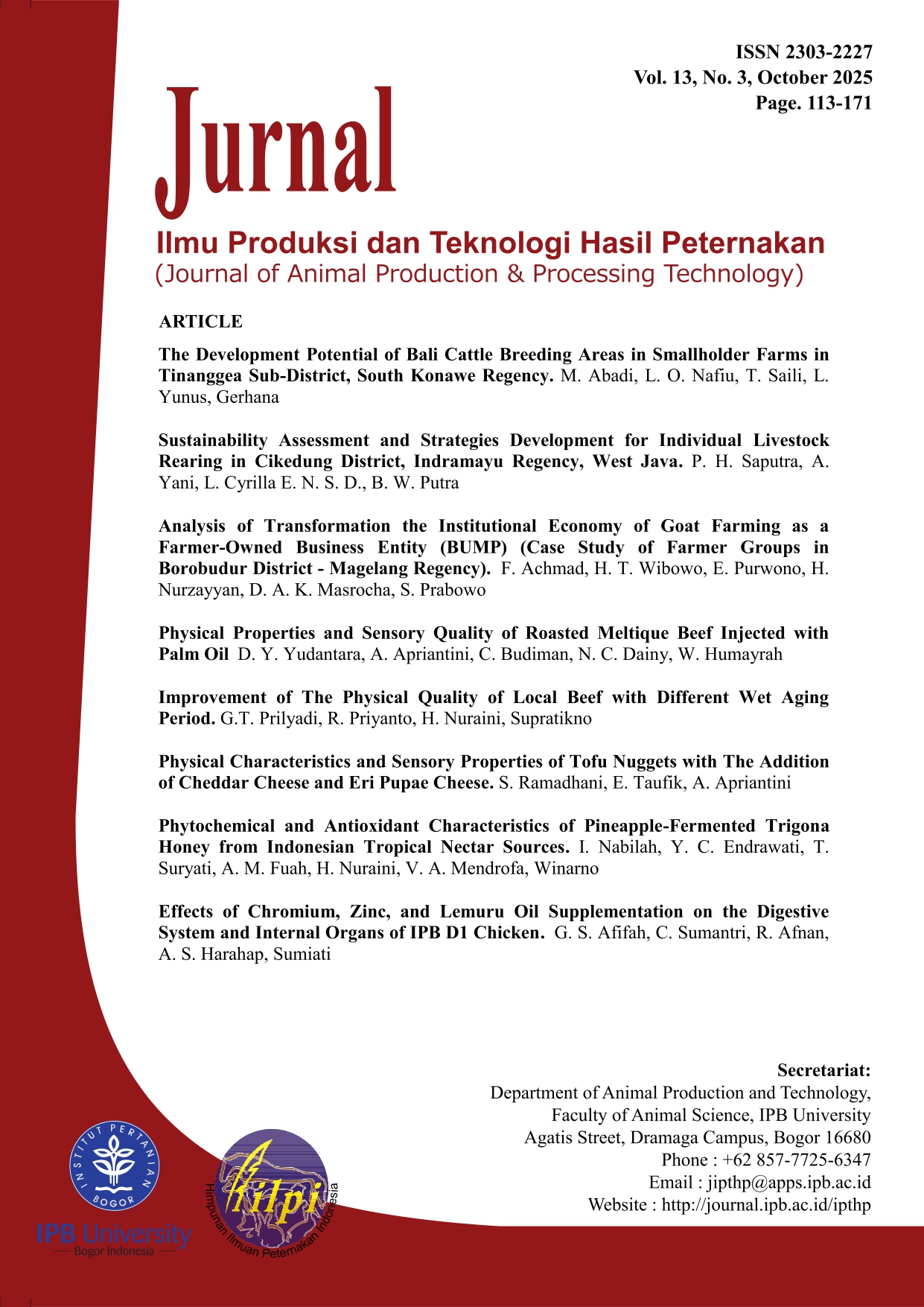
Phytochemical and Antioxidant Characteristics of Pineapple-Fermented TrigonaHoney from Indonesian Tropical Nectar Sources
DOI:
https://doi.org/10.29244/jipthp.13.3.159-165Abstract
Trigona honey is a stingless bee product rich in secondary metabolites and recognized for its antioxidant
properties. Pineapple also contains bioactive phytochemicals. Therefore, their combination through
fermentation has the potential to produce a functional product. This study aimed to evaluate the
phytochemical profile and antioxidant activity of Trigona honey fermented with pineapple for seven days.
The honey originated from nectar nutmeg (Myristica fragrans), mangosteen (Garcinia mangostana), and
durian (Durio zibethinus). Analyses included pH, moisture, alcohol content, sugar profile, total phenolics,
saponins, and antioxidant activity. Fermentation decreased pH due to microbial acid production and
increased moisture. Glucose and sucrose declined from 6.13% and 4.83% on day 4 to 3.99% and 1.47%
on day 7, respectively. Alcohol content rose to 6.21% w/w, indicating active Saccharomyces cerevisiae
metabolism. Total phenolic content decreased from 1.508 to 0.541 mg TAE/g on day 4 and rose slightly
to 0.707 mg TAE/g on day 7. Saponin content dropped from 573.16 to 147.66 mg KOH/g on day 4,
increasing to 429.84 mg KOH/g on day 7. Antioxidant activity rose significantly from 3.17% to 24.36%.
These results show that seven day fermentation enhances antioxidant activity while modifying honey’s
phytochemical properties, making it a potential functional product from tropical Indonesia.
Downloads
Published
Issue
Section
License
Copyright (c) 1970 Jurnal Ilmu Produksi dan Teknologi Hasil Peternakan

This work is licensed under a Creative Commons Attribution-ShareAlike 4.0 International License.