Exploring Key Themes in Halal Tourism Studies: A Systematic Literature Review Approach
DOI:
https://doi.org/10.29244/hass.2.2.18-21Keywords:
Digital innovation, Halal tourism, Policy and governance, Systematic Literature Review, Tourist behaviorAbstract
Halal tourism has grown rapidly over the past two decades, becoming a strategic pillar of the global industry. The expansion of the Muslim travel market, reaching millions of international arrivals annually, underscores the growing need for destinations, products, and services consistent with Islamic values. Therefore, this study aims to identify major themes and gaps in the halal tourism literature through a Systematic Literature Review (SLR) based on PRISMA guidelines. Using the keyword “halal tourism” in the Scopus database (2014–2025), a total of 659 articles were initially retrieved, with 31 fulfilling the final inclusion criteria after screening for access, language, and relevance. The results showed that Indonesia dominates halal tourism literature (28 articles), with case studies and surveys being the most common methods. Thematically, studies cluster into nine categories, namely Muslim tourist behavior and loyalty, policy and governance, branding and promotion, religious moderation and local wisdom, destination strategies, halal food consumption, technology and digitalization, literacy and social capital, as well as certification. Previous studies have largely focused on tourist behavior, while implementation and certification remain underexplored. In general, halal tourism is a multidimensional field integrating culture, governance, branding, and technology beyond mere compliance with Islamic law. Future studies should focus on practical implementation, certification systems, and digital transformation. Strengthening these areas will enhance competitiveness, ensure inclusivity for Muslim travelers, and support the sustainability of halal tourism as a driver of equitable growth in the global landscape.
Introduction
Halal tourism has experienced rapid growth over the past two decades, becoming one of the key sectors in the global industry. The potential market for halal tourism is highly significant both economically and socially, evidenced by the global Muslim population of more than 1.9 billion. According to the Global Muslim Travel Index (Index, 2024), the Muslim travel market recorded 145 million international arrivals in 2023. This figure is projected to increase to 164-168 million in 2024 and reach 230 million arrivals with an estimated expenditure of around USD 225 billion by 2028 (Index, 2024). The upward trend shows that the demand for destinations, products, and tourism services in line with Islamic principles is not merely a religious matter but also a strategic opportunity for countries aiming to achieve market expansion.
Academic studies on halal tourism have evolved dynamically in line with the increasing practices in the field. The literature shows that current study topics are diverse, ranging from halal certification and the role of regulation, Muslim tourist preferences and behavior, strategies for developing halal destinations, to the use of digital technology in promotion (W. et al., 2024);(T. et al., 2019);(E. et al., 2024);(S. et al., 2024). In addition, studies also examined aspects of management, marketing, destination branding, as well as the integration of cultural values and sustainability (A. et al., 2019);(N. et al., 2025). Various disciplines, such as tourism management, Islamic economics, law, and cultural studies, have contributed to enriching both the conceptual and practical understandings of halal tourism. This underscores that halal tourism should not be perceived merely as a form of religious tourism, but also a complex global social, cultural, and economic phenomenon (M. & N, 2016);(C, 2016).
Despite the increasing number of studies, wide variations exist in both methodological approach and thematic focus. Most studies focus on the supply side, such as policies, regulations, and destination management (J, 2023);(T. et al., 2025), while others emphasize the demand side, examining the behavior, perceptions, experiences, and loyalty of Muslim tourists(J. et al., n.d.);(K. et al., 2025). This fragmentation is also reflected in the work of (Judijanto, 2025), which underscores the diversity of themes and study directions in halal tourism across different countries. Furthermore, local-level studies show persistent gaps between potential and implementation, for instance, in Eastern Indonesia, which holds significant prospects but faces regulatory and resource-related challenges (I. & R, 2025). This condition underscores the need for a systematic literature review (SLR) to identify the key study areas already discussed and to uncover gaps for future development. Based on the discussion above, this study aims to identify the key study topics addressed in the global halal tourism literature. The objective is essential for mapping the current landscape, identifying new trends and gaps, as well as providing guidance for future studies. Through a comprehensive synthesis of the literature, the results offer in-depth insights into the existing gaps in halal tourism studies and outline the contributions to the further development of the field.
2. Methodology
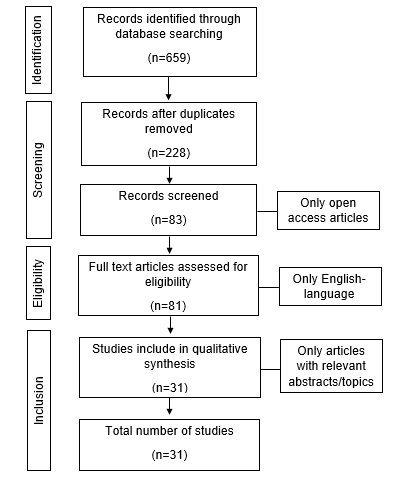
This study used the SLR method, a systematic, transparent, andstructured approach to identifying, critically evaluating, and synthesizingresults from studies relevant to the topic (N. et al., 2021); (P. et al., 2019). To ensure the quality and accountability of the literature reviewprocess, this study followed the PRISMA guidelines (Preferred ReportingItems for Systematic Reviews and Meta-Analyses).The processes ofidentification, screening, eligibility, and inclusion of articles are presentedin a PRISMA flow diagram, which shows the number of articles at eachstage of selection, from initial identification to the final articles included inthe analysis (Fig. 1).
Figure 1.PRISMA flow diagram adapted from(D. et al., 2009)
The article selection process started with searches across several databases using the keyword "halal tourism." The search was limited to publications from 2014 to 2025 and was conducted on May 28, 2025. Using the Scopus database, the initial search yielded 659 records. After restricting the results to articles containing the keyword "halal tourism," the number was reduced to 228. At the inclusion stage, only open-access articles were retained, resulting in 83 articles. From these, only articles written in English were kept, leaving 81. Finally, abstract screening was conducted to ensure relevance to the topic of halal tourism, which resulted in 31 selected articles for further analysis.
3. Result and Discussion
3.1 Geographical location of authors
Figure 2.Geographical location of authors
In this SLR, 31 articles were analyzed based on predetermined selection criteria. Studies on halal tourism were dominated by contributions from Indonesia, with a remarkably significant number of 28 articles ( Fig. 2). This shows that the topic of halal tourism has strong relevance to the social, cultural, and religious context. Two studies originated from Thailand, reflecting that this topic has also attracted attention in Southeast Asia, a region with similar cultural and religious backgrounds. Meanwhile, only one study was from the United States, suggesting a rising interest from a global perspective, particularly in a country with a non-Muslim majority. Overall, these results show that studies on halal tourism remain heavily centered in Indonesia, with limited contributions from Thailand and the United States. At the same time, this opens opportunities for expanding cross-country studies.
The dominance of Indonesian publications not only shows the country leadership in halal tourism scholarship but also shows a significantgeographical imbalance.Consequently, the generalizability of currentresults at the global level remains limited. These results point to the need forbroader cross-country and comparative studies to enhance the internationalrepresentation and understanding of halal tourism.
3.2 Analytical method of the study
Based on the data in (Fig. 3), most studies on halal tourism used the case study method, with a total of 11 articles. This shows that the majority prefer the case study approach to explore halal tourism phenomena within specific contexts, such as regions, communities, or institutions. The survey method ranked second with eight articles, suggesting that quantitative approach using questionnaires are also quite popular for measuring tourists perceptions, attitudes, and intentions toward halal destinations. Furthermore, interview and conceptual methods were each used in four articles, reflecting studies that emphasize gaining deeper insights from stakeholders through interviews, as well as the development of concepts and theories. Only three articles applied the review method, showing that SLR remain relatively scarce. The simulation method was identified in only one article, suggesting that computational modelling and scenario-based simulations in halal tourism study are still minimal. These results show the dominance of exploratory and descriptive studies, while also pointing to significant opportunities for further developing investigations that use systematic reviews and simulation-based approach.
Figure 3.Analytical method of study
3.3 Key study discussed in relation to halal tourism
Based on the classification of key study (Table 1), the results show a fairly diverse distribution with varying emphases across different aspects. The largest focus was Muslim tourist behavior, satisfaction, and loyalty (26% of the total studies), with key results showing that affective value, halal value, Islamic attributes, destination image, and memorable experiences play crucial roles in shaping satisfaction, loyalty, and revisit intentions (Junaidi, 2020);(R. et al., 2021);(Y. et al., 2021);(M. & F, 2024);(S. et al., 2024);(E. et al., 2024); (S. et al., 2024). Affective and halal values are proven to be stronger determinants of loyalty compared to cognitive values (S. et al., 2024). Meanwhile, Islamic attributes and destination image have a strong influence on revisit intentions, even though satisfaction does not always serve as a strong mediator (M. & F, 2024). Memorable experiences enhance destination attachment (E. et al., 2024), and Islamic environments, along with halal services, remain dominant determinants of visitation (Y. et al., 2021). A study in Lombok showed that the quality of experience significantly influenced revisit intentions (R. et al., 2021), while industry actors tended to adopt a Muslim-friendly model approach to expand the market with moderate transition costs (Junaidi, 2020). From a global perspective, studies in Thailand emphasize the importance of sustainability and cultural sensitivity through Muslim tourist lifestyles, as well as the need to improve certified halal services and environmentally friendly tourism (S. et al., 2024). Overall, halal tourism relies not only on the availability of halal services but also on emotional dimensions, memorable experiences, destination image, and cultural sustainability.
The category of policies, regulations, and governance of halal tourism ranked second with five articles (19%), emphasizing the importance of legal frameworks and governance in supporting development (L. et al., 2022);(C. et al., 2024);(U. et al., 2024);(E. & H, 2024);(Y. et al., 2024). These studies underscore the significance of regulatory formulation, legal politics, and governance of halal tourism across different countries, particularly in Indonesia and Thailand. The results show that the success of halal tourism development does not solely rely on market and destination aspects but also strongly influenced by clear legal and policy frameworks.
In Indonesia, (Y. et al., 2024) emphasized the role of Islamiclaw and ulama in shaping halal tourism policies. (L. et al., 2022) underlined the trend of positive regulations that must remain adaptive to societal pluralism. (E. & H, 2024) also emphasized the importance of compliance with regional rules, while (C. et al., 2024) showed that differences in local authorities create misconceptions hindering implementation. In Thailand, (U. et al., 2024) showed that legal politics combined with digital advertising strategies effectively increase Muslim tourists interest, recommendations, and engagement. Overall, regulatory support is identified as a key driver in strengthening the global competitiveness of halal tourism.
| Key Study | Number of Papers | Author(s) |
|---|---|---|
| Behavior, Satisfaction, and Loyalty of Muslim Tourists | 7 | (Junaidi, 2020); (R. et al., 2021); (Y. et al., 2021); (M. & F, 2024); (S. et al., 2024); (E. et al., 2024); (S. et al., 2024) |
| Policies, Regulations, and Governance of Halal Tourism | 5 | (L. et al., 2022); (C. et al., 2024); (U. et al., 2024); (E. & H, 2024); (Y. et al., 2024) |
| Branding, Promotion, and Communication of Halal Tourism | 4 | (A. et al., 2019); (S. et al., 2019); (I. et al., 2022); (A. et al., n.d.) |
| Religious Moderation, Islamic Values, and Local Wisdom | 3 | (A. et al., 2024); (M. et al., 2024); (Rusyaida, 2024) |
| Destination Development Strategies and Halal Tourism Ecosystems | 3 | (A. et al., 2017); (Maftukhatusolikhah et al., 2024); (A. et al., 2024) |
| Halal Food Consumption and Halal Tourism Products | 2 | (A. et al., 2021); (S. et al., 2024) |
| Technology, Digitalization, and Innovation in Halal Tourism | 2 | (S. et al., 2020); (M. et al., 2022) |
| Literacy, Education, and Social Capital | 2 | (I. et al., 2023); (A. et al., 2024) |
| Mapping of Halal Tourism Study through Systematic and Bibliometric Studies | 2 | (J. et al., n.d.); (A. et al., n.d.) |
| Implementation and Certification of Halal Tourism | 1 | (Syufa'at et al., 2024) |
The aspects of branding, promotion, and communication of halal tourism were quite prominent, with four articles (A. et al., 2019);(S. et al., 2019);(I. et al., 2022);(S. et al., 2020), contributing around 15% of the total articles. Studies in this category emphasize long-term strategies for building the image of halal destinations through marketing, religious identity-based city branding, and halal tourism communication models. The studies also underscore the importance of digital promotion in the post-pandemic era in revitalizing the tourism sector and adapting to changing tourist behaviors. Studies on halal tourism in Indonesia have showed various approach, ranging from local identity-based city branding (A. et al., 2019), communication models that remain top-down (S. et al., 2019), to post-pandemic marketing strategies emphasizing halal literacy and tourist motivation (I. et al., 2022). In a contemporary context, digital campaigns have also proven effective in promoting halal ecotourism and environmental conservation through social media (S. et al., 2020). Overall, the development of halal tourism relies not only on halal services but also on branding, communication, literacy, and digital campaigns that strengthen Indonesia competitiveness at the global level.
An equal number of studies were found in the category of destinationdevelopment strategies and halal tourism ecosystems (Maftukhatusolikhah et al., 2024); (A. et al., 2024); (A. et al., 2017), which focus onsustainable development, strengthening value chains, and the directionof national halal tourism development. This category contributed around11% of the overall articles and emphasized the importance of sustainability,
adaptive ecosystems, and strong Islamic foundations. A study in PerlangVillage, Bangka Belitung, showed that the halal tourism model developedwas consistent with halal principles and the SDGs, while also providinginclusive benefits for the wider community (Maftukhatusolikhah et al., 2024).In West Sumatra, the halal tourism value chain ecosystem was establishedthrough the support of destinations, regulations, and digital technologies,although further institutional strengthening, activity diversification, andcommunity empowerment are still needed for greater optimization (A. et al., 2024). From a conceptual perspective, (A. et al., 2017)traced theshift in nomenclature from “Islamic tourism” to “halal tourism” since 2013,rooted in the principles of the Qur’an and Sunnah, and later formulated ninecore principles by the DSN-MUI, including public benefit, enlightenment,tranquility, inclusivity, environmental sustainability, and respect for localwisdom.
Studies on halal tourism in Indonesia have shown thematic diversity with varying proportions.
More specifically, studies on halal food consumption and tourism products (A. et al., 2021);(S. et al., 2024), technology and digitalization (S. et al., 2020);(M. et al., 2022), literacy and social capital (I. et al., 2023);(A. et al., 2024), as well as systematic and bibliometric reviews (J. et al., n.d.);(A. et al., n.d.) each account for two articles, or about 7% of the total. This variation reflects a wide range of approach, from halal food management and cultural integration to the use of GIS-based technologies and recommendation systems, halal tourism literacy, as well as mapping of previous studies. Meanwhile, the topic of implementation and certification of halal tourism remains underexplored, with only one article (Syufa'at et al., 2024) examining CHSE certification in halal tourism sites, contributing just 4% of the total studies. This shows a study area that remains open for further exploration.
Studies in Indonesia underscore the importance of halal food and products as pillars of sustainable tourism. (A. et al., 2021) reported that halal tourism in East Nusa Tenggara is grounded in DSN-MUI principles while remaining inclusive for all ethnicities and religions, making it a diversity-embracing model. (S. et al., 2024) identified significant opportunities in Tana Toraja through increasing demand, menu diversification, as well as the support of technology and e-commerce, although challenges remain regarding public awareness and the need for certification. Overall, the integration of Islamic values, local wisdom, technological innovation, and institutional support was identified as the key to strengthening Indonesia competitiveness in global halal tourism.
In the theme of digital technology, (S. et al., 2020) showed how GIS-based web and mobile applications (GPWI) in Bukittinggi facilitated Muslim tourists in locating mosques and nearby tourism facilities. (M. et al., 2022) also developed a game-based multi-criteria recommender system for halal tourism destinations. The composition and quantity of input data significantly influence the system accuracy. Both studies show that the integration of data-driven technologies can enhance convenience as well as the overall tourist experience.
Aspects of literacy and institutional capacity also attract attention. (I. et al., 2023) constructed a conceptual framework for halal tourism literacy, finding that tourists at different literacy levels are able to self-assess with reasonable accuracy. (A. et al., 2024) further explained that intellectual capital significantly affects the performance of tourism organizations, while spiritual capital has an indirect effect through mediation mechanisms. This underscores the importance of integrating knowledge and spiritual values in strengthening halal tourism institutions.
From the perspective of facilities and literature, (J. et al., n.d.), through a bibliometric study, reported limited studies on supporting facilities, even though amenities such as mosques, prayer rooms, and halal culinary options have been proven to be key factors in Muslim tourists destination choices. Indonesia was identified as the main contributor to halal tourism studies. (A. et al., n.d.), through a SLR, emphasized that halal attributes, such as the availability of halal food and Islamic accommodation, remain the primary considerations for Muslim tourists when selecting destinations.
4. Conclusion
In conclusion, studies on halal tourism show diverse thematic distributions with varying emphases across different aspects. The results on Muslim tourist behavior, satisfaction, and loyalty dominate the literature, showing the importance of affective values, Islamic attributes, destination image, and memorable experiences in shaping satisfaction and revisit intentions. Meanwhile, policy, regulation, and governance occupy a central position, particularly regarding the role of Islamic law, local authorities, and legal-political strategies that strengthen the global competitiveness of halal tourism.
Branding, promotion, and communication are critical focuses in building the image of halal destinations through city branding, digital promotion, and contemporary communication strategies. Other studies emphasize the integration of Islamic values, religious moderation, and local wisdom, which play significant roles in maintaining socio-cultural sustainability. Strategies for destination development and halal tourism ecosystems underscore the importance of Islamic-based models consistent with the principles of the Sustainable Development Goals (SDGs). Studies on technology, literacy, and halal food consumption also show an increasingly inclusive and adaptive direction of innovation. Overall, halal tourism has developed into a multidimensional field that relies not only on the availability of halal services but also emotional factors, clear regulations, strong branding, integration of local values, and the use of digital technologies. However, gaps remain in the areas of implementation and certification, as well as in the effective use of digital technologies, literacy, and innovation to strengthen the halal tourism ecosystem. Therefore, future studies should focus on developing more applicable implementation frameworks, strengthening certification and halal service standards, as well as exploring digital technologies and interdisciplinary approach to ensure the sustainability, inclusiveness, and global competitiveness of halal tourism.
References
- S. Afnarius, F. Akbar, F Yuliani. Developing Web-Based and Mobile-Based GIS for Places of Worship Information to Support Halal Tourism: A Case Study in Bukittinggi". Indonesia. ISPRS Int. J. Geo-Inf. 2020; 9(52)
- E. Ahman, A. Utami S., Y. Rohmana, S Ismail. Development strategies for sustainable halal tourism village in West Java Province. 2024; 568
- A. Alam, R. Mellinia, T. Ratnasari R., I Mawardi. Analysis of Halal Ecotourism Digital Campaigns in a Mosque by an Online Environmental Community. International Journal of Sustainable Development and Planning. 2024(7)
- A. Alam, T. Ratnasari R., A. Prasetyo, I. Hapnitasari, E Rahmawati. Systematic Literature Review on Halal Label Studies of Halal Tourism. TEM Journal. 2024(1)
- M. Arif Y., H. Nurhayati, S. Nugroho, M Hariadi. Destinations Ratings Based Multi-Criteria Recommender System for Indonesian Halal Tourism Game. International Journal of Intelligent Engineering and Systems. 2022; 15(1)
- A. Ariyanto, M. Adam, S. Musnadi, A Djalil M.. Empowering and Influencing Factors of Intellectual and Spiritual Capital in Improving Organizational Performance at Tourism Institutions. Journal of Ecohumanism. 2024; 3(7)
- A. Bahiej, M. Munajat, F Maulana D.. The Lifestyle and Halal Industry Methods with Local Culture: Study of Tourism and Halal Products in Nusa Tenggara Timur 2020. Jurnal Ilmiah Al-Syir'ah. 2021; 19(1)
- M. Battour, N Ismail M.. Halal tourism: Concepts, practices, challenges and future. Tourism Management Perspectives. 2016; 19
- A. Danarta, M. Pradana, I. Abror, N Yahya. Encouraging religion and sustainable tourism as a conception of Indonesian halal tourism development. Revista de Gestão Social e Ambiental. 2024; 18(7)
- M. Daulay, I. Sukardi, I. Nasution, Miswari. Jurnal Tasawuf dan Pemikiran Islam: Teosofi; 2024.
- J Dewi I.. Development of halal tourism in Indonesia using the 'place attachment' approach and 'value-belief-norm theory. Frontiers in Sustainable Tourism. 2023; 2
- Index Global Muslim Travel. Bridging Journeys: Spotlight on RIDA Framework and Accessible Travel in GMTI 2024. CrescentRating. 2024.
- A. Hakim A., A. Hakim, S. Hasanuddin, M. Ridwan, H A.. Towards Indonesia halal tourism. AHKAM: Jurnal Ilmu Syariah. 2017; 17(2)
- C Henderson J.. Halal food, certification and halal tourism. Tourism Management Perspectives. 2016; 19
- C. Hennida, D. Nauvarian, O. Saptari N., S Putri R.. The role of belief systems and misperceptions in halal tourism policy: evidences from Indonesia. Cogent Social Sciences. 2024; 10(1)
- P. Higgins J., A. López-López J., J. Becker B., R. Davies S., S. Dawson, M. Grimshaw J., M Caldwell D.. Synthesising quantitative evidence in systematic reviews of complex health interventions. BMJ Global Health. 2019; 4(Suppl 1)
- Judijanto L.. Trends and emerging themes in halal tourism studies: A bibliometric review using VOSviewer. 2025.
- Junaidi J.. Halal-friendly tourism and factors influencing halal tourism. Management Science Letters. 2020; 10(2)
- I. Kanaha, R Satunggale. Halal tourism potential in North Maluku. Jurnal Ekonomi dan Keuangan Syariah (JIE Lariba. 2025; 9(1)
- A. Kasdi, U. Farida, F Cahyadi I.. Wali City Branding: Marketing Strategy in Promoting Halal Tourism Destinations Demak Indonesia. GeoJournal of Tourism and Geosites. 2019; 25(2)
- N. Khan, M. Falahat, I. Ullah, H. Sikandar, N. T Integrating halal tourism with sustainable development goals through Islamic values environmental responsibility and technological innovation. Discover Sustainability. 2025; 6(1)
- T. Kurniawan, F. Utami A., A. Prasetyo, H Nugroho. Halal tourism research in Indonesian context: A bibliometric analysis. Discover Sustainability. 2025; 5(1)
- S. Madjid S., P. Nurwahidin, H. Jan R., A Yama. Opportunities and Challenges in Developing Halal Food for Muslim Tourists in Tana Toraja: A Study on Sustainable Tourism. Jurnal Ilmiah Al-Syir'ah. 2024; 22(2)
- J. Mahardhani A., Z. Setiawan, F. Harahap E., T. Udiati, T. Gutomo R., K. Kraugusteeliana, R Rahim. The case of Lombok honeymoon halal tourism. 24
- J. Mahardhani A., Z. Setiawan, F. Harahap E., T. Udiati, T. Gutomo R., K. Kraugusteeliana, R Rahim. Assessing the impact of supporting facilities on the development of halal tourism: A bibliometric review. Journal of Infrastructure. 2024(11)
- Maftukhatusolikhah Handayani D.L., N. Pratomo, M. Iqbal, E Litriani. Strategy for Sustainable Halal Tourism Development in Perlang Village, Bangka Belitung Islands Province, Indonesia. Mazahib Jurnal Pemikiran Hukum Islam. 2024; 23
- D. Moher, A. Liberati, J. Tetzlaff, G. Altman D., P Group. Preferred reporting items for systematic reviews and meta-analyses: the PRISMA statement. PLoS Medicine. 2009; 6(7)
- N. Muflikh Y., C. Smith, A Aziz A.. A systematic review of the contribution of system dynamics to value chain analysis in agricultural development. Agricultural Systems. 2021; 189
- U. Osijo I., D. Murwani F., T. Djatmika E., Sopiah Boonsayan R.. The Legal Politics of Halal Tourism in Thailand: The Impact of Digital Advertising Interventions on Consumer Intent, Recommendations, and Engagement in the Contemporary Era. MILRev: Metro Islamic Law Review. 2024; 3(2)
- S. Perbawasari, W. Sjuchro D., Y. Setianti, R. Nugraha A., I Muda. Halal tourism communication formation model in West Java. Indonesia. GeoJournal of Tourism and Geosites. 2019; 25(2)
- M. Permana I., F Adam. Impact of Islamic attributes and destination image on tourist satisfaction and revisit intentions in halal tourism: A study in Banda Aceh. International Journal of Advanced and Applied Sciences. 2024; 11(4)
- S. Pongsakornrungsilp, P. Pongsakornrungsilp, T. Chouykaew, H. Niyomdecha, S. Chansamran, Y He. Integrating Sustainability and Cultural Sensitivity: Clustering Muslim Tourist Lifestyles in the Andaman Coastal Cluster. Thailand. Sustainability. 2024; 16
- R. Rahmawati, K. Oktora, L. Ratnasari S., R. Ramadania, D Darma C.. Is It True That Lombok Deserves to Be a Halal Tourist Destination in the World? A Perception of Domestic Tourists. GeoJournal of Tourism and Geosites. 2021; 34(1)
- Rusyaida D.. Local wisdom as Halal tourism model in West Sumatera: an Urf perspective. Indonesian Journal of Islam and Muslim Societies. 2024; 14(2)
- T. Salam, N. Muhamad, A. Ghani, M.. The Routledge Handbook of Halal Hospitality and Islamic Tourism. 2019.
- K. Sano, T. Takahashi, H Yamada. Identifying effective halal attributes for Muslim tourists in Japan: Perspectives of supply and demand. ASEAN Journal on Hospitality and Tourism. 2025; 24(1)
- L. Santoso, A. Triyanta, J Thontowy. Halal tourism regulations in Indonesia: trends and dynamics in the digital era. Ijtihad: Jurnal Wacana Hukum Islam dan Kemanusiaan. 2022; 22
- E. Solehudin, H Ahyani. Legal compliance on sharia economics in halal tourism regulations. Petita. 2024; 9
- E. Sthapit, P. Björk, N. Coudounaris D., J. Barreto, J.. Memorable Halal Tourism Experience and Its Effects on Place Attachment. International Journal of Hospitality & Tourism Administration. 2024; 25(3)
- S. Supriono, T. Djatmika E., A Hermawan. Muslim tourist perceived value as determinant on destination brand loyalty. Tourism and Hospitality Management. 2024; 30(3)
- I. Supryadi D., A. Sudiro, F. Rohman, S Sumiati. Post-Pandemic Tourism Marketing Strategy Towards Visiting Intentions: The Case of Indonesia. General Management. 2022; 23(191)
- I. Supryadi D., A. Sudiro, F. Rohman, S Sumiati. Assessing Halal Tourism Literacy: A Conceptual Framework. WSEAS Transactions on Business and Economics. 2023; 20
- A. Sutono, Sumaryadi Rahtomo W., F. Puksi F., O Permana. Re-modelling Muslim-friendly tourism value chain ecosystem: the case study of West Sumatera. Indonesia. Cogent Social Sciences. 2024; 10(1)
- S. Syamsurizal, R. Andrini, V Rismawati. Generation Z and Halal Travel: How Digital Promotion and Service Quality Influence Interest. Likuid Jurnal Ekonomi Industri Halal. 2024; 4(2)
- Syufa'at Mutaqin E.Z., A. Dharin, Mutholaah. Implementation of CHSE certificate for tourism object management in Banyumas (Halal Tourism Perspective). Revista de Gestão Social e Ambiental. 2024; 18(9)
- Y. Trishananto, F. Mas'ud, Setiawan Fauziah U.N.. Formulating policies for halal tourism in Indonesia based on Islamic law. Ijtihad: Jurnal Wacana Hukum Islam dan Kemanusiaan. 2024; 24
- W. Wiryanto, D. Walujo, M. Nuryana M., A. Hutapea A., G.. Development of halal tourism policies in Indonesia after DSN-MUI Fatwa Number 108/DSNMUI/X/2016: Preliminary insights. 2024; 146
- Y. Yusuf M., Innayatillah Isnaliana, H Maulana. Jurnal Hukum Keluarga dan Hukum Islam: Samarah; 2021.
References
Afnarius S, Akbar F, Yuliani F. Developing Web-Based and Mobile-Based GIS for Places of Worship Information to Support Halal Tourism: A Case Study in Bukittinggi, Indonesia. ISPRS International Journal of Geo-Information. 2020;9(52):1-18. https://doi.org/10.3390/ijgi9010052
Ahman E, Utami SA, Rohmana Y, Ismail S. Development strategies for sustainable halal tourism village in West Java Province, Indonesia. E3S Web of Conferences. 2024;568:04011. https://doi.org/10.1051/e3sconf/202456804011
Alam A, Mellinia R, Ratnasari RT, Mawardi I. Analysis of Halal Ecotourism Digital Campaigns in a Mosque by an Online Environmental Community. International Journal of Sustainable Development and Planning. 2024a;19(7):2651-2659. https://doi.org/10.18280/ijsdp.190721
Alam A, Ratnasari RT, Prasetyo A, Hapnitasari I, Rahmawati E. Systematic Literature Review on Halal Label Studies of Halal Tourism. TEM Journal. 2024b;13(1):635-645. https://doi.org/10.18421/TEM131-66
Arif YM, Nurhayati H, Nugroho SMS, Hariadi M. Destinations Ratings Based Multi-Criteria Recommender System for Indonesian Halal Tourism Game. International Journal of Intelligent Engineering and Systems. 2022;15(1):282-294. https://doi.org/10.22266/ijies2022.0228.26
Ariyanto A, Adam M, Musnadi S, Djalil MA. Empowering and Influencing Factors of Intellectual and Spiritual Capital in Improving Organizational Performance at Tourism Institutions. Journal of Ecohumanism. 2024;3(7):5074-5085. https://doi.org/10.62754/joe.v3i7.4616
Bahiej A, Munajat M, Maulana DF. The Lifestyle and Halal Industry Methods with Local Culture: Study of Tourism and Halal Products in Nusa Tenggara Timur 2020. Jurnal Ilmiah Al-Syir'ah. 2021;19(1):46-70. https://doi.org/10.30984/jis.v19i1.1210
Battour M, Ismail MN. Halal tourism: Concepts, practices, challenges and future. Tourism Management Perspectives. 2016;19:150-154. https://doi.org/10.1016/j.tmp.2015.12.008
Danarta A, Pradana MYA, Abror I, Yahya NEPS. Encouraging religion and sustainable tourism as a conception of Indonesian halal tourism development. Revista de Gestão Social e Ambiental. 2024;18(7):1-15. https://doi.org/10.24857/rgsa.v18n7-073
Daulay M, Sukardi I, Nasution IFA, Miswari. Navigating Religious Moderation in Halal Tourism: Insights from Traditional Leaders in the Lake Toba Caldera, North Sumatra. Teosofi: Jurnal Tasawuf dan Pemikiran Islam. 2024;14(2):25-52. https://doi.org/10.15642/teosofi.2024.14.2.25-52
Dewi IJ. Development of halal tourism in Indonesia using the 'place attachment' approach and 'value-belief-norm theory'. Frontiers in Sustainable Tourism. 2023;2:1183347. https://doi.org/10.3389/frsut.2023.1183347
[GMTI] Global Muslim Travel Index. Bridging Journeys: Spotlight on RIDA Framework and Accessible Travel in GMTI 2024. CrescentRating. 2024.
Hakim AA, Al Hakim S, Hasanuddin M, Ridwan AH. Towards Indonesia halal tourism. AHKAM: Jurnal Ilmu Syariah. 2017;17(2):279-299. https://doi.org/10.15408/ajis.v17i2.6243
Henderson JC. Halal food, certification and halal tourism. Tourism Management Perspectives. 2016;19:160-164. https://doi.org/10.1016/j.tmp.2015.12.006
Hennida C, Nauvarian D, Saptari NO, Putri RS. The role of belief systems and misperceptions in halal tourism policy: evidences from Indonesia. Cogent Social Sciences. 2024;10(1):2352915. https://doi.org/10.1080/23311886.2024.2352915
Higgins JP, López-López JA, Becker BJ, Davies SR, Dawson S, Grimshaw JM, Caldwell DM. Synthesising quantitative evidence in systematic reviews of complex health interventions. BMJ Global Health. 2019;4(Suppl 1). https://doi.org/10.1136/bmjgh-2018-000858
Judijanto L. Trends and emerging themes in halal tourism studies: A bibliometric review using VOSviewer. ResearchGate (Preprint). 2025. https://doi.org/10.58812/wsiss.v3i03.2096
Junaidi J. Halal-friendly tourism and factors influencing halal tourism. Management Science Letters. 2020;10(2):1-8. https://doi.org/10.5267/j.msl.2020.1.004
Kanaha I, Satunggale R. Halal tourism potential in North Maluku. Jurnal Ekonomi dan Keuangan Syariah (JIE Lariba). 2025;9(1):1-16.
Kasdi A, Farida U, Cahyadi IF. Wali City Branding: Marketing Strategy in Promoting Halal Tourism Destinations Demak Indonesia. GeoJournal of Tourism and Geosites. 2019;25(2):463-473. https://doi.org/10.30892/gtg.25215-373
Khan N, Falahat M, Ullah I, Sikandar H, Van NT. Integrating halal tourism with sustainable development goals through Islamic values environmental responsibility and technological innovation. Discover Sustainability. 2025;6(1):648. https://doi.org/10.1007/s43621-025-01503-3
Kurniawan T, Utami AF, Prasetyo A, Nugroho H. Halal tourism research in Indonesian context: A bibliometric analysis. Discover Sustainability. 2025;5(1):59. https://doi.org/10.1007/s43621-025-00959-7
Madjid SS, Nurwahidin P, Jan RH, Yama A. Opportunities and Challenges in Developing Halal Food for Muslim Tourists in Tana Toraja: A Study on Sustainable Tourism. Jurnal Ilmiah Al-Syir'ah. 2024;22(2):170-185. https://doi.org/10.30984/jis.v22i2.3276
Mahardhani AJ, Setiawan Z, Harahap EF, Udiati T, Gutomo RT, Kraugusteeliana K, Rahim R. The case of Lombok honeymoon halal tourism. Tourist Studies. 2024a;24(3):412-428.
Mahardhani AJ, Setiawan Z, Harahap EF, Udiati T, Gutomo RT, Kraugusteeliana K, Rahim R. Assessing the impact of supporting facilities on the development of halal tourism: A bibliometric review. Journal of Infrastructure, Policy and Development. 2024b;8(11):8286. https://doi.org/10.24294/jipd.v8i11.8286
Maftukhatusolikhah, Handayani DL, Pratomo N, Iqbal M, Litriani E. Strategy for Sustainable Halal Tourism Development in Perlang Village, Bangka Belitung Islands Province, Indonesia. Mazahib Jurnal Pemikiran Hukum Islam. 2024;23(2). https://doi.org/10.21093/mj.v23i2.8968
Moher D, Liberati A, Tetzlaff J, Altman DG, Prisma Group. Preferred reporting items for systematic reviews and meta-analyses: the PRISMA statement. PLoS Medicine. 2009;6(7). https://doi.org/10.1371/journal.pmed.1000097
Muflikh YN, Smith C, Aziz AA. A systematic review of the contribution of system dynamics to value chain analysis in agricultural development. Agricultural Systems. 2021;189:103044. https://doi.org/10.1016/j.agsy.2020.103044
Osijo IU, Murwani FD, Djatmika ET, Sopiah, Boonsayan R. The Legal Politics of Halal Tourism in Thailand: The Impact of Digital Advertising Interventions on Consumer Intent, Recommendations, and Engagement in the Contemporary Era. MILRev: Metro Islamic Law Review. 2024;3(2):320-342. https://doi.org/10.32332/milrev.v3i2.9992
Perbawasari S, Sjuchro DW, Setianti Y, Nugraha AR, Muda I. Halal tourism communication formation model in West Java, Indonesia. GeoJournal of Tourism and Geosites. 2019;25(2):309-320. https://doi.org/10.30892/gtg.25203-361
Permana IM, Adam F. Impact of Islamic attributes and destination image on tourist satisfaction and revisit intentions in halal tourism: A study in Banda Aceh. International Journal of Advanced and Applied Sciences. 2024;11(4):118-127. https://doi.org/10.21833/ijaas.2024.04.014
Pongsakornrungsilp S, Pongsakornrungsilp P, Chouykaew T, Niyomdecha H, Chansamran S, He Y. Integrating Sustainability and Cultural Sensitivity: Clustering Muslim Tourist Lifestyles in the Andaman Coastal Cluster, Thailand. Sustainability. 2024;16:9542. https://doi.org/10.3390/su16219542
Rahmawati R, Oktora K, Ratnasari SL, Ramadania R, Darma CD. Is It True That Lombok Deserves to Be a Halal Tourist Destination in the World? A Perception of Domestic Tourists. GeoJournal of Tourism and Geosites. 2021;34(1):94-101. https://doi.org/10.30892/gtg.34113-624
Rusyaida D. Local wisdom as Halal tourism model in West Sumatera: an Urf perspective. Indonesian Journal of Islam and Muslim Societies. 2024;14(2):259-287. https://doi.org/10.18326/ijims.v14i2.259-287
Salam T, Muhamad N, Abd Ghani M. Exploring Muslim millennials' perception and value placed on the concept of 'Halal' in their tourism preferences and behaviours. In: The Routledge Handbook of Halal Hospitality and Islamic Tourism. Routledge. 2019. p. 130-142. https://doi.org/10.4324/9781315150604-9
Sano K, Takahashi T, Yamada H. Identifying effective halal attributes for Muslim tourists in Japan: Perspectives of supply and demand. ASEAN Journal on Hospitality and Tourism. 2025;24(1):45-63.
Santoso L, Triyanta A, Thontowy J. Halal tourism regulations in Indonesia: trends and dynamics in the digital era. Ijtihad: Jurnal Wacana Hukum Islam dan Kemanusiaan. 2022;22(1):73-94. https://doi.org/10.18326/ijtihad.v22i1.73-94
Solehudin E, Ahyani H. Legal compliance on sharia economics in halal tourism regulations. Petita. 2024;9:58. https://doi.org/10.22373/petita.v9i1.224
Sthapit E, Björk P, Coudounaris DN, Jiménez-Barreto J. Memorable Halal Tourism Experience and Its Effects on Place Attachment. International Journal of Hospitality & Tourism Administration. 2024;25(3):575-601. https://doi.org/10.1080/15256480.2022.2135666
Supriono, Sudarmiatin, Djatmika ET, Hermawan A. Muslim tourist perceived value as determinant on destination brand loyalty. Tourism and Hospitality Management. 2024;30(3):417-431. https://doi.org/10.20867/thm.30.3.10
Supryadi DI, Sudiro A, Rohman F, Sumiati S. Post-Pandemic Tourism Marketing Strategy Towards Visiting Intentions: The Case of Indonesia. General Management. 2022;23(191):28-37. https://doi.org/10.47750/QAS/23.191.04
Supryadi DI, Sudiro A, Rohman F, Sumiati S. Assessing Halal Tourism Literacy: A Conceptual Framework. WSEAS Transactions on Business and Economics. 2023;20. https://doi.org/10.37394/23207.2023.20.73
Sutono A, Sumaryadi, Rahtomo W, Puksi FF, Permana O. Re-modelling Muslim-friendly tourism value chain ecosystem: the case study of West Sumatera, Indonesia. Cogent Social Sciences. 2024;10(1):2361536. https://doi.org/10.1080/23311886.2024.2361536
Syamsurizal S, Andrini R, Rismawati V. Generation Z and Halal Travel: How Digital Promotion and Service Quality Influence Interest. Likuid Jurnal Ekonomi Industri Halal. 2024;4(2):77-92. https://doi.org/10.15575/likuid.v4i2.35352
Syufa'at, Mutaqin EZ, Dharin A, Mutholaah. Implementation of CHSE certificate for tourism object management in Banyumas (Halal Tourism Perspective). Revista de Gestão Social e Ambiental. 2024;18(9):1-18. https://doi.org/10.24857/rgsa.v18n9-069
Trishananto Y, Mas'ud F, Setiawan, Fauziah UN. Formulating policies for halal tourism in Indonesia based on Islamic law. Ijtihad: Jurnal Wacana Hukum Islam dan Kemanusiaan. 2024;24(1):47-70. https://doi.org/10.18326/ijtihad.v24i1.47-70
Wiryanto W, Walujo D, Nuryana MM, Adnan A, Hutapea G. Development of halal tourism policies in Indonesia after DSN-MUI Fatwa Number 108/DSNMUI/X/2016: Preliminary insights. BIO Web of Conferences. 2024;146:01097. https://doi.org/10.1051/bioconf/202414601097
Yusuf MY, Innayatillah, Isnaliana, Maulana H. The Determinants of Tourists' Intention to Visit Halal Tourism Destinations in Aceh Province. Samarah: Jurnal Hukum Keluarga dan Hukum Islam. 2021;5(2):892-912. https://doi.org/10.22373/sjhk.v5i2.9270
Published
Issue
Section
License
Copyright (c) 2025 Puput Lestari, Risa Nur Hidayah

This work is licensed under a Creative Commons Attribution-ShareAlike 4.0 International License.
How to Cite