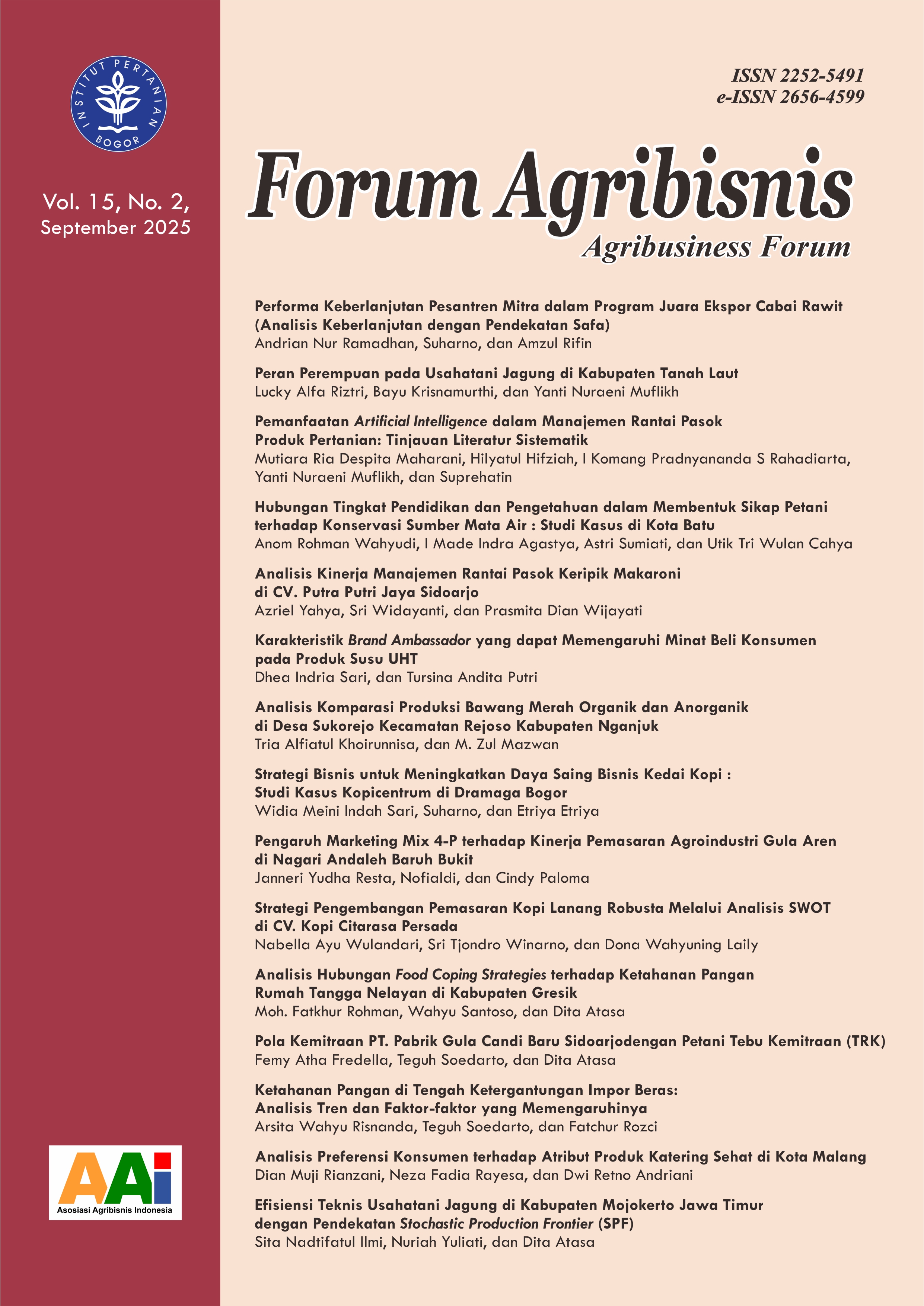
Analisis Hubungan Food Coping Strategies Terhadap Ketahanan Pangan Rumah Tangga Nelayan Di Kabupaten Gresik
DOI:
https://doi.org/10.29244/fagb.15.2.320-331Keywords:
fishing households, food cooping, food security, strategiesAbstract
Fishing households in Gresik Regency represent a vulnerable group in terms of food security due to fluctuating incomes and limited access to food. This study aims to: (1) identify the level of food security among fishing households, (2) analyze the food coping strategies adopted by these households, and (3) examine the relationship between food coping strategies and household food security. The research was conducted in Lumpur Village, Gresik Regency, involving 80 fishing households selected through purposive sampling. Data were collected via questionnaires and interviews, and analyzed using the US-HFSSM, Reduced Coping Strategies Index (RCSI), and chi-square tests. Results showed that 88% of fishing households were food insecure, with 50% experiencing moderate hunger and 25% experiencing severe hunger. Most households employed coping strategies at a moderate level (51.25%), followed by low (26.25%) and high levels (23.75%). The chi-square test indicated a significant relationship between the intensity of coping strategies and the level of food security (p < 0.05). Higher coping intensity was associated with lower household food security. These findings highlight the need for locally tailored policy interventions, including the development of alternative income sources and the promotion of healthy coping mechanisms, to enhance the long-term food security of fishing households.
Downloads
References
Abidin, Z. (2015). Kesetaraan gender dan emansipasi perempuan dalam pendidikan Islam. Tarbawiyah. Jurnal Ilmiah Pendidikan, 12(01), 1–17.
Ambarsari, R., Isyanto, A. Y., & Yusuf, M. N. (2020). Hubungan Tingkat Coping Dengan Tingkat Ketahanan Pangan Rumah Tangga Miskin (Suatu Kasus Di Kecamata Cihaurbeuti Kabupaten Ciamis). Jurnal Ilmiah Mahasiswa Agroinfo Galuh, 7(3), 693–704.
Anggrayni, F. M., Andrias, D. R., & Adriani, M. (2015). Ketahanan pangan dan coping strategy rumah tangga urban farming pertanian dan perikanan Kota Surabaya. Media Gizi Indonesia, 10(2)(173–178).
Ardiansya, Frahmawati, B., Meyko, P., Irwan, Y., & Sri, T. R. (2023). Pengaruh Pendapatan Masyarakat Nelayan Terhadap Peningkatan Ekonomi. 3, 5158–5169.
Badan Pusat Statistik Jawa Timur. (2024). Statistik Wilayah Pesisir dan Kelautan Jawa Timur.
BPS Kabupaten Gresik. (2024). Kecamatan Gresik Dalam Angka 2023.
Gibson, J., Begun, B., Ugan, J., & Soedarmo, T. (2021). Coping or adapting? Experiences of food and nutrition insecurity in specialised fishing households in Komodo District, eastern Indonesia. BMC Public Health, 21.
Karyani, T., Dewi, R. K., & Setiawan, A. (2020). Dampak Perubahan Iklim terhadap Kehidupan Nelayan Tradisional di Pesisir. Jurnal Sosial Dan Ekonomi Pesisir, 12(1), 45–56.
Koni, M. D., Bakari, Y., & Boeckoesoe, Y. (2025). Aksesibilitas dan Ketahanan Pangan Rumah Tangga Nelayan di Pesisir Gorontalo (Studi Kasus Desa Bangga Kecamatan Paguyaman Pantai). Jurnal Ilmiah Membangun Desa Dan Pertanian, 10(2), 225–235.
Lybaws, L., Renyoet, B. S., & Sanubari, T. P. E. (2022). Analisis Hubungan Food Coping Strategies terhadap Ketahanan Pangan Rumah Tangga Miskin di Kota Salatiga. Amerta Nutrition, 6(1), 32. https://doi.org/10.20473/amnt.v6i1.2022.32-43
Maulana, M. A. H., Ningtyias, F. W., & Ririanty, M. (2022). Food coping strategy oleh Keluarga Nelayan di Desa Puger Wetan Kabupaten Jember. Amerta Nutrition, 6(1).
Maulana, M. A. H. (2020). Praktik Food Coping Strategy oleh Keluarga Nelayan Di Desa Puger Wetan Kecamatan Puger Kabupaten Jember. Doctoral dissertation, fakultas kesehatan masyarakat.
Maxwell, D., Caldwell, R., & Langworthy, M. (2008). Measuring food insecurity: Can an indicator based on localized coping behaviors be used to compare across contexts? Food Policy, 33(6), 533–540.
Militao, E. M. A., Salvador, E. M., Silva, J. P., Uthman, O. A., Vinberg, S., & Macassa, G. (2022). Coping Strategies for Household Food Insecurity, and Perceived Health in an Urban Community in Southern Mozambique: A Qualitative Study. Sustainability (Switzerland), 14(14), 1–16. https://doi.org/10.3390/su14148710
Nasution, A., Krisnamurthi, B., & Rachmina, D. (2020). Analisis Permintaan Pangan Rumah Tangga Penerima Manfaat Bantuan Pangan Nono Tunai ( BPNT ). Jurnal Forum Agribisnis, 10(1), 1–10. https://dx.doi.org/10.29244/fagb.10.1.1-10
Nurrahma, H., Hakim, L., & Parmawati, R. (2021). Strategi pengembangan pariwisata berdasarkan daya dukung wisata dan CHSE pada masa pandemi covid-19. Jurnal Sumberdaya Akuatik Indopasifik, 5(1), 87–94.
Piecesha, R. F., & Tondang, S. (2025). PENENTUAN KOMODITAS PANGAN UNGGULAN. Forum Agribisnis, 15(1), 103–113. https://doi.org/10.29244/fagb.15.1.103-113
Prakusya, D. A., & Tanziha, I. (2021). Food Coping Strategy, ketahanan pangan, dan status gizi anak pada keluarga nelayan saat pandemi COVID‑19 [Institut Pertanian Bogor]. https://repository.ipb.ac.id/handle/123456789/109318
Rosada, I. (2020). Struktur Pendapatan dan Pola Konsumsi Pangan Rumah Tangga Nelayan. Jurnal Galung Tropika, 9(2), 137–146.
Salasa, A. R. (2021). Paradigma dan dimensi strategi ketahanan pangan Indonesia. Jejaring Administrasi Publik, 13(1), 35–48.
Sayekti, W. D., Zakaria, W. A., & Syafani, T. S. T. (2019). Food coping strategy rumah tangga sasaran penerima manfaat beras sejahtera di Kabupaten Pringsewu. Indonesian. Journal of Socio Economics, 1(1), 61–71.
Zulfiqar, A. (2021). Peran perempuan dalam strategi coping pangan rumah tangga nelayan. Jurnal Ketahanan Pangan, 15(2), 45–60.
Downloads
Published
Issue
Section
License
Copyright (c) 2025 Forum Agribisnis

This work is licensed under a Creative Commons Attribution-ShareAlike 4.0 International License.
The author submitting the manuscript must understand and agree that the copyright of the article manuscript must be submitted/transferred to the Journal Forum Agribisnis. This work is licensed under the Creative Commons Attribution-ShareAlike 4.0 (CC BY-SA) International License in which the Author and Reader can copy and redistribute the material in any media or format, and remix, modify and build material for any purpose, but they must provide appropriate credit (citing articles or content), provide a link to the license, and indicate whether there is a change. If you mix, change, or create material, you must distribute your contribution under the same license as the original.