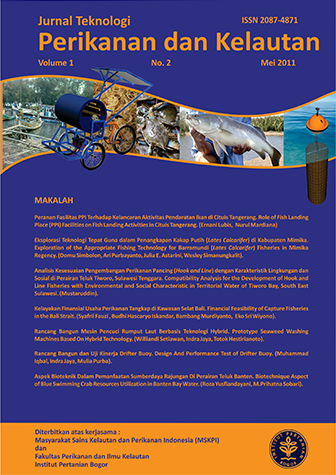
ASPEK BIOTEKNIK DALAM PEMANFAATAN SUMBERDAYA RAJUNGAN DI PERAIRAN TELUK BANTEN
DOI:
https://doi.org/10.24319/jtpk.2.71-80Keywords:
bio-technique aspects, small crab, swimming crab net, Banten Bay watersAbstract
Indonesia has the potential fishery resources of large marine fish. One of the potential of marine fisheries is small crab (Portunus pelagicus). Small crab is one Crustracea and its existence almost spread all over the waters of Indonesia. This study aimed to: 1) Describe the swimming crab net consists of construction of fishing gear, methods of operation, and productivity of swimming crab net, 2) Determining the influence of resource utilization activities of small crab on the level of biomass, production and sustainable levels in Banten Bay waters. Data collected in this study consisted of primary data and secondary data. Primary data was obtained directly by researchers with direct interviews using a questionnaire to fishermen in Banten Bay. Secondary data obtained from Fishery Port Beach (PPP) and the Marine Fisheries Department in Karangantu. Research using time series data of 2000-2008 are processed using Microsoft Office Excel. Swimming crab net construction consists of corporate nets, rope line, float, float line, lead sinker, sinker line, float marking, float marking line, stone sinker, and stone sinker line. Productivity of swimming crab net in 2008 was 209.37 kg per unit, while in 2010 was 320 kg per unit. Productivity of swimming crab net in 2008 of 10.72 kg per trip and in 2010 of 5.33 kg per trip. Productivity swimming crab net operating costs in 2010 with 0.0000676 kg/rupiah. The number of optimum swimming crab net to operate in Banten Bay waters is 178 units.
Downloads
Downloads
Published
Issue
Section
License
This journal is published under the terms of the Creative Commons Attribution-NonCommercial 4.0 International License. Authors who publish with this journal agree to the following terms: Authors retain copyright and grant the journal right of first publication with the work simultaneously licensed under a Creative Commons Attribution-NonCommercial 4.0 International License. Attribution — You must give appropriate credit, provide a link to the license, and indicate if changes were made. You may do so in any reasonable manner, but not in any way that suggests the licensor endorses you or your use. NonCommercial — You may not use the material for commercial purposes.
How to Cite