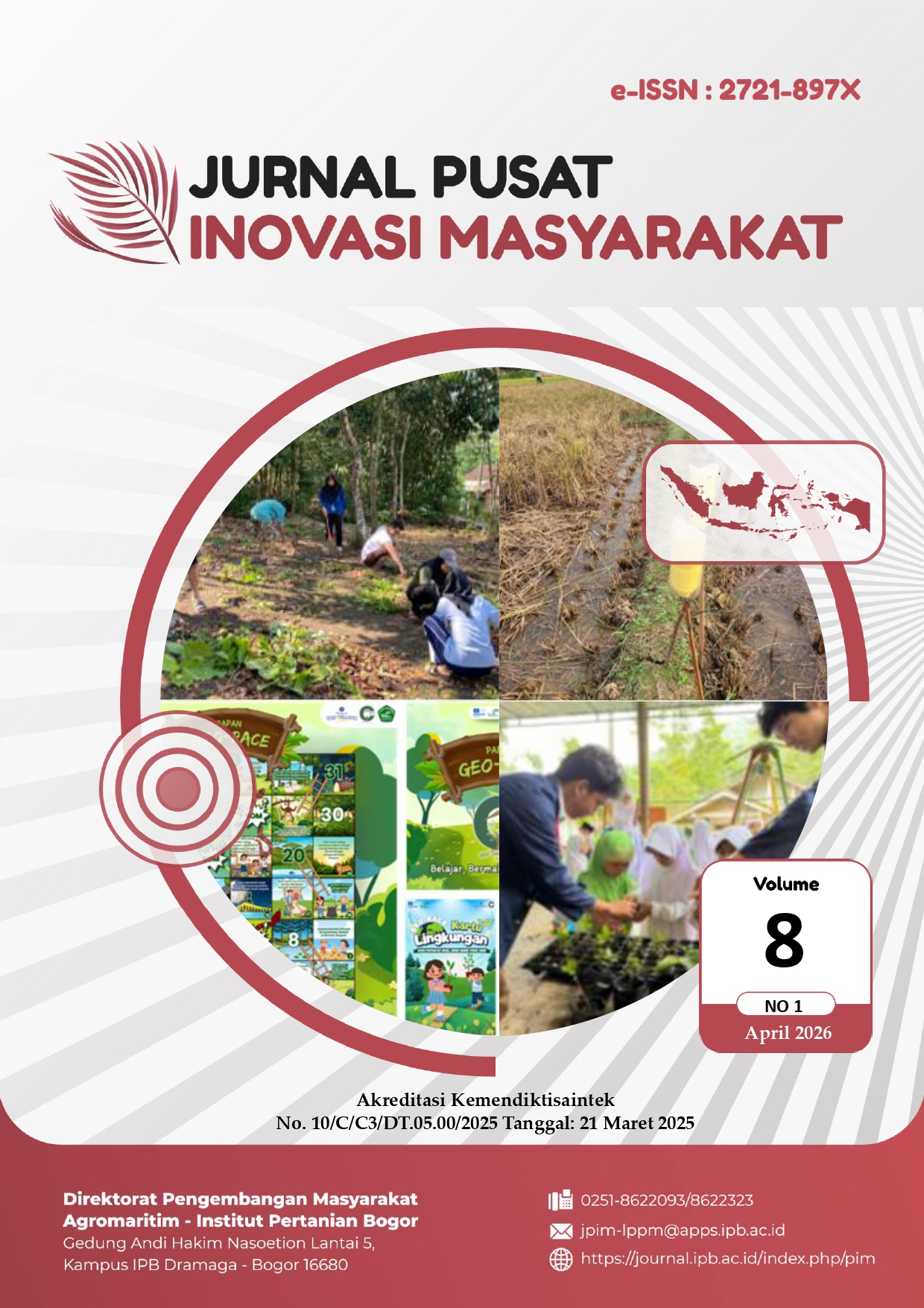
Penguatan Karakter Siswa SDN 2 Jayamekar melalui Experiential Learning dalam Kolaborasi Indonesia–Jepang SUIJI-SLP 2026
DOI:
https://doi.org/10.29244/jpim.8.1.87-99Keywords:
character education, experiential learning, intrinsic motivation, Japanese culture, student aspirationsAbstract
The MIRAI Program is an initiative to strengthen the character of students at SDN 2 Jayamekar through Experiential Learning combined with Japanese cultural introduction. Its main goal is to foster intrinsic motivation, courage to dream, and creativity among elementary school students. The program is divided into two parts: Yume Mirai for grades 5 and 6, which emphasizes self-reflection, positive value recognition, and writing letters of hope, and Yume Sōzō for grade 4, which focuses on creative expression through making teru-teru bozu dolls, puppet shows about future aspirations, and writing dreams on “dream clouds.” The learning process follows Kolb’s Experiential Learning cycle (2014), involving concrete experience, reflective observation, conceptualization, and active experimentation. The implementation of MIRAI demonstrated significant improvements in student engagement, courage in expressing aspirations, and understanding of positive character values such as hard work and self-confidence. Students also showed enthusiasm toward new cultural experiences, particularly Japanese traditions. Creative outputs like letters of hope and dream clouds served as tangible evidence of the program’s success. Furthermore, teachers provided positive feedback, highlighting the program’s impact on students’ motivation and self-confidence. In conclusion, the MIRAI Program offers an innovative solution for character education in rural elementary schools. By integrating global cultural elements with experiential learning methods, it effectively builds a foundation of intrinsic motivation, courage to dream, and readiness for students to envision a better future.
Downloads
References
Aljarrah A. (2017). Play as a manifestation of children’s imagination and creativity. Journal for the Education of Gifted Young Scientists. 5(1):23-36.
Badan Pusat Statistik (BPS) 2025a, Indikator Pendidikan Indonesia 2024-2025: Harapan Lama Sekolah dan Rata-rata Lama Sekolah Provinsi Jawa Barat, BPS RI, Jakarta.
Badan Pusat Statistik (BPS) 2025b, Statistik Kesejahteraan Rakyat Provinsi Jawa Barat 2024, BPS Provinsi Jawa Barat, Bandung.
Berdousis I. 2025. Gamification and motivation in elementary education: A self-determination theory approach to teacher perspectives. International Journal of Innovative Research in Education. 12(2): 70-84.
Bringle RG, Hatcher JA. 1995. Reflection in service learning: Making meaning of experience, Educational Horizons. 73(3): 112-122.
Febriani LF, Noviekayati IGAA. 2025. Goal setting training to improve future orientation in the “The Lost Boys” community. Sinergi International Journal of Psychology. 3(4): 211–222.
Forrester G. Hudson R, Rowley J, Pugh J. 2022. Mind The Aspiration Gap: How Primary School Pupils Perceive Their Future Adult Selves and The Perspectives and Expectations of Parents and Teachers. Educational Review. 76(4): 732–752.
Han Z. 2021. Exploring the conceptual constructs of learners' goal commitment, grit, and self-efficacy. Frontiers in Psychology. 12(1): 1-6.
Hiver P, Al-Hoorie AH, Vitta JP, Wu J. 2021. Engagement in Language Learning: A Systematic Review of 20 Years of Research Methods and Definitions. Language Teaching Research. 28(1): 201-230.
Hwang S. 2025. Unpacking the impact of writing feedback perception on self-regulated writing ability: The role of writing self-efficacy and self-regulated learning strategies. Behavioral Sciences. 15(2): 1-24.
Kolb DA. 2014. Experiential Learning: Experience as the Source of Learning and Development, 2nd edn, Pearson Education, New Jersey.
Kurniawan A, Saputra H. 2023. Urgensi pendidikan karakter di sekolah dasar pedesaan dalam menghadapi krisis motivasi belajar. Jurnal Pendidikan Dasar. 11(20): 145-158.
Piaget J. 1936. Origins of Intelligence in the Child. Routledge & Kegan Paul, London.
Rahmansyah M. 2022. Implementasi model pembelajaran berbasis pengalaman (experiential learning) untuk meningkatkan efikasi diri siswa. Jurnal Pengabdian Masyarakat Pendidikan. 3(1): 22-30.
Sari H, Amanda RS, Rahman KA. 2024. Upaya meningkatkan kemampuan motorik halus anak usia 4-5 Tahun melalui kegiatan art and craft di TK Kirana Kota Jambi. JECIE (Journal of Early Childhood and Inclusive Education). 7(2): 399-406.
Siregar E, Aswan D, Adning M. 2024. Correlation between experiential learning and micro-learning approaches in enhancing learning quality. Jurnal Teknodi. 147-157.
Undang-Undang Dasar Negara Republik Indonesia Tahun 1945.
Vasylets O, Gilabert R, Manchón RM. 2017. Effects of aligned interaction on second language speech learning: The role of native speaker interaction. Language Learning. 67(4). 909–944.
Yuniari LK, Parmiti DP, Astawan IG. 2024. Demonstration learning method assisted by hand puppet media improves children’s language and social-emotional skills. Journal of Education Action Research. 8(2): 350–358.
Zultrianti M, Supriatna N, Gunawan A, Hendayani S. 2023. Imajinasi kreatif dalam kemampuan berpikir anak sekolah dasar, penting kah?. Jurnal Elementaria Edukasia. 6(4): 1926-1936.