DNA Barcoding Reveals Frequent Conflicts between Molecular and Morphological Identifications in Wild-Caught Shrimp from Coastal East Kalimantan, Indonesia
Article Sidebar
-
COI, DNA barcoding, mtDNA, Shrimp, Species identification
Abstract
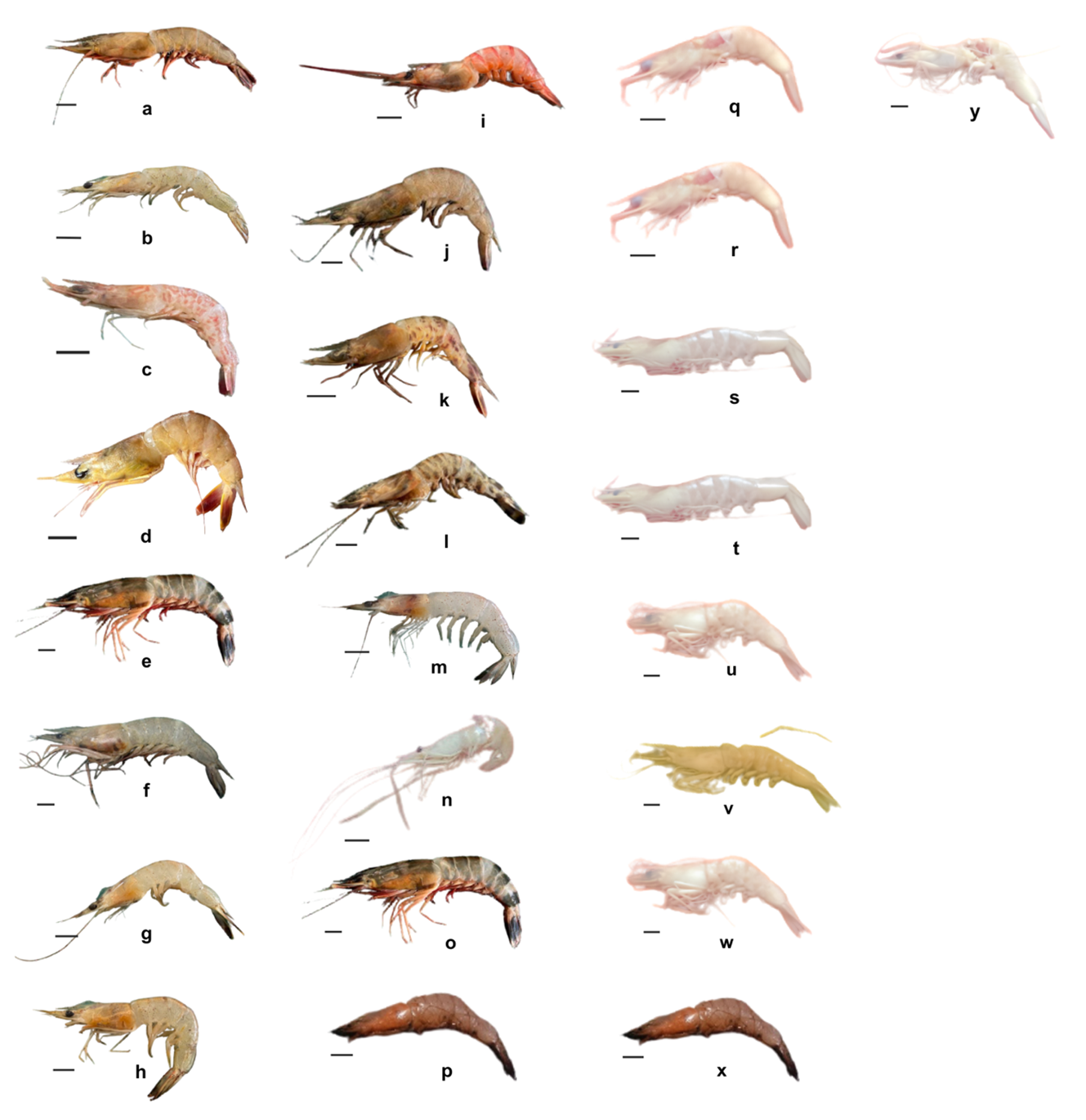
Unreliable species identification can hinder management of key fisheries, including shrimp, in Coastal East Kalimantan. This study integrated preliminary morphological identification with COI DNA barcoding to validate species assignments of wild-caught shrimp landed at three coastal sites in East Kalimantan. Wild-caught shrimp from coastal East Kalimantan, were first identified using morphological characters. These identifications were then verified using COI DNA barcoding. Sequences were identified via database percentage similarity in NCBI and BOLD databases, and barcoding gap based on Kimura 2-parameter (K2P) was calculated to assess reliability of molecular species identification. A total of 25 shrimp specimens were morphologically assigned to Penaeidae and Solenoceridae, identifying 16 morphospecies (15 at species level and one assigned only to genus level). DNA barcoding identified three families (Palaemonidae, Penaeidae and Solenoceridae) and 15 species, with sequence similarities ranging from 98.17% to 100% (~99% query cover). In contrast, the BOLD database identified 12 specimens to species level and 12 to genus level with top match similarities ranged from 93.74% to 100%. Morphological and genetic identifications conflicted in 15 specimens and agreed in nine specimens. Genetic distances (K2P) ranged 0.000–0.238 with mean interspecific distance (0.197) exceeded mean intraspecific distance (0.00205). One species (Metapenaeus ensis) showed a negative barcoding gap, suggesting cryptic diversity or misidentification. The partial sequence of COI DNA barcoding supplements morphological shrimp identification, but conflicting results and incomplete databases remain challenges. Building well curated reference sequences is required to close these gaps and enhance the accuracy of species identification.
Full text article
References
Aguilar, R., Prakash, S., Ogburn, M. B., Pagenkopp Lohan, K. M., MacDonald, K. S., III, Driskell, A. C., Ahyong, S. T., Leray, M., McIlroy, S. E., Tuckey, T. D., & Baeza, J. A. (2022). Unresolved taxonomy confounds invasive species identification: The Lysmata vittata Stimpson, 1860 (Decapoda: Caridea: Lysmatidae) species complex and recent introduction of Lysmata vittata sensu stricto in the western Atlantic. Journal of Crustacean Biology, 42(1), ruab079. https://doi.org/10.1093/jcbiol/ruab079
Anggorowati, D. A. (2014). Struktur komunitas fauna krustasea di daerah intertidal perairan Lombok Barat. Zoo Indonesia, 23, 92–100. https://e-journal.biologi.lipindonesia.com/index_php/zoo_indonesia/article/view/408/506
Bosma, R., Sidik, A. S., van Zwieten, P., Aditya, A., & Visser, L. (2012). Challenges of a transition to a sustainably managed shrimp culture agro-ecosystem in the Mahakam Delta, East Kalimantan, Indonesia. Wetlands Ecology and Management, 20(2), 89–99. https://doi.org/10.1007/s11273-011-9244-0
Breinholt, J. W., Porter, M. L., & Crandall, K. A. (2012). Testing phylogenetic hypotheses of the subgenera of the freshwater crayfish genus Cambarus (Decapoda: Cambaridae). PLOS ONE, 7(5), e46105. https://doi.org/10.1371/journal.pone.0046105
Broadhurst, M. K., Millar, R. B., Spach, H. L., & Colombo, N. (2016). Damage and mortality of juvenile seabob shrimp (Xiphopenaeus kroyeri) discarded in a tropical artisanal trawl fishery. ICES Journal of Marine Science, 73(9), 2364–2369. https://doi.org/10.1093/icesjms/fsw064
Buhay, J. E. (2009). COI-like sequences are becoming problematic in molecular systematics and DNA barcoding studies. Journal of Crustacean Biology, 29(1), 96–110. https://doi.org/10.1651/08-3020.1
Butlin, R. K., Galindo, J., & Grahame, J. W. (2008). Sympatric, parapatric or allopatric: The most important way to classify speciation? Philosophical Transactions of the Royal Society B: Biological Sciences, 363(1506), 2997–3007. https://doi.org/10.1098/rstb.2008.0076
Cabon, L., Varma, M., Winter, G., Ebeling, A., & Schielzeth, H. (2025). Phenotypic plasticity, heritability, and genotype-by-environment interactions in an insect dispersal polymorphism. BMC Ecology and Evolution, 25, Article 94. https://doi.org/10.1186/s12862-025-02447-y
Čandek, K., & Kuntner, M. (2015). DNA barcoding gap: Reliable species identification over morphological and geographical scales. Molecular Ecology Resources, 15(2), 268–277. https://doi.org/10.1111/1755-0998.12304
Chalermwong, P., Panthum, T., Wattanadilokcahtkun, P., Ariyaraphong, N., Thong, T., Srikampa, P., et al. (2023). Overcoming taxonomic challenges in DNA barcoding for improvement of identification and preservation of clariid catfish species. Genomics & Informatics, 21(4), Article e39. https://doi.org/10.5808/gi.23038
Costa, F. O., Boutillier, J., Ratnasingham, S., Dooh, R. T., Hajibabaei, M., & Hebert, P. D. N. (2007). Biological identifications through DNA barcodes: The case of the Crustacea. Canadian Journal of Fisheries and Aquatic Sciences, 64(2), 272–295. https://doi.org/10.1139/f07-008
Engel, M. S., Ceríaco, L. M. P., Daniel, G. M., Dellapé, P. M., Löbl, I., Marinov, M., et al. (2021). The taxonomic impediment: A shortage of taxonomists, not the lack of technical approaches. Zoological Journal of the Linnean Society, 193(2), 381–387. https://doi.org/10.1093/zoolinnean/zlab072
Fauzi, M., Prianto, E., & Hendrizal, A. (2023). Morphological and genetic characteristics (mitochondrial DNA) as a basis for determining the direction of giant prawn (Macrobrachium rosenbergii) resources management in Riau Province, Indonesia. AACL Bioflux, 16(2), 733–742. http://bioflux.com.ro/docs/2023.733-742.pdf
Gunawan, B. I. (2016). The diversity of fisheries-based livelihoods in the Berau Delta, East Kalimantan. Wacana, 17(1), 68–84. https://doi.org/10.17510/wacana.v17i1.429
Hadadi, N., Madduppa, H., Azaraly, I. S., & Anggraini, N. P. (2023). DNA barcoding, identifikasi morfologi dan kepadatan populasi genus Tridacna di Perairan Maluku Utara [DNA barcoding, morphological identification, and population density of the genus Tridacna in North Maluku waters]. Jurnal Ilmu dan Teknologi Kelautan Tropis, 15(3), 349–368. https://doi.org/10.29244/jitkt.v15i3.47110
Hall, T. A. (1999). BioEdit: A user-friendly biological sequence alignment editor and analysis program for Windows 95/98/NT. Nucleic Acids Symposium Series, 41, 95–98.
Hamid, A., & Wardiatno, Y. (2018). Diversity of decapod crustaceans in Lasongko Bay, southeast Sulawesi, Indonesia. Biodiversity Journal, 9(3), 303–311. https://doi.org/10.31396/Biodiv.Jour.2018.9.3.303.311
Hoang, D. T., Chernomor, O., von Haeseler, A., Minh, B. Q., & Vinh, L. S. (2018). UFBoot2: Improving the ultrafast bootstrap approximation. Molecular Biology and Evolution, 35(2), 518–522. https://doi.org/10.1093/molbev/msx281
Hünicken, L. A., Paolucci, E. M., Lavinia, P. D., & Sylvester, F. (2024). Morphological and genetic assessment of invasive Corbicula lineages in southern South America: A case study in Argentina. Animals, 14(12), Article 1843. https://doi.org/10.3390/ani14131843
Kalyaanamoorthy, S., Minh, B. Q., Wong, T. K. F., von Haeseler, A., & Jermiin, L. S. (2017). ModelFinder: Fast model selection for accurate phylogenetic estimates. Nature Methods, 14(6), 587–589. https://doi.org/10.1038/nmeth.4285
Katoh, K., Rozewicki, J., & Yamada, K. D. (2019). MAFFT online service: Multiple sequence alignment, interactive sequence choice and visualization. Briefings in Bioinformatics, 20(4), 1160–1166. https://doi.org/10.1093/bib/bbx108
Kolde, R. (2025). pheatmap: Pretty heatmaps (Version 1.0.13). GitHub. https://github.com/raivokolde/pheatmap
Kühl, H. S., Bowler, D. E., Bösch, L., Bruelheide, H., Dauber, J., Eichenberg, D., Eisenhauer, N., Fernández, N., Guerra, C. A., Henle, K., Herbinger, I., Isaac, N. J. B., Jansen, F., König-Ries, B., Kühn, I., Nilsen, E. B., Pe'er, G., Richter, A., Schulte, R., ... Bonn, A. (2020). Effective biodiversity monitoring needs a culture of integration. One Earth, 3(4), 462–474. https://doi.org/10.1016/j.oneear.2020.09.010
Leray, M., Knowlton, N., Ho, S.-L., Nguyen, B. N., & Machida, R. J. (2019). GenBank is a reliable resource for 21st century biodiversity research. Proceedings of the National Academy of Sciences of the United States of America, 116(45), 22651–22656. https://doi.org/10.1073/pnas.1911714116
Letunic, I., & Bork, P. (2019). Interactive Tree of Life (iTOL) v4: Recent updates and new developments. Nucleic Acids Research, 47(W1), W256–W259. https://doi.org/10.1093/nar/gkz239
Lobo, J., Ferreira, M. S., Antunes, I. C., Teixeira, M. A. L., Borges, L. M. S., Sousa, R., Gomes, P. A., Costa, M. H., Cunha, M. R., & Costa, F. O. (2017). Contrasting morphological and DNA barcode-suggested species boundaries among shallow-water amphipod fauna from the southern European Atlantic coast. Genome, 60(2), 147–157. https://doi.org/10.1139/gen-2016-0009
Loh, K.-H., Lim, K.-C., Then, A. Y.-H., Adam, S., Leung, A. J.-X., Hu, W., et al. (2023). Advancing DNA barcoding to elucidate elasmobranch biodiversity in Malaysian waters. Animals, 13(6), Article 1002. https://doi.org/10.3390/ani13061002
Luo, A., Ling, C., Ho, S. Y. W., & Zhu, C.-D. (2018). Comparison of methods for molecular species delimitation across a range of speciation scenarios. Systematic Biology, 67(5), 830–846. https://doi.org/10.1093/sysbio/syy011
Madduppa, H., Sani, L. M. I., Nugroho, K. C., Bengen, D. G., Muchlisin, Z. A., Fadli, N., et al. (2022). eDNA metabarcoding of decapod crustaceans across Indonesian seas has implications for biodiversity conservation and fisheries sustainability. Frontiers in Marine Science, 9, Article 918295. https://doi.org/10.3389/fmars.2022.918295
Meier, R., Shiyang, K., Vaidya, G., & Ng, P. K. L. (2006). DNA barcoding and taxonomy in Diptera: A tale of high intraspecific variability and low identification success. Systematic Biology, 55(5), 715–728. https://doi.org/10.1080/10635150600969864
Minh, B. Q., Schmidt, H. A., Chernomor, O., Schrempf, D., Woodhams, M. D., von Haeseler, A., & Lanfear, R. (2020). IQ-TREE 2: New models and efficient methods for phylogenetic inference in the genomic era. Molecular Biology and Evolution, 37(5), 1530–1534. https://doi.org/10.1093/molbev/msaa015
Ministry of Fisheries and Marine Affairs. (2024). Capture fisheries production statistics data. Retrieved March 22, 2026, from https://portaldata.kkp.go.id/portals/data-statistik/prod-ikan/summary
Mutanen, M., Kivelä, S. M., Vos, R. A., Doorenweerd, C., Ratnasingham, S., Hausmann, A., Huemer, P., Dincă, V., van Nieukeren, E. J., Lopez-Vaamonde, C., Vila, R., Aarvik, L., Decaëns, T., Efetov, K. A., Hebert, P. D. N., Johnsen, A., Karsholt, O., Pentinsaari, M., Rougerie, R., ... Godfray, H. C. J. (2016). Species-level para- and polyphyly in DNA barcode gene trees: Strong operational bias in European Lepidoptera. Systematic Biology, 65(6), 1024–1040. https://doi.org/10.1093/sysbio/syw044
Nunes, D. B. S. M., Pontes, A. I., Santos, L. F., Calado, L. L., Barros-Neto, L. F., Lustosa-Costa, S. Y., Lima, S. M. Q., & Jacobina, U. P. (2024). DNA barcoding highlights taxonomic uncertainties and cryptic lineages of São Francisco River basin fishes. Neotropical Ichthyology, 22(3), Article e240059. https://doi.org/10.1590/1982-0224-2024-0059
Paradis, E., & Schliep, K. (2019). ape 5.0: An environment for modern phylogenetics and evolutionary analyses in R. Bioinformatics, 35(3), 526–528. https://doi.org/10.1093/bioinformatics/bty633
Parenrengi, A., Tenriulo, A., Suryati, E., Lante, S., Nawang, A., & Rosmiati, R. (2022). Morphological discrimination of tiger shrimp Penaeus monodon between female and male based on traditional and truss morphometric analyses. IOP Conference Series: Earth and Environmental Science, 1119, Article 012055. https://doi.org/10.1088/1755-1315/1119/1/012055
Pentinsaari, M., Ratnasingham, S., Miller, S. E., & Hebert, P. D. N. (2020). BOLD and GenBank revisited: Do identification errors arise in the lab or in the sequence libraries? PLOS ONE, 15(4), Article e0231814. https://doi.org/10.1371/journal.pone.0231814
Pratiwi, R. (2010). Asosiasi Krustasea di Ekosistem Padang Lamun Perairan Teluk Lampung. Ilmu Kelautan: Indonesian Journal of Marine Sciences, 15(2), 66–76. https://doi.org/10.14710/ik.ijms.15.2.66-76
Pratiwi, R., & Astuti, O. (2012). Biodiversitas Krustasea (Decapoda, Brachyura, Macrura) dari Ekspedisi Perairan Kendari 201. Ilmu Kelautan: Indonesian Journal of Marine Sciences, 17(1), 8–14. https://doi.org/10.14710/ik.ijms.17.1.8-14
Pratiwi, R., & Widyastuti, E. (2013). Pola Sebaran dan Zonasi Krustasea di Hutan Bakau Perairan Teluk Lampung. Zoo Indonesia, 22(1), 11–21. https://d1wqtxts1xzle7.cloudfront.net/108617503/194-libre.pdf?1702130845=&response-content-disposition=inline%3B+filename%3DPola_sebaran_dan_zonasi_krustasea_di_hut.pdf&Expires=1786943049&Signature=KLkfvE0wZcOh9smgS6FVUvWYMXkmvWXP0cs-2~4qAtkFy6ELIZPdM8d5SLTfqNCGag09g28mZO7f5go9FyeF8c9BP2xNMtAlkuE6APLmFvvGiwIzEBtKNM8EhnHH4JPqTKFuphsIoLQA16IzC-3uSCCzdXgvA4SibA9gQC59PdAkcKH6xoXM2FlJ4Fo4hOjPC16egdZ4CPLi9-sn7W74hgZE7eEJcWCCqMysfYgMFo0c1DmRX04uv4UisHo5sIm7f8N~DXkW40O4f77Qh3YZoOm-FnHu~LvxTeZCLKUptizxabSYqZB~1Q-Bh1cOVIYzgCXr9gbd926cBAta0YHVPQ__&Key-Pair-Id=APKAJLOHF5GGSLRBV4ZA
Pratiwi, R., & Wijaya, N. I. (2013). Crustacean community diversity in Matasiri Islands, South Kalimantan [In Indonesian]. Berita Biologi, 12(1), 127–140. https://www.researchgate.net/profile/Rianta-Afriadi-2/publication/279298444_KEANEKARAGAMAN_KOMUNITAS_KRUSTASEA_DI_KEPULAUAN_MATASIRI_KALIMANTAN_SELATAN_The_Community_Diversity_of_Crustacean_in_Matasiri_Islands_South_Kalimantan/links/5591ec7808ae15962d8e395c/KEANEKARAGAMAN-KOMUNITAS-KRUSTASEA-DI-KEPULAUAN-MATASIRI-KALIMANTAN-SELATAN-The-Community-Diversity-of-Crustacean-in-Matasiri-Islands-South-Kalimantan.pdf
R Core Team. (2026). R: A language and environment for statistical computing [Computer software]. R Foundation for Statistical Computing. https://www.R-project.org
Rajkumar, G., Bhavan, P. S., Udayasuriyan, R., & Vadivalagan, C. (2015). Molecular identification of shrimp species, Penaeus semisulcatus, Metapenaeus dobsoni, Metapenaeus brevicornis, Fenneropenaeus indicus, Parapenaeopsis stylifera and Solenocera crassicornis inhabiting in the Coromandel Coast (Tamil Nadu, India) using MT-COI gene. International Journal of Fisheries and Aquatic Studies, 2(4), 96–106.
Ramirez, J. L., Simbine, L., Marques, C. G., Zelada-Mázmela, E., Reyes-Flores, L. E., López, A. S., Gusmão, J., Tavares, C., Galetti, P. M., Jr., & Freitas, P. D. (2021). DNA barcoding of Penaeidae (Decapoda; Crustacea): Non-distance-based species delimitation of the most economically important shrimp family. Diversity, 13(10), Article 460. https://doi.org/10.3390/d13100460
Ratnasingham, S., & Hebert, P. D. N. (2007). BOLD: The Barcode of Life Data System. Molecular Ecology Notes, 7(3), 355–364. https://doi.org/10.1111/j.1471-8286.2007.01678.x
Ratnasingham, S., & Hebert, P. D. N. (2013). A DNA-based registry for all animal species: The barcode index number (BIN) system. PLOS ONE, 8(7), Article e66213. https://doi.org/10.1371/journal.pone.0066213
Ratnasingham, S., Wei, C., Chan, D., Agda, J., Agda, J., Ballesteros-Mejia, L., Ait Boutou, H., El Bastami, Z. M., Ma, E., Manjunath, R., Rea, D., Ho, C., Telfer, A., McKeowan, J., Rahulan, M., Steinke, C., Dorsheimer, J., Milton, M., & Hebert, P. D. N. (2024). BOLD v4: A centralized bioinformatics platform for DNA-based biodiversity data. Methods in Molecular Biology, 2744, 403–441. https://doi.org/10.1007/978-1-0716-3581-0_26
Rismawati, R., Krisanti, M., & Farajallah, A. (2024). Sexual dimorphism phenomenon of first record Macrobrachium lar (Fabricius, 1978) from the southern Sukabumi, West Java, Indonesia. Biodiversitas, 25(5), 2159–2167. https://doi.org/10.13057/biodiv/d250509
Saengprajak, J., Wangkahart, E., Phalaraksh, C., & Pakdeenarong, N. (2025). Morphological and genetic identification of novel cryptic freshwater shrimp species (Caridina and Macrobrachium) in northeastern Thailand using DNA barcoding. Biodiversitas, 26(1), 487–498. https://doi.org/10.13057/biodiv/d261005
Sakai, K., & Shinomiya, S. (2011). Preliminary report on eight new genera formerly attributed to Parapenaeopsis Alcock, 1901, sensu lato (Decapoda, Penaeidae). Crustaceana, 84(4), 491–504. https://doi.org/10.1163/001121611X557037
Salahuddin, & Lambiase, J. J. (2013). Sediment dynamics and depositional systems of the Mahakam Delta, Indonesia: Ongoing delta abandonment on a tide-dominated coast. Journal of Sedimentary Research, 83(7), 503–521. https://doi.org/10.2110/jsr.2013.42
Saputra, S. W. (2008). Pedoman identifikasi udang (Subordo Macrura natantia) [Shrimp identification guide]. Universitas Diponegoro.
Srivathsan, A., & Meier, R. (2012). On the inappropriate use of Kimura-2-parameter (K2P) divergences in the DNA-barcoding literature. Cladistics, 28(2), 190–194. https://doi.org/10.1111/j.1096-0031.2011.00370.x
Trifinopoulos, J., Nguyen, L.-T., von Haeseler, A., & Minh, B. Q. (2016). W-IQ-TREE: A fast online phylogenetic tool for maximum likelihood analysis. Nucleic Acids Research, 44(W1), W232–W235. https://doi.org/10.1093/nar/gkw256
Wacker, A., & Harzsch, S. (2021). Crustaceans in a changing world. Zoology, 146, Article 125921. https://doi.org/10.1016/j.zool.2021.125921
Wickham, H. (2016). ggplot2: Elegant graphics for data analysis. Springer-Verlag.
Yang, C.-H., Ma, K. Y., Chu, K. H., & Chan, T.-Y. (2023). Making sense of the taxonomy of the most commercially important shrimps Penaeus Fabricius, 1798 s. l. (Crustacea: Decapoda: Penaeidae), a way forward. Aquaculture, 563, Article 738955. https://doi.org/10.1016/j.aquaculture.2022.738955
Zhou, C.-J., Feng, M.-X., Tang, Y.-T., Yang, C.-X., Meng, X.-L., & Nie, G.-X. (2021). Species diversity of freshwater shrimp in Henan Province, China, based on morphological characters and COI mitochondrial gene. Ecology and Evolution, 11(15), 10502–10514. https://doi.org/10.1002/ece3.7855
Zhou, Y., Trujillo-González, A., Nicol, S., Huerlimann, R., Sarre, S. D., & Gleeson, D. (2025). Evaluation of DNA barcoding reference databases for marine species in the western and central Pacific Ocean. PeerJ, 13, Article e19674. https://doi.org/10.7717/peerj.19674
Authors
Copyright (c) 2026 M Syahrir R, Nurfadillah, Yadi, Sabrina Azzahrah, Madinah Tul Quraini, Yuni Syahriani, Meyli Anisa, Umra, Dewi Embong Bulan, Trifan Budi

This work is licensed under a Creative Commons Attribution 4.0 International License.

This work is licensed under a Creative Commons Attribution 4.0 International License.
Jurnal Ilmu dan Teknologi Kelautan Tropis i is an open-access journal, meaning that all content is freely available without charge to the user or their institution. Users are allowed to read, download, copy, distribute, print, search, or link to the full texts of the articles in this journal without needing to request prior permission from the publisher or the author.
All articles published by Jurnal Ilmu dan Teknologi Kelautan Tropis are licensed under the Creative Commons Attribution 4.0 International License. This allows for unrestricted use, distribution, and reproduction in any medium, provided proper credit is given to the original authors.
Authors submitting manuscripts should understand and agree that the copyright of published manuscripts is retained by the authors. Copyright encompasses the exclusive rights of authors to reproduce, distribute, and sell any part of the journal articles in all forms and media. Reproduction of any part of this journal, its storage in databases, and its transmission by any form or media is allowed without written permission from Jurnal Ilmu dan Teknologi Kelautan Tropis.