First Report Molecular Identification and Bioactivity Screening of Razor Clam (Solen sp.) from Merauke, Indonesia
Article Sidebar
-
antibacterial, antioxidant, bamboo clam, bivalvia , phytochemical screening
Abstract
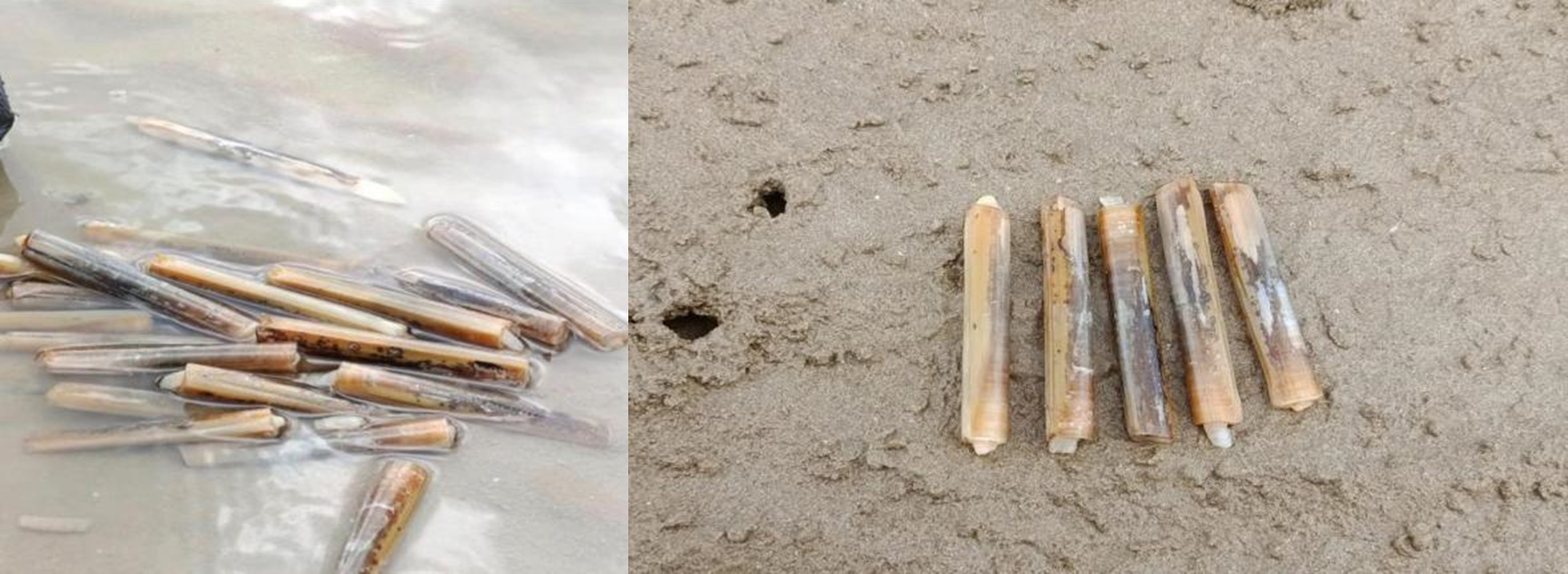
Marine bivalves are increasingly recognized as reservoirs of natural metabolites that may support biotechnological development and functional food innovation. Nevertheless, information on the taxonomic status and biological properties of bamboo clams from eastern Indonesia is still scarce. This research examined the genetic affiliation and preliminary bioactive characteristics of Solen sarawakensis obtained from the coastal area of Merauke, Indonesia. Specimens were collected from the intertidal habitat, followed by molecular characterization based on the mitochondrial cytochrome oxidase I marker. The crude extract was subsequently evaluated for antibacterial properties using an agar disk assay against Staphylococcus aureus and Escherichia coli. Free-radical scavenging capacity was determined using DPPH analysis, while major secondary-metabolite groups were assessed through qualitative phytochemical tests. Sequence comparison and phylogenetic reconstruction placed the Merauke specimens within the S. sarawakensis lineage. The extract inhibited the growth of both tested bacterial species, suggesting activity across Gram-positive and Gram-negative targets. However, its radical-scavenging performance was relatively low, producing an IC₅₀ of 353.52 ppm. Alkaloids, steroids, and saponins were detected in the extract, whereas flavonoids and tannins were absent. These findings document the genetic characterization and initial bioactivity profile of S. sarawakensis from Merauke. Despite modest antioxidant performance, its antibacterial response and detected metabolite classes indicate that this bivalve may warrant further investigation as a natural source of antimicrobial compounds. Purification of active fractions, compound elucidation, and mechanistic evaluation should be pursued in subsequent work.
Full text article
References
Abubakar, A. R., & Haque, M. (2020). Preparation of medicinal plants: basic extraction and fractionation procedures for experimental purposes. Journal of Pharmacy and Bioallied Sciences , 12(1), 1–10. https://doi.org/10.4103/jpbs.JPBS
Andini, D., Mulangsri, K., Ningrum, R. A., & Imliyyah, N. (2022). Antibacterial activity of n-hexane and diethyl ether fraction of Piper betle L . leaf against Staphylococcus aureus dan Escherichia coli Bacteria. Indonesian Journal of Chemical Science, 11(1), 26–32. https://doi.org/10.15294/ijcs.v11i1.51850
Atanasov, A. G., Zotchev, S. B., Dirsch, V. M., & Supura, T. C. (2021). Natural products in drug discovery : advances and opportunities. Drug Discovery, 20, 200–216. https://doi.org/10.1038/s41573-020-00114-z
Blunt, J. W., Copp, B. R., Hu, W., Munro, M. H. G., & Northcote, P. T. (2009). Marine natural products. Natural Product Reports, 25, 35. https://doi.org/10.1039/c5np00156k
Bouchet, P., Decock, W., Lonneville, B., Vanhoorne, B., & Vandepitte, L. (2023). Marine biodiversity discovery : the metrics of new species descriptions. Frontier in Marine Science, 10, 929989. https://doi.org/10.3389/fmars.2023.929989
Brand-Williams, W., Cuvelier, M. E., & Berset, C. (1995). Use of a free radical method to evaluate antioxidant activity. LWT - Food Science and Technology, 28, 25–30. https://doi.org/10.1016/S0023-6438(95)80008-5
Carroll, A. R., Copp, B. R., Davis, R. A., & Keyzers, R. A. (2019). Marine natural products. Natural Product Reports, 122–173. https://doi.org/10.1039/c8np00092a
Centella, M. H., Arévalo-gallegos, A., Parra-saldivar, R., & Iqbal, H. M. N. (2017). Marine-derived bioactive compounds for value-added applications in bio- and non-bio sectors. Journal of Cleaner Production, 1–13. https://doi.org/10.1016/j.jclepro.2017.05.086
Chakraborty, K., & Joy, M. (2020). High-value compounds from the molluscs of marine and estuarine ecosystems as prospective functional food ingredients : An overview. Food Research International, 137(1603), 109637. https://doi.org/10.1016/j.foodres.2020.109637
Deiner, K., Bik, H. M., Elvira, M., Seymour, M., Creer, S., Bista, I., Pfrender, M. E., Bernatchez, L., Altermatt, F., Lodge, D. M., & Vere, N. De. (2017). Environmental DNA metabarcoding : Transforming how we survey animal and plant communities. Molecular Ecology, 26, 5872–5895. https://doi.org/10.1111/mec.14350
Dildar, T., Cui, W., & Ikhwanuddin, M. (2025). Aquatic Organisms in Response to Salinity Stress : Ecological Impacts, Adaptive Mechanisms, and Resilience Strategies. Biology, 14, 667. https://doi.org/https://doi.org/10.3390/biology14060667
Dubale, S., & Zeynudin, A. (2023). Phytochemical screening and antimicrobial activity evaluation of selected medicinal plants in Ethiopia. Journal of Experimental Pharmacology, 15, 51–62. https://doi.org/10.2147/jep.s379805
Gomes-dos-Santos, A., Lopes-Lima, M., Castro, L. F. C., & Froufe, E. (2020). Molluscan genomics : the road so far and the way forward. Hydrobiologia (2020), 847, 1705–1726. https://doi.org/10.1007/s10750-019-04111-1
Green, M. R., & Sambrook, J. (2019). Agarose gel electrophoresis. Cold Spring Harbor Protocols, 1, 1–9. https://doi.org/10.1101/pdb.prot100404
Harborne, J. B. (1998). Phytochemical Methods: A Guide to Modern Techniques of Plant Analysis. 3rd ed. London: Chapman and Hall.
Hebert, P. D. N., Ratnasingham, S., & Jeremy, R. (2003). Barcoding animal life : cytochrome c oxidase subunit 1 divergences among closely related species. Biology Letters, 96–99. https://doi.org/10.1098/rsbl.2003.0025
Hung, J., & Weng, Z. (2016). Sequence alignment and homology search with BLAST and ClustalW. Cold Spring Harbor Protocols, 1–7. https://doi.org/10.1101/pdb.prot093088
Indrayanto, G. (2018). NPC Natural Product Communications. Natural Product Communications Recent, 13(12), 1599–1606. https://doi.org/10.1177/1934578X1801301208
Izzati, F., Warsito, M. F., Bayu, A., & Prasetyoputri, A. (2021). Chemical diversity and biological activity of secondary metabolites isolated from Indonesian marine invertebrates. Molecules, 26, 1898. https://doi.org/10.3390/molecules26071898
Kumar, S., Stecher, G., Li, M., Knyaz, C., & Tamura, K. (2018). MEGA X : Molecular Evolutionary Genetics Analysis across Computing Platforms. Molecular Biology and Evolution, 35(6), 1547–1549. https://doi.org/10.1093/molbev/msy096
Liang, X., Luo, D., & Luesch, H. (2020). Advances in Exploring the Therapeutic Potential of Marine Natural Products. Pharmacological Research, 147, 1–42. https://doi.org/10.1016/j.phrs.2019.104373.Advances
Liu, L., Zheng, Y. Y., Shao, C. L., & Wang, C. Y. (2019). Metabolites from marine invertebrates and their symbiotic microorganisms : molecular diversity discovery , mining , and application. Marine Life Science & Technology, 1(1), 60–94. https://doi.org/10.1007/s42995-019-00021-2
Mckeon, C. S., & Barshis, D. J. (2015). Ecological drivers and habitat associations of estuarine bivalves. PeerJ, 3, e1348. https://doi.org/10.7717/peerj.1348
Meyer-kaiser, K. S., Houlihan, E. P., Wheeler, J. D., Mccorkle, D. C., & Mullineaux, L. S. (2019). Behavioral response of eastern oyster Crassostrea virginica larvae to a chemical settlement cue is not impaired by low pH. Marine Ecology Progress Series, 623, 13–24. https://doi.org/10.3354/meps13014
Pertiwi, R. T. A., Pringgenies, D., Dewi, E. N., & Sabdaningsih, A. (2025). Nutritional and nutraceutical profiles of different types of shells in Tambaklorok , Semarang , Indonesia. International Journal of Agriculture and Biosciences, 14(3), 365–373. https://doi.org/https://doi.org/10.47278/journal.ijab/2025.022
Pringgenies,D. , Ari S. W. , Feliatra,F. & Ariyanto,D. (2023). The antibacterial and antifungal potential of marine natural ingredients from the symbiont bacteria of mangrove. Global Journal of Environmental Science and Management, 9(4), 819–832. https://doi.org/10.22034/gjesm.2023.04.11
Pringgenies, D., Sari, E., Widianigsih, W., & Nateewathana, A. (2021). Exploration of Bioactive Compounds Potency of Extract Namanereis sp. ( Polychaeta : Annelida ) as an Antibacterial Agent Against Escherichia coli and Staphylococcus aureus. ILMU KELAUTAN: Indonesian Journal of Marine Sciences, 26, 182–188. https://doi.org/10.14710/ik.ijms.26.3.182-188
Putri, D. B., Pringgenies, D., & Trianto, A. (2025). Antibacterial, Antifungal, Antioxidant, and Photoprotective Analysis of Mangrove Extracts as Additives Ingredients in a Cosmetic Cream. HAYATI Journal of Biosciences, 32(3), 571–580. https://doi.org/10.4308/hjb.32.3.571-580
Qin, D., & Xi, J. (2021). Trends in Food Science & Technology Flash extraction : An ultra-rapid technique for acquiring bioactive compounds from plant materials. Trends in Food Science & Technology, 112, 581–591. https://doi.org/10.1016/j.tifs.2021.04.025
Re, R., Pellegrini, N., Proteggente, A., Pannala, A., Yang, M., & Rice-evans, C. (1999). Free Radical Biology and Medicine Antioxidant activity applying an improved ABTS radical cation decolorization assay. Free Radical Biology and Medicine, 26, 1231–1237. https://doi.org/10.1016/S0891-5849(98)00315-3
Saeedi, H., Basher, Z., & Costello, M. J. (2016). Modelling present and future global distributions of razor clams (Bivalvia : Solenidae). Helgoland Marine Research, 70, 23. https://doi.org/10.1186/s10152-016-0477-4
Saleky, D., & Merly, S. L. (2021). Molecular phylogenetic of Cerithidea anticipata. Iredale, 1929. Mollusk: Gastropod. Jurnal Ilmiah PLATAX, 9(1), 9–17. https://doi.org/10.35800/jip.9.1.2021.32422
Sarker, S. D., & Nahar, L. (2012). Natural Products Isolation. 3rd ed. Methods in Molecular Biology, Vol. 864. Humana Press/Springer, New York. https://doi.org/10.1007/978-1-61779-624-1
Sharma, S., Mohler, J., Mahajan, S. D., Schwartz, S. A., Bruggemann, L., & Aalinkeel, R. (2023). Microbial biofilm : a review on formation , infection , antibiotic resistance , control measures , and innovative treatment. Microorganisms, 11, 1614. https://doi.org/10.3390/microorganisms11061614
Shi, L., Zhao, W., Yang, Z., Subbiah, V., Ansar, H., & Suleria, R. (2022). Extraction and characterization of phenolic compounds and their potential antioxidant activities. Environmental Science and Pollution Research, 29, 81112–81129. https://doi.org/10.1007/s11356-022-23337-6
Silva, L., Delgado, M., & Rom, S. (2025). Megabenthic bivalves in the subtidal area of the Gulf of C a Diversity and assemblages patterns. Regional Studies in Marine Science, 92, 104606. https://doi.org/10.1016/j.rsma.2025.104606
Stark, R. H., & Johnson, K. B. (2025). Benthic mollusk biodiversity correlates with polluted sediment conditions in a shallow subtropical estuary. Journal of Marine Science and Engineering, 13, 13. https://doi.org/10.3390/jmse13010013
Xu, R., Lü, Y., Tang, Y., Chen, Z., Xu, C., & Zhang, X. (2022). DNA Barcoding Reveals High Hidden Species Diversity of Chinese Waters in the Cephalopoda. Frontiers in Marine Science, 9, 1–7. https://doi.org/10.3389/fmars.2022.830381
Yan, Y., Li, X., Zhang, C., Lv, L., Gao, B., & Li, M. (2021). Research progress on antibacterial activities and mechanisms of natural alkaloids: A review. Antibiotics, 10, 318. https://doi.org/10.3390/antibiotics10030318
Zhang, Q. W., Lin, L. G., & Ye, W. C. (2018). Techniques for extraction and isolation of natural products : a comprehensive review. Chinese Medicine, 13, 20. https://doi.org/10.1186/s13020-018-0177-x
Authors
Copyright (c) 2026 Delianis Pringgenies, Ali Ridlo, Ria Azizah Tri Nuraini, Sendy L. Merly, Dafit Ariyanto

This work is licensed under a Creative Commons Attribution 4.0 International License.

This work is licensed under a Creative Commons Attribution 4.0 International License.
Jurnal Ilmu dan Teknologi Kelautan Tropis i is an open-access journal, meaning that all content is freely available without charge to the user or their institution. Users are allowed to read, download, copy, distribute, print, search, or link to the full texts of the articles in this journal without needing to request prior permission from the publisher or the author.
All articles published by Jurnal Ilmu dan Teknologi Kelautan Tropis are licensed under the Creative Commons Attribution 4.0 International License. This allows for unrestricted use, distribution, and reproduction in any medium, provided proper credit is given to the original authors.
Authors submitting manuscripts should understand and agree that the copyright of published manuscripts is retained by the authors. Copyright encompasses the exclusive rights of authors to reproduce, distribute, and sell any part of the journal articles in all forms and media. Reproduction of any part of this journal, its storage in databases, and its transmission by any form or media is allowed without written permission from Jurnal Ilmu dan Teknologi Kelautan Tropis.