Coral Disease Prevalence in the Western Lombok Waters
Article Sidebar
-
coral bleaching, coral reefs, disease prevalence, life below water, ulcerative white spots
Abstract
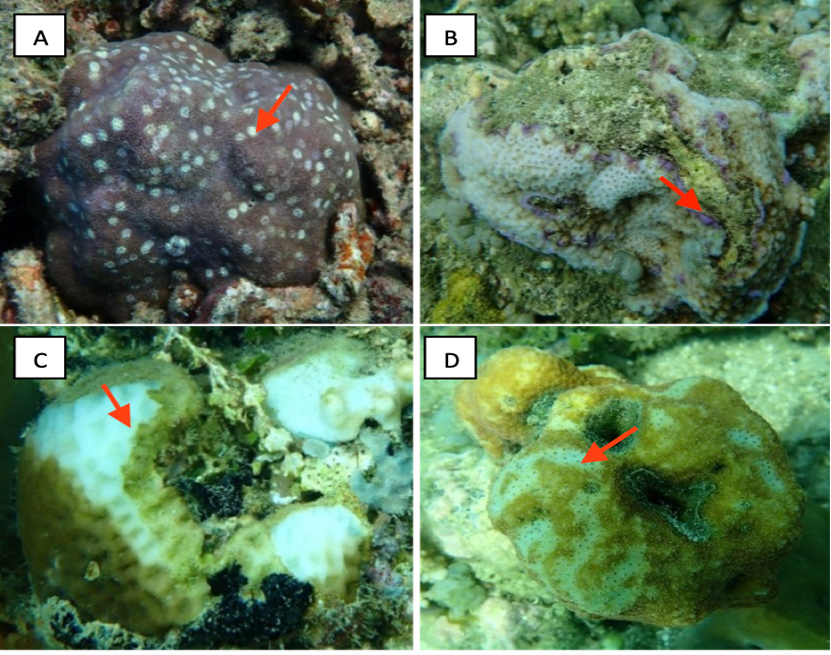
Coral disease is one of the major threats to coral mortality, leading to severe degradation of coral reef ecosystems. Several studies on coral disease have been conducted in Indonesia; however, coral disease prevalence in Lombok waters remains unknown. This study aims to identify coral diseases, quantify their prevalence, and examine their relationships with coral reef covers. Two data collection methods used were the belt transect method for coral disease observation and underwater photo transect for benthic substrate cover assessment. Four types of coral diseases were identified: ulcerative white spots (UWS), pigmentation response (PR), white syndrome (WS), and white pox (WP). Additionally, two types of coral health disorder caused by other organisms were found, namely coralliophila and tube formers. The overall coral disease prevalence was 10.2±0.18% (± SE), while coral health disorder prevalence reached 6.0±0.62%. Coral diseases were only found in the massive corals: Astreopora, Cyphastrea, Favia, Goniastrea, and Porites. The condition of coral reefs was classified as moderate (fair), and coral diseases were distributed homogenously among sites. There were neither significant correlation between coral reef covers and coral disease prevalence, nor between coral reef covers and coral health disorder prevalence. Coral disease prevalence was more related to sponges and soft corals covers, while coral health disorder prevalence was more closely related to hard corals and rubble covers. The results suggest that coral disease is concerning in Lombok waters, and regular long-term monitoring coral diseases is required to achieve the sustainable development goal life below water.
Full text article
References
Aeby, G. S., Williams, G. J., Franklin, E. C., Kenyon, J., Cox, E. F., Coles, S., & Work, T. M. (2011). Patterns of coral disease across the Hawaiian archipelago: relating disease to environment. PloS one, 6(5), e20370. https://doi.org/10.1371/journal.pone.0020370
Bachtiar, I. (2002). Promoting recruitment of scleractinian corals using artificial substrate in the Gili Indah, Lombok Barat, Indonesia. Proceedings of the Ninth International Coral Reef Symposium, Bali, July 2020, 1, 425–430.
Bachtiar, I. (2004). Status terumbu karang di Propinsi Nusa Tenggara Barat: sebuah kajian. Jurnal Biologi Tropis, 5(1), 1–9.
Bachtiar, I., & Hadi, T. A. (2019). Differential impacts of 2016 coral bleaching on coral reef benthic communities at Sekotong Bay, Lombok Barat, Indonesia. Biodiversitas Journal of Biological Diversity, 20(2), 570–575. https://doi.org/10.13057/BIODIV/D200237
Bachtiar, I., & Hotmariyah (2017). Management challenges of Marine Protected Areas in Indonesia: Case study of the Aquatic Recreation Park Gili Matra, District of Lombok Utara, Indonesia. Proceeding International Seminar on Integrated Coastal Management and Marine Biotechnology, IPB Bogor, November 2016, 61–67.
Barott, K., Smith, J., Dinsdale, E., Hatay, M., Sandin, S., & Rohwer, F. (2009). Hyperspectral and physiological analyses of coral-algal interactions. PloS one, 4(11), e8043. https://doi.org/10.1371/journal.pone.0008043
Burke, S., Pottier, P., Lagisz, M., Macartney, E. L., Ainsworth, T., Drobniak, S. M., & Nakagawa, S. (2023). The impact of rising temperatures on the prevalence of coral diseases and its predictability: A global meta‐analysis. Ecology Letters, 26(8), 1466-1481. https://doi.org/10.1111/ele.14266
Byrne, M., Clements, M., Kingsford, M., Foo, S. A., Ramjus, N., & Waller, A. (2025). Marine heatwave-driven mortality of bleached colonies of the massive coral Goniopora is exacerbated by a black band disease epizootic. Proceedings of the Royal Society B: Biological Sciences, 292(2060). https://doi.org/10.1098/RSPB.2025.1912/363970
Eaton, K. R., Banister, R. B., Arick, L. N., Hall, E. R., & Muller, E. M. (2025). Genotype and symbiont composition rather than environment influence susceptibility to stony coral tissue loss disease in coral restoration broodstock. Scientific Reports, 15, 44400. https://doi.org/10.1038/s41598-025-29292-9
Fitt, W. K. (2025). Bleaching and a corallivore of the coral Siderastrea radians in the Florida Keys. Journal of Marine Science and Engineering 2025, Vol. 13, Page 650, 13(4), 650. https://doi.org/10.3390/JMSE13040650
Ghafari, M. I. A. (2025). Evidence and impact of 2020 coral bleaching in West Lombok, Lesser Sunda Seascape, Indonesia. Journal of Marine Studies, 2203–2203. https://doi.org/10.29103/JOMS.V2I2.21520
Haapkylä, J., Melbourne-Thomas, J., Flavell, M., & Willis, B. L. (2010). Spatiotemporal patterns of coral disease prevalence on Heron Island, Great Barrier Reef, Australia. Coral Reefs, 29(4), 1035–1045. https://doi.org/10.1007/S00338-010-0660-Z
Haapkylä, J., Seymour, A. S., Trebilco, J., & Smith, D. (2007). Coral disease prevalence and coral health in the Wakatobi Marine Park, south-east Sulawesi, Indonesia. Journal of the Marine Biological Association of the United Kingdom, 87(2), 403–414. https://doi.org/10.1017/S0025315407055828
Haapkylä, J., Unsworth, R. K., Seymour, A. S., Melbourne-Thomas, J., Flavell, M., Willis, B. L., and Smith, D. J. (2009). Spatio-temporal coral disease dynamics in the Wakatobi Marine National Park, south-east Sulawesi, Indonesia. Diseases of Aquatic Organisms, 87(1-2), 105-115. https://doi.org/10.3354/dao02160
Harvell, D., Jordán-Dahlgren, E., Merkel, S., Rosenberg, E., & Raymundo, L. (2007). Coral disease, environmental drivers, and the balance between coral and microbial associates. Oceanography, 20(1), 172–195. https://doi.org/10.5670/OCEANOG.2007.91
Huda, F. M., Effendy, M., Insafitri, I., & Nugraha, W. A. (2018). Karakteristik penyakit White Band Disease dan White Syndrome secara visual dan histologi pada karang Acropora SP. Dari Pulau Gili Labak Sumenep Madura. Jurnal Ilmu dan Teknologi Kelautan Tropis, 10(3), 711–718. https://doi.org/10.29244/JITKT.V10I3.18382
Johan, O., & Idris. (2022). The abundance of coral disease and compromise health in Sabu Raijua Waters, East Nusa Tenggara. IOP Conference Series: Earth and Environmental Science, 967(1), 012020. https://doi.org/10.1088/1755-1315/967/1/012020
Johan, O., Kusumah, G., & Wisha, U.J. (2017). Kondisi terumbu karang di kawasan KALP Pantai Krakas, Lombok Utara. Jurnal Segara, 13(3), 193-200. https://doi.org/10.15578/SEGARA.V13I3
Kaczmarsky, L. T., Draud, M., & Williams, E. H. (2005). Is there a relationship between proximity to sewage effluent and the prevalence of coral disease. Caribbean Journal of Science, 41(1), 124-137.
Karim, W. (2019). Status of coral diseases and compromised health syndromes on Pemuteran shallow reefs, North Bali Island. In IOP Conference Series: Earth and Environmental Science (Vol. 236, No. 1, p. 012048). IOP Publishing. https://doi.org/10.1088/1755-1315/236/1/012048
Kohler, K. E., & Gill, S. M. (2006). Coral Point Count with Excel extensions (CPCe): A Visual Basic program for the determination of coral and substrate coverage using random point count methodology. Computers & Geosciences, 32(9), 1259–1269. https://doi.org/10.1016/J.CAGEO.2005.11.009
Muller, E. M., Raymundo, L. J., Willis, B. L., Haapkylä, J., Yusuf, S., Wilson, J. R., & Harvell, D. C. (2012). Coral health and disease in the Spermonde Archipelago and Wakatobi, Sulawesi. Journal of Indonesia Coral Reefs, 1(3), 147–159.
Myers, R. L., & Raymundo, L. J. (2009). Coral disease in Micronesian reefs: a link between disease prevalence and host abundance. Diseases of Aquatic Organisms, 87(1–2), 97–104. https://doi.org/10.3354/DAO02139
Page, C., & Willis, B. (2006). Distribution, host range and large-scale spatial variability in black band disease prevalence on the Great Barrier Reef, Australia. Diseases of Aquatic Organisms, 69(1), 41–51. https://doi.org/10.3354/DAO069041
Palmer, C. V., McGinty, E. S., Cummings, D. J., Smith, S. M., Bartels, E., & Mydlarz, L. D. (2011). Patterns of coral ecological immunology: variation in the responses of Caribbean corals to elevated temperature and a pathogen elicitor. Journal of Experimental Biology, 214(24), 4240–4249. https://doi.org/10.1242/JEB.061267
Pollock, F. J., Morris, P. J., Willis, B. L., & Bourne, D. G. (2011). The urgent need for robust coral disease diagnostics. PLOS Pathogens, 7(10), e1002183. https://doi.org/10.1371/JOURNAL.PPAT.1002183
Pribawastuti, V. B., Santanumurti, M. B., Jamal, M. T., El-Regal, M. A. A., Wijaya, Z. M., Farizky, H. S., Kusdawarti, R., Johan, O., Luthfi, O.M. & Sari, P. D. W. (2024). Coral black band disease in Indonesia: An overview. Egyptian Journal of Aquatic Research, 50(1), 103–109. https://doi.org/10.1016/J.EJAR.2024.03.005
Raymundo, L. J., Couch, C. S., Bruckner, A. W., Harvell, C. D., Work, T. M., Weil, E., Woodley, C. M., Jordan-Dahlgren, E., Willis, B. L., Sato, Y., & Aeby, G. S. (2008). Coral Disease Handbook Guidelines for Assessment, Monitoring & Management. St Lucia, The University of Queensland. www.gefcoral.org
Raymundo, L. J. H., Harvell, C. D., & Reynolds, T. L. (2003). Porites ulcerative white spot disease: description, prevalence, and host range of a new coral disease affecting Indo-Pacific reefs. Diseases of Aquatic Organisms, 56(2), 95–104. https://doi.org/10.3354/DAO056095
Raymundo, L. J., Resell, K. B., Reboton, C. T., & Kaczmarsky, L. (2005). Coral diseases on Philippine reefs: genus Porites is a dominant host. Diseases of Aquatic Organisms, 64(3), 181–191. https://doi.org/10.3354/DAO064181
Renzi, J. J., Shaver, E. C., Burkepile, D. E., & Silliman, B. R. (2022). The role of predators in coral disease dynamics. Coral Reefs, 41(2), 405–422. https://doi.org/10.1007/S00338-022-02219-W
Riegl, B., Bruckner, A., Coles, S. L., Renaud, P., & Dodge, R. E. (2009). Coral reefs: Threats and conservation in an era of global change. Annals of the New York Academy of Sciences, 1162(1), 136–186. https://doi.org/10.1111/J.1749-6632.2009.04493.X;ISSUE:ISSUE:DOI
Rotjan, R. D., & Lewis, S. M. (2008). Impact of coral predators on tropical reefs. Marine Ecology Progress Series, 367, 73–91. https://doi.org/10.2307/24872886
Ruiz-Moreno D, Willis BL, Page AC, Weil E, Croquer A, Vargas-Angel B, Jordan-Garza AG, Jordán-Dahlgren E, Raymundo L, Harvell CD (2012). Global coral disease prevalence associated with sea temperature anomalies and local factors. Diseases of Aquatic Organisms, 100, 249-261. https://doi.org/10.3354/dao02488
Sato, Y., Bourne, D. G., & Willis, B. L. (2009). Dynamics of seasonal outbreaks of black band disease in an assemblage of Montipora species at Pelorus Island (Great Barrier Reef, Australia). Proceedings of the Royal Society B: Biological Sciences, 276(1668), 2795–2803. https://doi.org/10.1098/RSPB.2009.0481
Smith, J.E., Shaw, M., Edwards, R.A., Obura, D., Pantos, O., Sala, E., Sandin, S.A., Smriga, S., Hatay, M. and Rohwer, F.L. (2006), Indirect effects of algae on coral: algae-mediated, microbe-induced coral mortality. Ecology Letters, 9, 835-845. https://doi.org/10.1111/j.1461-0248.2006.00937.x
Sussman, M., Willis, B. L., Victor, S., & Bourne, D. G. (2008). Coral pathogens identified for white syndrome (WS) epizootics in the Indo-Pacific. PLoS One, 3(6), e-2393. https://doi.org/10.1371/JOURNAL.PONE.0002393
Weil, E., & Cróquer, A. (2009). Spatial variability in distribution and prevalence of Caribbean scleractinian coral and octocoral diseases. I. Community-level analysis. Diseases of Aquatic Organisms, 83(3), 195–208. https://doi.org/10.3354/DAO02011
Widiastuti, W., Juliarta, I. W. G. K., & Kusuma, I. G. A. I. W. (2025). The state of coral reefs in the Gilimanuk Bay - West Bali National Park, Bali Island, Indonesia. Thalassas: An International Journal of Marine Sciences, 41(3), 148. https://doi.org/10.1007/S41208-025-00889-1
Wijayanti, D. P., Sabdono, A., Widyananto, P. A., Dirgantara, D., & Hidaka, M. (2018). Bacterial symbionts of acroporid corals: Antipathogenic potency against Black Band Disease. Biodiversitas Journal of Biological Diversity, 19(4), 1235–1242. https://doi.org/10.13057/BIODIV/D190408
Williams, G. J., Aeby, G. S., Cowie, R. O. M., & Davy, S. K. (2010). Predictive modeling of coral disease distribution within a reef system. PLoS One, 5(2), e9264. https://doi.org/10.1371/JOURNAL.PONE.0009264
Zakaria, I. J., Wulandari, A., & Febria, F. A. (2021). Diseases and health disturbances on scleractinian corals in the West Sumatra Sea, Indian Ocean. Aquaculture, Aquarium, Conservation & Legislation, 14(1), 462–477.
Zhang, F., Jia, X., Lin, Z., Jiang, Y., & Qu, M. (2023). The outbreak of Drupella snails and its catastrophic effects on coral reefs: a comprehensive review. Frontiers in Marine Science, 10, 1290001. https://doi.org/10.3389/FMARS.2023.1290001/TEXT
Authors
Copyright (c) 2026 Dr. Imam Bachtiar, Farrel Rizky Fahrezy, Dr. Nurliah Buhari

This work is licensed under a Creative Commons Attribution 4.0 International License.

This work is licensed under a Creative Commons Attribution 4.0 International License.
Jurnal Ilmu dan Teknologi Kelautan Tropis i is an open-access journal, meaning that all content is freely available without charge to the user or their institution. Users are allowed to read, download, copy, distribute, print, search, or link to the full texts of the articles in this journal without needing to request prior permission from the publisher or the author.
All articles published by Jurnal Ilmu dan Teknologi Kelautan Tropis are licensed under the Creative Commons Attribution 4.0 International License. This allows for unrestricted use, distribution, and reproduction in any medium, provided proper credit is given to the original authors.
Authors submitting manuscripts should understand and agree that the copyright of published manuscripts is retained by the authors. Copyright encompasses the exclusive rights of authors to reproduce, distribute, and sell any part of the journal articles in all forms and media. Reproduction of any part of this journal, its storage in databases, and its transmission by any form or media is allowed without written permission from Jurnal Ilmu dan Teknologi Kelautan Tropis.