Reef Fish Biodiversity and Behavior in The Seribu Islands of Jakarta, Indonesia
Article Sidebar
-
reef fish behavior, habitat utilization, reef fishes, Seribu Islands
Abstract
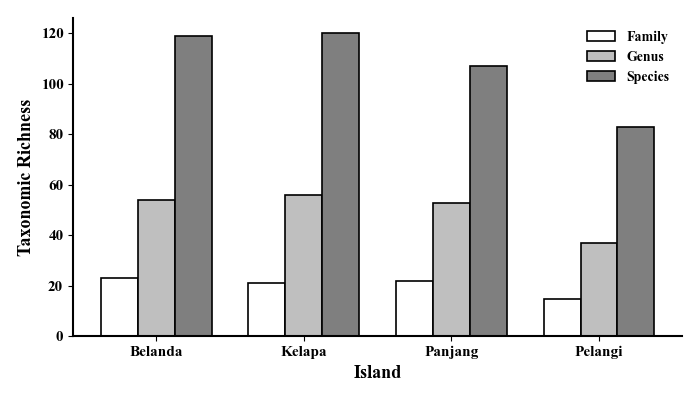
Coral reef ecosystems are centers of biodiversity with high productivity in tropical waters; however, information on reef fish communities and their behavioral interactions with coral colonies in the Seribu Islands remains limited. This study aimed to identify reef fish species, coral genera utilized by reef fishes, and variations in reef fish behavior associated with coral colony structures. An Underwater Video Survey (UVS) was conducted using systematic underwater video recordings at Panjang, Pelangi, Belanda, and Kelapa Islands, Jakarta, Indonesia. The Videos were analysed to identify reef fish species, coral genera, and behavioural patterns associated with coral colonies. A total of 215 reef fish species belonging to 82 genera and 29 families were identified across the study sites. Kelapa Island exhibited the highest species richness (120 species), followed by Belanda Island (119 species) and Panjang Island (107 species), while Pelangi Island showed the lowest richness (83 species). Sixteen coral genera were recorded, with Acropora and Porites being the most dominant and occurring at all study sites. In contrast, Cyhastrea, Echinophyllia, Echinopora, Monstastraea, Platygra, and Pocillopora were restricted to a single location. Acropora and Porites also supported the highest numbers of associated reef fish species. A total of 13 behavioural categories were observed. Feeding, roaming, and hovering were the dominant behaviours across all study sites, whereas cleaning, resting, ambush, and aggressive behaviours were less frequent. Variations in behavioural patterns among islands suggest that complexity influences both reef fish diversity and behavioural expression. These findings highlight the importance of structurally complex coral habitats in supporting reef fish diversity and ecological functions in the Seribu Islands.
Full text article
References
Akmal, K. F., Zuhairi, N. A., Muhaimin, Z. A., Waheed, Z., Hussein, M. A. S., Hoon, G. S., Kiu, Y. T., Hariz, K. H., Addin, M. M., & Oslan, S. N. H. (2025). Coral diversity and abundance patterns at the West Coast of Sabah: a case study of Kota Kinabalu coral reefs. In Community Ecology (Vol. 26, Issue 1). Springer International Publishing. https://doi.org/10.1007/s42974-024-00218-1
Baird, A. H., Bellwood, D. R., Connell, J. H., Cornell, H. V., Hughes, T. P., Karlson, R. H., Rosen, B. R., Briggs, J. C., Roberts, C. M., McClean, C. J., Veron, J. E. N., Hawkins, J. P., Allen, G. R., McAllister, D. E., Mittermeier, C. G., Schueler, F. W., Spalding, M., Wells, F., Vynne, C., & Werner, T. B. (2002). Coral reef biodiversity and conservation [2] (multiple letters). Science, 296(5570), 1026–1028. https://doi.org/10.1126/science.296.5570.1026
Barott, K. L., Venn, A. A., Perez, S. O., Tambutteeé, S., Tresguerres, M., & Somero, G. N. (2015). Coral host cells acidify symbiotic algal microenvironment to promote photosynthesis. Proceedings of the National Academy of Sciences of the United States of America, 112(2), 607–612. https://doi.org/10.1073/pnas.1413483112
Baum, G., Januar, H. I., Ferse, S. C. A., & Kunzmann, A. (2015). Local and regional impacts of pollution on coral reefs along the thousand islands north of the megacity Jakarta, Indonesia. PLoS ONE, 10(9), 1–26. https://doi.org/10.1371/journal.pone.0138271
Bos, A. R., & Hoeksema, B. W. (2015). Cryptobenthic fishes and co-inhabiting shrimps associated with the mushroom coral HelioFungia actiniformis (Fungiidae) in the Davao Gulf, Philippines. Environmental Biology of Fishes, 98(6), 1479–1489. https://doi.org/10.1007/s10641-014-0374-0
Bos, A. R., & Hoeksema, B. W. (2017). Mushroom corals (Fungiidae) in the Davao Gulf, Philippines, with records of associated fish and other cryptofauna. Raffles Bulletin of Zoology, 65(June), 198–206.
Brandl, S. J., Rasher, D. B., Côté, I. M., Casey, J. M., Darling, E. S., Lefcheck, J. S., & Duffy, J. E. (2019). Coral reef ecosystem functioning: eight core processes and the role of biodiversity. Frontiers in Ecology and the Environment, 17(8), 445–454. https://doi.org/10.1002/fee.2088
Brodnicke, O. B., Jensen, M. R., Thomsen, P. F., Brorly, T., Andersen, B. L., Knudsen, S. W., Præbel, K., Brandl, S. J., Sweet, M. J., Møller, P. R., & Worsaae, K. (2024). Field collections and environmental DNA surveys reveal topographic complexity of coral reefs as a predictor of cryptobenthic biodiversity across small spatial scales. Environmental DNA, 6(3), 1–15. https://doi.org/10.1002/edn3.545
Cleary, D. F. R., Polónia, A. R. M., Renema, W., Hoeksema, B. W., Rachello-Dolmen, P. G., Moolenbeek, R. G., Budiyanto, A., Yahmantoro, Tuti, Y., Giyanto, Draisma, S. G. A., Prud’homme van Reine, W. F., Hariyanto, R., Gittenberger, A., Rikoh, M. S., & de Voogd, N. J. (2016). Variation in the composition of corals, fishes, sponges, echinoderms, ascidians, molluscs, foraminifera and macroalgae across a pronounced in-to-offshore environmental gradient in the Jakarta Bay–Thousand Islands coral reef complex. Marine Pollution Bulletin, 110(2), 701–717. https://doi.org/10.1016/j.marpolbul.2016.04.042
Cook, D. T., Schmitt, R. J., Holbrook, S. J., & Moeller, H. V. (2024). Modeling the effects of selectively fishing key functional groups of herbivores on coral resilience. Ecosphere, 15(1), 1–14. https://doi.org/10.1002/ecs2.4749
González-Rivero, M., Harborne, A. R., Herrera-Reveles, A., Bozec, Y. M., Rogers, A., Friedman, A., Ganase, A., & Hoegh-Guldberg, O. (2017). Linking fishes to multiple metrics of coral reef structural complexity using three-dimensional technology. Scientific Reports, 7(1), 1–16. https://doi.org/10.1038/s41598-017-14272-5
Graham, N. A. J., & Nash, K. L. (2013). The importance of structural complexity in coral reef ecosystems. Coral Reefs, 32(2), 315–326. https://doi.org/10.1007/s00338-012-0984-y
Heery, E. C., Hoeksema, B. W., Browne, N. K., Reimer, J. D., Ang, P. O., Huang, D., Friess, D. A., Chou, L. M., Loke, L. H. L., Saksena-Taylor, P., Alsagoff, N., Yeemin, T., Sutthacheep, M., Vo, S. T., Bos, A. R., Gumanao, G. S., Syed Hussein, M. A., Waheed, Z., Lane, D. J. W., … Todd, P. A. (2018). Urban coral reefs: Degradation and resilience of hard coral assemblages in coastal cities of East and Southeast Asia. Marine Pollution Bulletin, 135(August), 654–681. https://doi.org/10.1016/j.marpolbul.2018.07.041
Holbrook, S. J., Schmitt, R. J., Messmer, V., Brooks, A. J., Srinivasan, M., Munday, P. L., & Jones, G. P. (2015). Reef fishes in biodiversity hotspots are at greatest risk from loss of coral species. PLoS ONE, 10(5), 1–12. https://doi.org/10.1371/journal.pone.0124054
Huang, L., McWilliam, M., Liu, C., Yu, X., Jiang, L., Zhang, C., Luo, Y., Yang, J., Yuan, X., Lian, J., & Huang, H. (2024). Loss of Coral Trait Diversity and Impacts on Reef Fish Assemblages on Recovering Reefs. Ecology and Evolution, 14(11), 1–13. https://doi.org/10.1002/ece3.70510
Hughes, T. P., Barnes, M. L., Bellwood, D. R., Cinner, J. E., Cumming, G. S., Jackson, J. B. C., Kleypas, J., Van De Leemput, I. A., Lough, J. M., Morrison, T. H., Palumbi, S. R., Van Nes, E. H., & Scheffer, M. (2017). Coral reefs in the Anthropocene. Nature, 546(7656), 82–90. https://doi.org/10.1038/nature22901
Isdianto, A., Ariefandi, M. F., Asadi, M. A., Yamindago, A., Setyawan, F. O., Bintoro, G., Setyanto, A., Lelono, T. D., Tumulyadi, A., Adhihapsari, W., Setyoningrum, D., Fathah, A. L., Putri, B. M., Supriyadi, & Luthfi, O. M. (2024). Community structure and biomass of reef fish concerning coral cover in Sempu Strait, East Java, Indonesia. Biodiversitas, 25(8), 3376–3385. https://doi.org/10.13057/biodiv/d250808
Jarriel, S. D., Formel, N., Ferguson, S. R., Jensen, F. H., Apprill, A., & Mooney, T. A. (2024). Unidentified fish sounds as indicators of coral reef health and comparison to other acoustic methods. Frontiers in Remote Sensing, 5(March), 1–14. https://doi.org/10.3389/frsen.2024.1338586
Johnson, J. V., Bruno, J. F., Le Gall, L., Doherty, M. L., Chequer, A., & Gringley, G. G. (2024). Creation of complex reef structures through coral restoration does not affect associated fish populations on a remote, well-protected, Caribbean reef. PeerJ, 12(8), 1–16. https://doi.org/10.7717/peerj.17855
Komyakova, V., Jones, G. P., & Munday, P. L. (2018). Strong effects of coral species on the diversity and structure of reef fish communities: A multi-scale analysis. PLoS ONE, 13(8), 1–20. https://doi.org/10.1371/journal.pone.0202206
LaJeunesse, T. C., Parkinson, J. E., Gabrielson, P. W., Jeong, H. J., Reimer, J. D., Voolstra, C. R., & Santos, S. R. (2018). Systematic Revision of Symbiodiniaceae Highlights the Antiquity and Diversity of Coral Endosymbionts. Current Biology, 28(16), 2570-2580.e6. https://doi.org/10.1016/j.cub.2018.07.008
MacDonald, C., Pinheiro, H. T., Shepherd, B., Phelps, T. A. Y., & Rocha, L. A. (2021). Disturbance and distribution gradients influence resource availability and feeding behaviours in corallivore fishes following a warm-water anomaly. Scientific Reports, 11(1), 1–12. https://doi.org/10.1038/s41598-021-03061-w
Madduppa, H. H., Zamani, N. P., Subhan, B., Aktani, U., & Ferse, S. C. A. (2014). Feeding behavior and diet of the eight-banded butterflyfish Chaetodon octofasciatus in the Thousand Islands, Indonesia. Environmental Biology of Fishes, 97(12), 1353–1365. https://doi.org/10.1007/s10641-014-0225-z
Madin, J. S., Anderson, K. D., Andreasen, M. H., Bridge, T. C. L., Cairns, S. D., Connolly, S. R., Darling, E. S., Diaz, M., Falster, D. S., Franklin, E. C., Gates, R. D., Harmer, A. M. T., Hoogenboom, M. O., Huang, D., Keith, S. A., Kosnik, M. A., Kuo, C. Y., Lough, J. M., Lovelock, C. E., … Baird, A. H. (2017). Corrigendum: The Coral Trait Database, a curated database of trait information for coral species from the global oceans. Scientific Data, 4, 170174. https://doi.org/10.1038/sdata.2017.174
McCarthy, O. S., Smith, J. E., Petrovic, V., & Sandin, S. A. (2022). Identifying the drivers of structural complexity on Hawaiian coral reefs. Marine Ecology Progress Series, 702, 71–86. https://doi.org/10.3354/meps14205
Mitchell, A., Hayes, C., Booth, D. J., & Nagelkerken, I. (2023). Projected ocean acidification and seasonal temperature alter the behaviour and growth of a range extending tropical fish. Coral Reefs, 42(4), 919–929. https://doi.org/10.1007/s00338-023-02396-2
Nash, K. L., Graham, N. A. J., Wilson, S. K., & Bellwood, D. R. (2013). Cross-scale Habitat Structure Drives Fish Body Size Distributions on Coral Reefs. Ecosystems, 16(3), 478–490. https://doi.org/10.1007/s10021-012-9625-0
Oh, D., Cresswell, A. K., Thomson, D. P., & Renton, M. (2025). Do greater coral cover and morphological diversity increase habitat complexity? Coral Reefs, 44(1), 257–272. https://doi.org/10.1007/s00338-024-02602-9
Prabowo, B., Fahlevy, K., Putra, N. F. D., Rizqydiani, M., Rahman, B. M. K., Habibie, A., Subhan, B., & Madduppa, H. (2019). Trophic structure of reef fishes and relationship of corallivore fishes with hard coral in Kepulauan Seribu, Jakarta. IOP Conference Series: Earth and Environmental Science, 278(1). https://doi.org/10.1088/1755-1315/278/1/012059
Priest, J., Ferreira, C. M., Munday, P. L., Roberts, A., Rodolfo-Metalpa, R., Rummer, J. L., Schunter, C., Ravasi, T., & Nagelkerken, I. (2024). Out of shape: Ocean acidification simplifies coral reef architecture and reshuffles fish assemblages. Journal of Animal Ecology, 93(8), 1097–1107. https://doi.org/10.1111/1365-2656.14127
Samoilys, M. A., Roche, R. C., Gudka, M., Thouless, C. J., Obura, D., Rowlands, S., Mbugua, J., & Osuka, K. (2025). Fish as indicators of coral reef ecosystem status. Ecological Indicators, 179(September), 114137. https://doi.org/10.1016/j.ecolind.2025.114137
Sani, L. M. I., Benyamin, A., Husna, A. K., Arafat, D., Subhan, B., Sunuddin, A., Cakasana, N., Lestari, D. F., & Madduppa, D. H. (2021). A CONTRAST PATTERN OF REEF FISH SPECIES DIVERSITY AND DISTRIBUTION USING ENVIRONMENTAL DNA (eDNA) METABARCODING IN LONGITUDINAL DISTANCE FROM JAKARTA BAY. Jurnal Ilmu Dan Teknologi Kelautan Tropis, 13(3), 469–484. https://doi.org/10.29244/jitkt.v13i3.37971
Sheppard, C. E., Williams, G. J., Exton, D. A., & Keith, S. A. (2023). Co-occurrence of herbivorous fish functional groups correlates with enhanced coral reef benthic state. Global Ecology and Biogeography, 32(3), 435–449. https://doi.org/10.1111/geb.13638
Smith, A. K., Cook, N., Songcuan, A., Brown, R. E., Molinaro, G., Saper, J., & Keane, K. (2024). Effectiveness of coral (Bilbunna) relocation as a mitigation strategy for pipeline construction at Hayman Island, Great Barrier Reef. Ecological Management and Restoration, 25(1), 21–31. https://doi.org/10.1111/emr.12590
Utami, D. A., Reuning, L., Konechnaya, O., & Schwarzbauer, J. (2021). Microplastics as a sedimentary component in reef systems: A case study from the Java Sea. Sedimentology, 68(6), 2270–2292. https://doi.org/10.1111/sed.12879
Wangpraseurt, D., Holm, J. B., Larkum, A. W. D., Pernice, M., Ralph, P. J., Suggett, D. J., & Kühl, M. (2017). In vivo microscale measurements of light and photosynthesis during coral bleaching: Evidence for the optical feedback loop? Frontiers in Microbiology, 8(JAN), 1–12. https://doi.org/10.3389/fmicb.2017.00059
Woodhead, A. J., Hicks, C. C., Norström, A. V., Williams, G. J., & Graham, N. A. J. (2019). Coral reef ecosystem services in the Anthropocene. Functional Ecology, 33(6), 1023–1034. https://doi.org/10.1111/1365-2435.13331
Authors
Copyright (c) 2026 ARTA SILABAN, Beginer Subhan

This work is licensed under a Creative Commons Attribution 4.0 International License.

This work is licensed under a Creative Commons Attribution 4.0 International License.
Jurnal Ilmu dan Teknologi Kelautan Tropis i is an open-access journal, meaning that all content is freely available without charge to the user or their institution. Users are allowed to read, download, copy, distribute, print, search, or link to the full texts of the articles in this journal without needing to request prior permission from the publisher or the author.
All articles published by Jurnal Ilmu dan Teknologi Kelautan Tropis are licensed under the Creative Commons Attribution 4.0 International License. This allows for unrestricted use, distribution, and reproduction in any medium, provided proper credit is given to the original authors.
Authors submitting manuscripts should understand and agree that the copyright of published manuscripts is retained by the authors. Copyright encompasses the exclusive rights of authors to reproduce, distribute, and sell any part of the journal articles in all forms and media. Reproduction of any part of this journal, its storage in databases, and its transmission by any form or media is allowed without written permission from Jurnal Ilmu dan Teknologi Kelautan Tropis.