About the Journal

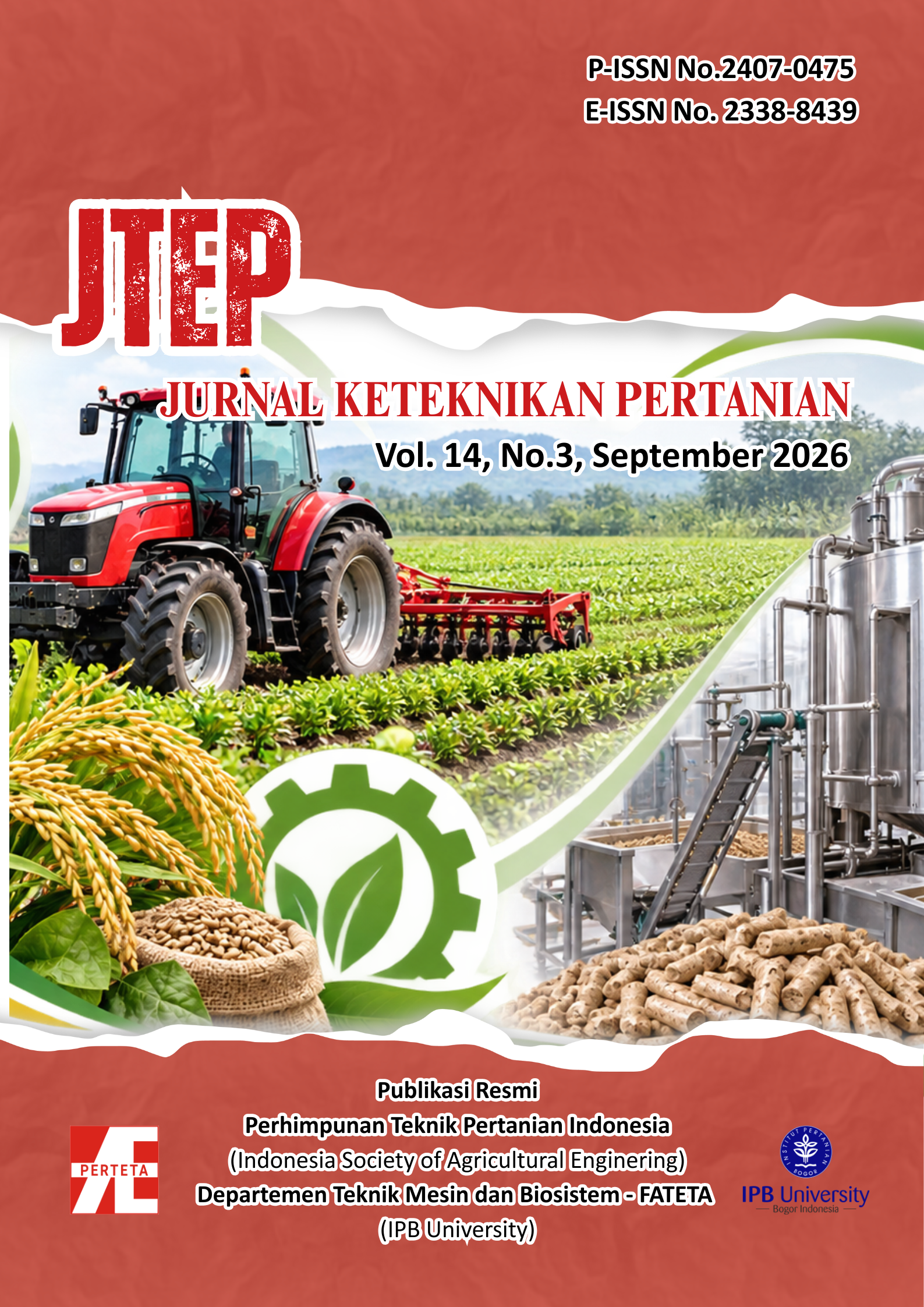
JTEP (Jurnal Keteknikan Pertanian) P-ISSN: 2407-0475 E-ISSN: 2338-8439, previously named Agricultural Engineering Bulletin, is an official publication of the Indonesian Society of Agricultural Engineers (ISAE) in collaboration with the Division of Biosystem Engineering, Faculty of Engineering and Technology, IPB University, formerly the Department of Mechanical and Biosystem Engineering, Faculty of Agricultural Technology and Engineering, Bogor Agricultural University. (The MoU can be downloaded here). JTEP starting in 2025 will be published four times a year in March, June, September, and December.

JTEP is a peer reviewed journal that has been accredited SINTA 2 by the Ministry of Research, Technology and Higher Education Number 177/E/KPT/2024 which is valid for 5 (five) years since volume 11 issue 2, 2023 to volume 16 issue 1, 2028. JTEP has been registered in Crossref, Indonesian Publication Index (IPI), Google Scholar, and other scientific databases

Focus and Scope

Jurnal Keteknikan Pertanian offers to publish original research articles, review articles and technical note, quarterly and integrates general engineering with applied agricultural, biological, environmental, food, and livestock systems to solve problems in developing countries. The journal aims to selectively publish highly notable original articles to advance and disseminate scientific and technical knowledge in the field of Agricultural and biosystems engineering. Jurnal Keteknikan Pertanian covers a wide range of topics related to the following categories: i) off-road machinery system engineering (including agricultural farm power and machinery, agricultural safety and health, agricultural and biosystems management, soil and terra-mechanics, and forest machinery), ii). agri-environmental system engineering and energy (including structure and facilities for living systems, indoor environmental control, farm structures and environment, livestock machinery, horticultural machinery, plant factory, and biomass/renewable energy), iii) agricultural process and food engineering (including postharvest technology, food quality and safety, and food processing and packaging), iv) information technology and electronics (including information and precision agriculture, instrumentation and controls, and robotics), and v). emerging technology related to smart farming, artificial intelligence, analysis and applications of big data, design, simulation and analysis in the field of agricultural and biosystem.

Open Access Policy

JTEP (Jurnal Keteknikan Pertanian) provides immediate open access to its content on the principle that making research freely available to the public supports a greater global exchange of knowledge.

JTEP follows the gold open access model, where all articles published in the journal are freely accessible to readers without any subscription or payment barriers. JTEP applies the  Creative Commons Attribution-ShareAlike 4.0 International License (CC BY-SA) where Authors and Readers can copy and redistribute the material in any medium or format, as well as remix, transform, and build upon the material for any purpose, but they must give appropriate credit (cite to the article or content), provide a link to the license, and indicate if changes were made. If you remix, transform, or build upon the material, you must distribute your contributions under the same license as the original.

Revenue Sources

This journal is funded from funds from the author-paid Article Processing Charge (APC).

Advertising and Direct Marketing Policy

Jurnal Keteknikan does not receive an advertisement.

Archiving Policy

JTEP uses a free utility called the Public Knowledge Project's (PKP) PN Archiving Plugin. By automatically uploading articles into the PKP PN Archiving Service, this plugin helps to widely distribute and preserve JTEP's scholarly materials, therefore facilitating the archiving process.

Repository Policy

JTEP has CC BY-SA or an equivalent license as the optimal license for the publication, distribution, use, and reuse of scholarly work.

Authors who publish with this journal agree to the following terms:

  • Authors are able to enter into separate, additional contractual arrangements for the non-exclusive distribution of the journal's published version of the work (e.g., post it to an institutional repository or publish it in a book), with an acknowledgment of its initial publication in this journal.
  • Authors are permitted and encouraged to post their work online (e.g., in institutional repositories or on their website) prior to and during the submission process, as it can lead to productive exchanges, as well as earlier and greater citation of published work (See The Effect of Open Access).

Generative AI Policy

  1. General Principles

JTEP (Jurnal Keteknikan Pertanian) recognizing the potential of Generative Artificial Intelligence (GenAI)—including Large Language Models (LLMs), automatic writing tools, and imaging models—as supporting tools in the academic process. However, GenAI is not a substitute for the intellectual capacity of the author and cannot be regarded as an entity that bears scientific responsibility. The use of GenAI must comply with academic integrity, transparency and scientific accuracy.

  1. Scope

This Gen AI policy applies to all parties involved in publishing, including authors, editors, reviewers, and all individuals participating in the publication of articles in JTEP (Jurnal Keteknikan Pertanian).

  1. GenAI Usage Limitations

The use of GenAI is permitted only as an auxiliary tool and not as a primary source of knowledge. The detailed provisions are as follows.

3.1 Allowed Uses of AI Tools

Writers can use GenAI to:

  • Language editing (grammar, writing style, summarization).
  • Drafting the initial outline of writing.
  • Assisted in formulating technical sentences without altering the scientific meaning.
  • Initial visualization (sketches and non-data illustrations).

3.2 Prohibited Use of AI Tools

Authors are prohibited from using GenAI to:

  • Producing primary scientific content (results, analysis, interpretation, and discussion).
  • Creation or modification of research data.
  • Generating unverified quotes, references or citations.
  • It produces images that appear to be based on empirical data.
  • The entire script was automatically written.

The content generated by GenAI should not be considered an academic reference.

  1. Mandatory Disclosure

All submitted manuscripts must include a statement regarding the use or non-use of generative AI and AI-assisted technologies in the writing process. This statement should be placed in a dedicated subsection titled “AI Writing Statement” after the Acknowledgements and before the Author Contributions section. The statement must include at least the following:

  • Type of GenAI tool used (e.g., ChatGPT, Gemini, Claude).
  • This section of the manuscript was assisted by GenAI.
  • Confirmation that the author has verified the accuracy of the entire output is required.

Example Format:

“The author used the Generative AI tool (ChatGPT, version xx) solely for language editing in the Introduction section. All analyses, data interpretations, and conclusions are the result of the author’s own thinking.”

Authors who do not disclose the use of GenAI will be considered to have committed a publication ethics violation.

  1. Ethical Responsibility

Authors who do not disclose the use of GenAI will be considered to have committed a publication ethics violation.

  1. Actions Against Violations

Policy violations will be subject to actions ranging from mandatory revisions, manuscript rejection, and article withdrawal if the violation is discovered after publication.

  1. Policy Revision

This policy will be updated periodically in accordance with technological developments and guidelines for scientific publication ethics.

The articles sent by the author - must be an original script and is not being considered for publication by other journal or publishers - should be written in accordance with the writing guidelines and submitted online via https://journal.ipb.ac.id/index.php/jtep. Editors can revise the paper without changing the substance and content after a blind review process.

For further information and correspondence, please contact the secretariate of Jurnal Keteknikan Pertanian, Division of Biosystem Engineering, Faculty of Engineering and Technology, IPB University, Kampus IPB Darmaga Kotak Pos 220, Bogor 16002; Phone: +62 251 8624503 Fax: +62 251 8623026; E-mail: jtep@apps.ipb.ac.id

Announcements

Announcement

2025-01-02

Announcement to author JTEP (Jurnal Keteknikan Pertanian).
Starting in 2025, Jurnal Keteknikan Pertanian will publish articles 4 times a year,  in March, June, September, and December. Your manuscript can be submitted via the link https://journal.ipb.ac.id/index.php/jtep/index.

Read more about Announcement

Current Issue

Vol. 14 No. 2 (2026): Jurnal Keteknikan Pertanian
					View Vol. 14 No. 2 (2026): Jurnal Keteknikan Pertanian
Published: 2026-06-11

Articles

View All Issues