
Soil Fertility Index on Rainfed and Irrigated Paddy Fields in Babat District, Lamongan
DOI:
https://doi.org/10.19028/jtep.014.3.335-363Keywords:
Soil Fertility Index, Soil Chemical Properties, Land Use, MappingAbstract
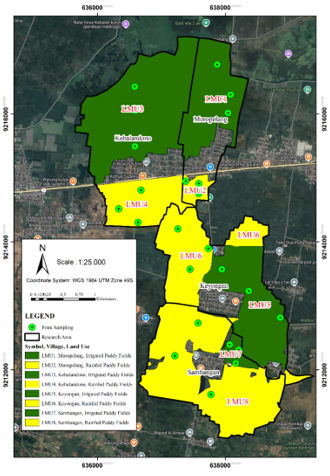
Fluctuations in agricultural production, arising from the lack of available soil fertility information have led to unsuitable land management practices. This study aims to state the chemical properties of soil as fertility indicators in Babat District, Lamongan and to compare fertility status between irrigated and rainfed paddy fields. In addition, this study aims to identify the values, classes and status of the soil fertility index within the study area. The study was conducted from February to June 2025 using a soil survey approach with purposive sampling across eight land mapping units (LMUs) with three field replicates per LMU at a depth 0-30 cm. Soil chemical properties analyzed included: Soil pH, OC, CEC, Total N, P available, K, Ca and Mg. The soil fertility index was calculated using scoring and weighting methods used, while differences between water management systems were assessed using an independent-samples t-test. The results state that the chemical soil properties at the research sites ranged from low to high criteria. Soil fertility index values ranged between 220 and 240, corresponding moderate to moderately high classes. T-test revealed no statistically significant differences in soil fertility index between irrigated and rainfed fields (p=0.55 > 0.05). Mg was the only parameter showing a statistically significant response to land management system (p=0.02 < 0.05) Given the limited sample size, these findings should be interpreted with caution and warrant further confirmation. These results suggest a need for increased organic matter inputs to improve soil fertility status in the study area.
Downloads
Downloads
Published
Issue
Section
License
Copyright (c) 2026 Muhammad Rizal Romadhon; Bambang Hermiyanto, Basuki

This work is licensed under a Creative Commons Attribution-ShareAlike 4.0 International License.
Authors submitting manuscripts should understand and agree that copyright of manuscripts of the article shall be assigned/transferred to Jurnal Keteknikan Pertanian. This work is licensed under a Creative Commons Attribution-ShareAlike 4.0 International License (CC BY-SA) where Authors and Readers can copy and redistribute the material in any medium or format, as well as remix, transform, and build upon the material for any purpose, but they must give appropriate credit (cite to the article or content), provide a link to the license, and indicate if changes were made. If you remix, transform, or build upon the material, you must distribute your contributions under the same license as the original.
Jurnal Keteknikan Pertanian is an open access journal.