
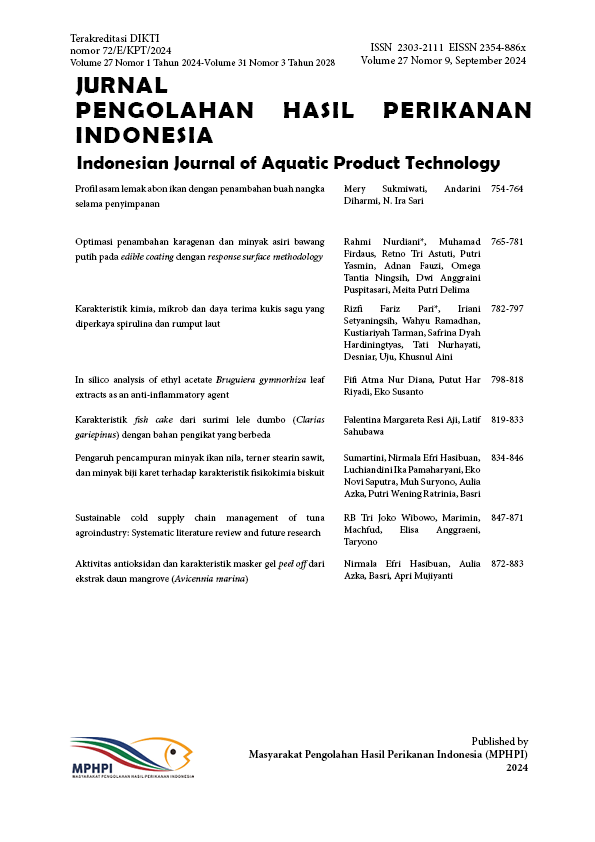
Optimasi penambahan karagenan dan minyak asiri bawang putih pada edible coating dengan response surface methodology Optimization of kappa carrageenan and garlic essential oil addition in edible coating using response surface methodology
Article Sidebar
-
amino acid, antioxidant, antimicrobe, gelatin, fish
Abstract
Protein-based edible coatings, such as gelatin, can help preserve product quality and extend shelf life while also serving as carriers for bioactive additives. The addition of kappa carrageenan enhanced the strength and stability of the coating, whereas garlic essential oil improved its antioxidant and antimicrobial properties through the presence of allicin and phenolic compounds. This study aimed to optimize the addition of carrageenan and garlic essential oils to produce edible coatings with optimal antioxidant and antimicrobial activities. The experimental method used Design Expert software version 13 with two factors: kappa carrageenan (0.7–1.3 g) and garlic essential oil (0.9–1.5 mL). Results showed that the best antioxidant and antimicrobial responses were obtained with 1.2 g of carrageenan and 1.4 mL of garlic essential oil, resulting in an antimicrobial response of 3.71 mm against Escherichia coli and 4.75 mm against Staphylococcus aureus, with an antioxidant activity of 57.5%. The highest amino acid content in catfish gelatin was glycine at 261,366.93 mg/kg, L-proline at 122,232.03 mg/kg, and L-arginine at 92,390.47 mg/kg. The addition of carrageenan and garlic essential oil enhances the antioxidant and antimicrobial activities of edible coatings, making them promising eco-friendly alternatives for active packaging.
Full text article
References
Abdelhedi, O., Salem, A., Nasri, R., Nasri, M., & Jridi, M. (2022). Food applications of bioactive marine gelatin films. Current Opinion in Food Science, 43, 206-215. https://doi.org/10.1016/j.cofs.2021.12.005. DOI: https://doi.org/10.1016/j.cofs.2021.12.005
Ahmad, T., Ismail, A., Ahmad, S. A., Khalil, K. A., Kumar, Y., Adeyemi, K. D., & Sazili, A. Q. (2017). Recent advances on the role of process variables affecting gelatin yield and characteristics with special reference to enzymatic extraction: A review. Food hydrocolloids, 63, 85-96. https://doi.org/10.1016/j.foodhyd.2016.08.007. DOI: https://doi.org/10.1016/j.foodhyd.2016.08.007
Asmawati, A., Fahrizal, F., Arpi, N., Amanatillah, D., & Husna, F. (2023). Yield, viscosity, and gel strength of gelatin from fish skin and bone. Aceh Journal of Animal Science, 8(3). https://doi.org/10.13170/ajas.8.3.33083.
Baliyan, S., Mukherjee, R., Priyadarshini, A., Vibhuti, A., Gupta, A., Pandey, R. P., & Chang, C. M. (2022). Determination of antioxidants by DPPH radical scavenging activity and quantitative phytochemical analysis of Ficus religiosa. Molecules, 27(4), 1326. https://doi.org/10.3390/molecules27041326. DOI: https://doi.org/10.3390/molecules27041326
Cao, W., Shi, L., Hao, G., Chen, J., & Weng, W. (2021). Effect of molecular weight on the emulsion properties of microfluidized gelatin hydrolysates. Food Hydrocolloids, 111, 106267, 1-9. https://doi.org/10.1016/j.foodhyd.2020.106267. DOI: https://doi.org/10.1016/j.foodhyd.2020.106267
Cavalieri, S. J. (Ed.). (2005). Manual of Antimicrobial Susceptibility Testing. American Society for Microbiology.
Chaudhari, A. K., Das, S., Dwivedi, A., & Dubey, N. K. (2023). Application of chitosan and other biopolymers based edible coatings containing essential oils as green and innovative strategy for preservation of perishable food products: A review. International Journal of Biological Macromolecules, 253, 127688. https://doi.org/10.1016/j.ijbiomac.2023.127688. DOI: https://doi.org/10.1016/j.ijbiomac.2023.127688
Dewinta, A. F., Susetya, I. E., Suriani, M., Addina, S., & Fadhilah, A. (2023). Alginate profile, antioxidant, and antibacterial activities of brown algae Sargassum cristaefolium from Pane Island, North Sumatera. Scientific Journal of Fisheries & Marine/Jurnal Ilmiah Perikanan dan Kelautan, 15(2), 331-345. http://doi.org/10.20473/jipk.v15i2.41621. DOI: https://doi.org/10.20473/jipk.v15i2.41621
Diah, A. W. M., Raihan, M. F., Rahmawati, S., Ningsih, P., & Nuryanti, S. (2022). The antioxidant activities of acid hydrolysis of κ-carrageenan. Rasayan Journal of Chemistry, 15(1). http://dx.doi.org/10.31788/RJC.2022.1516556. DOI: https://doi.org/10.31788/RJC.2022.1516556
Dwivany, F. M., Aprilyandi, A. N., Suendo, V., & Sukriandi, N. (2020). Carrageenan edible coating application prolongs Cavendish banana shelf life. International Journal of Food Science. https://doi.org/10.1155/2020/8861610. DOI: https://doi.org/10.1155/2020/8861610
Fahmi, Y. I., Andriana, A., & Hidayati, D. S. (2019). Uji daya hambat ekstrak bawang putih (Allium Sativum) terhadap bakteri (S. aureus). Jurnal Kedokteran, 4(2), 82-90. http://dx.doi.org/10.36679/kedokteran.v4i2.109. DOI: https://doi.org/10.36679/kedokteran.v4i2.109
Food and Agricultural Organization (FAO). (1990). The state of food and agriculture. Rome Italy.
Gelatin Manufactures Institute of America (GMIA). (2012). Gelatin Handbook. Gelita North America.
Ha, H. T., Cuong, D. X., Thuy, L. H., Thuan, P. T., Tuyen, D. T. T., Mo, V. T., & Dong, D. H. (2022). Carrageenan of red algae Eucheuma gelatinae: Extraction, antioxidant activity, rheology characteristics, and physicochemistry characterization. Molecules, 27(4), 1268. https://doi.org/10.3390/molecules27041268. DOI: https://doi.org/10.3390/molecules27041268
Hajlaoui, K., Abdelhedi, O., Salem, A., Debeaufort, F., Zouari, N., Zhang, Y., & Jridi, M. (2024). Food-grade gelatin from camel skin: Extraction, characterisation and potential use for thin film packaging preparation. Food Hydrocolloids, 150(10), 109698. https://doi.org/10.1016/j.foodhyd.2023.109698 DOI: https://doi.org/10.1016/j.foodhyd.2023.109698
Hasdar, M., & Rahmawati, Y. D. (2016). Nilai pH, titik leleh dan viskositas pada gelatin kulit domba asal brebes yang dikatalis berbagai konsentrasi NaOH. Parapemikir: Jurnal Ilmiah Farmasi, 5(2). https://doi.org/10.30591/pjif.v5i2.387. DOI: https://doi.org/10.30591/pjif.v5i2.387
Hido, F., Sompie, F., Pontoh, J. H. W., dan Lontaan, N. N. (2021). Pengaruh perbedaan suhu ekstraksi terhadap kekuatan gel, viskositas, dan rendemen gelatin ceker ayam kampung. Zootec, 41(2), 451-456. https://doi.org/10.35792/zot.41.2.2021.36587.
Hirbo, H. G., Kuse, K. A., & Alemu, A. D. (2023). Extraction and characterization of gelatin from Nile Tilapia (Oreochromis Niloticus) skin wastes generated in Arba Minch local fish processing industry and its value addition as stabilizer on yoghurt. Research Square, 1-36. https://doi.org/10.21203/rs.3.rs-2882193/v1. DOI: https://doi.org/10.21203/rs.3.rs-2882193/v1
Huang, L., Liu, Z., Wang, J., Fu, J., Jia, Y., Ji, L., & Wang, T. (2023). Bioactivity and health effects of garlic essential oil: A review. Food Science and Nutrition, 11(6), 2450-2470. https://doi.org/10.1002/fsn3.3253. DOI: https://doi.org/10.1002/fsn3.3253
James, J., Verma, M., & Sharma, N. (2023). Nanotechnology-driven improvisation of red algae-derived carrageenan for industrial and bio-medical applications. World Journal of Microbiology and Biotechnology, 40(1), 4. https://doi.org/10.1007/s11274-023-03787-x. DOI: https://doi.org/10.1007/s11274-023-03787-x
Jenita, L., & Wibisono, A. P. (2022). Utilization of waste from trimming process for the development of pangasius fish nugget. Canrea Journal: Food Technology, Nutritions, and Culinary Journal, 69-79. https://doi.org/10.20956/canrea.v5i1.513. DOI: https://doi.org/10.20956/canrea.v5i1.513
Karayannakidis, P. D., & Zotos, A. (2016). Fish processing by-products as a potential source of gelatin: A review. Journal of Aquatic Food Product Technology, 25(1), 65-92. https://doi.org/10.1080/10498850.2013.827767. DOI: https://doi.org/10.1080/10498850.2013.827767
Khairani, K., Busman., & Edrizal. (2017). Uji aktivitas antibakteri ekstrak jamur tiram purih (Pleurotus ostreatus) terhadap bakteri Streptococcus mutans penyebab karang gigi. Jurnal B-Dent, 4(2), 110-116. https://doi.org/10.33854/jbd.v4i2.102.g72. DOI: https://doi.org/10.33854/JBDjbd.102
Khalid, A., Ahmad, P., Uddin Khandaker, M., Modafer, Y., Almukhlifi, H. A., Bazaid, A. S., & Qanash, H. (2023). Biologically reduced zinc oxide nanosheets using Phyllanthus emblica plant extract for antibacterial and dye degradation studies. Journal of Chemistry, 1-10. https://doi.org/10.1155/2023/3971686. DOI: https://doi.org/10.1155/2023/3971686
Khambhaty, Y. (2020). Applications of enzymes in leather processing. Environmental Chemistry Letters, 18(3), 747-769. https://doi.org/10.1007/s10311-020-00971-5. DOI: https://doi.org/10.1007/s10311-020-00971-5
Kim, D. & Min S. C. (2012). Trout skin gelatin-based edible film development. Journal of Foos Science, 77(9), 1-7. https://doi.org/10.1111/j.1750-3841.2012.02880.x. DOI: https://doi.org/10.1111/j.1750-3841.2012.02880.x
Laga, S., Sutanto, S., Fatmawati., Halik, A., Sheyoputri, A. C.A. (2021). Penggunaan edible coating dalam pengawetan buah kelengkeng Dimocarpus longan lour. Jurnal Ilmiah Ecosystem, 21(2), 374-382. https://doi.org/10.35965/eco.v21i2.1126. DOI: https://doi.org/10.35965/eco.v21i2.1126
Liaqat, A., Zahoor, T., Atif Randhawa, M., & Shahid, M. (2019). Characterization and antimicrobial potential of bioactive components of sonicated extract from garlic (Allium sativum) against foodborne pathogens. Journal of Food Processing and Preservation, 43(5), e13936. https://doi.org/10.1111/jfpp.13936. DOI: https://doi.org/10.1111/jfpp.13936
Lu, Y., Luo, Q., Chu, Y., Tao, N., Deng, S., Wang, L. & Li, L. (2022). Application of gelatin in food packaging: A review. Polymers, 14(3), 436. https://doi.org/10.3390/polym14030436. DOI: https://doi.org/10.3390/polym14030436
Malik, G. K., Mitra, J., & Kaushal, M. (2023). Rheology of nano ZnO-Hydroxypropyl Methylcellulose (HPMC) based suspensions and structural properties of resulting films. Journal of Food Engineering, 337, 111187. https://doi.org/10.1016/j.jfoodeng.2022.111187. DOI: https://doi.org/10.1016/j.jfoodeng.2022.111187
Manzoor, A., Yousuf, B., Pandith, J. A., & Ahmad, S. (2023). Plant-derived active substances incorporated as antioxidant, antibacterial or antifungal components in coatings/films for food packaging applications. Food Bioscience, 102717. https://doi.org/10.1016/j.fbio.2023.102717. DOI: https://doi.org/10.1016/j.fbio.2023.102717
Masum, A. K. M., Zisu, B., Augustin, M. A., & Oliver, C. M. (2023). Use of milk proteins for encapsulation of food ingredients. In Microencapsulation in the Food Industry, 245-268. Academic Press. DOI: https://doi.org/10.1016/B978-0-12-821683-5.00029-7
Mouffok, A., Bellouche, D., Debbous, I., Anane, A., Khoualdia, Y., Boublia, A., & Benguerba, Y. (2023). Synergy of garlic extract and deep eutectic solvents as promising natural Antibiotics: Experimental and COSMO-RS. Journal of Molecular Liquids, 375, 121321. https://doi.org/10.1016/j.molliq.2023.121321. DOI: https://doi.org/10.1016/j.molliq.2023.121321
Muflih, M. H., & Syarifuddin, A. (2023). The effect of carrageenan-gluten ratio and garlic essential oil concentration on physical, mechanical, and antimicrobial properties of edible film. In IOP Conference Series: Earth and Environmental Science, 1230 (1): 012165. IOP Publishing. DOI: https://doi.org/10.1088/1755-1315/1230/1/012165
Munawaroh, H. S. H., Pratiwi, R. N., Gumilar, G. G., Aisyah, S., Rohilah, S., Nurjanah, A., & Show, P. L. (2023). Synthesis, modification and application of fish skin gelatin-based hydrogel as sustainable and versatile bioresource of antidiabetic peptide. International journal of biological macromolecules, 231, 123248. https://doi.org/10.1016/j.ijbiomac.2023.123248. DOI: https://doi.org/10.1016/j.ijbiomac.2023.123248
Nitsuwat, S., Zhang, P., Ng, K., & Fang, Z. (2021). Fish gelatin as an alternative to mammalian gelatin for food industry: A meta-analysis. Food Science and technology, 141, 110899. https://doi.org/10.1016/j.lwt.2021.110899. DOI: https://doi.org/10.1016/j.lwt.2021.110899
Nurdiani, R., Prihanto, A. A., Firdaus, M., Aini, F. N., Nabilah, F. A., Talib, R. A., & Huda, N. (2023). Physicochemical characteristics of Pangasius sp. skin-gelatin-based-edible film enriched with silver nanoparticles. F1000Research, 12(160), 160. https://doi.org/10.12688/f1000research.129024.1. DOI: https://doi.org/10.12688/f1000research.129024.1
Nurilmala, M., Jacoeb, A. M., Dzaky, R. H. (2018). Karakteristik gelatin kulit ikan tuna sirip kuning. Jurnal Pengolahan Hasil Perikanan Indonesia, 20(2), 339-350. http://dx.doi.org/10.17844/jphpi.v20i2.18049. DOI: https://doi.org/10.17844/jphpi.v20i2.18049
Nurilmala, M., Suryamarevita, H., Hizbullah, H. H., Jacoeb, A. M., & Ochiai, Y. (2022). Fish skin as a biomaterial for halal collagen and gelatin. Saudi Journal of Biological Sciences, 29(2), 1100-1110. https://doi.org/10.1016/j.sjbs.2021.09.056. DOI: https://doi.org/10.1016/j.sjbs.2021.09.056
Nurjanah, N., Aprilia, B. E., Fransiskayana, A., Rahmawati, M., & Nurhayati, T. (2018). Senyawa bioaktif rumput laut dan ampas teh sebagai antibakteri dalam formula masker wajah. Jurnal Pengolahan Hasil Perikanan Indonesia, 21(2), 304-316. https://doi.org/10.17844/jphpi.v21i2.23086. DOI: https://doi.org/10.17844/jphpi.v21i2.23086
Prihanto, A. A., Nurdiani, R., & Bagus, A. D. (2019). Production and characteristics of fish protein hydrolysate from parrotfish (Chlorurus sordidus) head. PeerJ, 7, e8297. https://doi.org/10.7717/peerj.8297. DOI: https://doi.org/10.7717/peerj.8297
Ramli, N. A., Adam, F., Mohd Amin, K. N., Abu Bakar, N. F., & Ries, M. E. (2022). Mechanical and thermal evaluation of Carrageenan/hydroxypropyl methyl cellulose biocomposite incorporated with modified starch corroborated by molecular interaction recognition. ACS Applied Polymer Materials, 5(1), 182-192. https://doi.org/10.1021/acsapm.2c01426 DOI: https://doi.org/10.1021/acsapm.2c01426
Rawat, R., & Saini, C. S. (2024). A novel biopolymeric composite edible film based on sunnhemp protein isolate and potato starch incorporated with clove oil: fabrication, characterization, and amino acid composition. International Journal of Biological Macromolecules, 268(2), 131940. https://doi.org/10.1016/j.ijbiomac.2024.131940 DOI: https://doi.org/10.1016/j.ijbiomac.2024.131940
Sahraee, S., Milani, J. M., Regenstein, J. M., & Kafil, H. S. (2019). Protection of foods against oxidative deterioration using edible films and coatings: A review. Food Bioscience, 32, 100451. https://doi.org/10.1016/j.fbio.2019.100451. DOI: https://doi.org/10.1016/j.fbio.2019.100451
Saputra, R. H., Widiastuti, I., Supriadi, A. (2015). Karakteristik fisik dan kimia gelatin kulit ikan patin (Pangasius pangasius) dengan kombinasi berbagai asam dan suhu. Jurnal Teknologi Hasil Perikanan, 4(1), 29-36. https://doi.org/10.36706/fishtech.v4i1.3496. DOI: https://doi.org/10.36706/fishtech.v4i1.3496
Setyaji, A., Wijayanti, I., & Romadhon, R. (2018). Effect of carrageenan addition to the edible characteristics of tilapia skin gelatin film (Oreochromis niloticus). Jurnal Ilmu Pangan dan Hasil Pertanian, 2(2), 134-145. https://doi.org/10.26877/jiphp.v2i2.3133. DOI: https://doi.org/10.26877/jiphp.v2i2.3133
Siburian, W. Z., Rochima, E., Andriani, Y., & Praseptiangga, D. (2020). Fish gelatin (definition, manufacture, analysis of quality characteristics, and application): A review. International Journal of Fisheries and Aquatic Studies, 8(4), 90-95.
Subramaniam, S. D., Ungka, M. L. A., Hao, T. J., Rahimi, N. A. S., Zakaria, L. M., & Azman, N. A. M. (2023). Semi refined carrageenan-nanocomposite film incorporated with Bentong ginger extracts for active food packaging: synthesis and characterization. Materials Today: Proceedings. https://doi.org/10.1016/j.matpr.2023.08.007. DOI: https://doi.org/10.1016/j.matpr.2023.08.007
Supriwanti, S., Warsidah, W., & Prayitno, D. I. (2023). Characterization of seaweed caragenan Eucheuma cottonii and its aplication as edible coating. Berkala Saintek, 11(2), 114-120. https://doi.org/10.19184/bst.v11i2.33865. DOI: https://doi.org/10.19184/bst.v11i2.33865
Tamal, M.A., Prabandari, A. (2017). Pengaruh Ekstrak Bawang Putih dan formalin dalam menghambat pertumbuhan bakteri salmonella pada bakso sapi pada lama penyimpanan yang berbeda. Jurnal JPT Stiper Kutim, 15-27. https://doi.org/10.36084/jpt..v1i1.14.
Tamba, N. F., Restuhadi, F., Efendi, R. (2022). Penambahan minyak asiri rimpang lengkuas merah pada edible coating taipioka terhadap mutu bakso ayam selama penyimpanan dingin. Journal Agritech, 21(2), 1-11. DOI: https://doi.org/10.31258/sagu.21.2.p.43-53
Tang, Q., Tan, P., Ma, N., & Ma, X. (2021). Physiological functions of threonine in animals: beyond nutrition metabolism. Nutrients, 13(8). https://doi.org/10.3390/nu13082592 DOI: https://doi.org/10.3390/nu13082592
Umaraw, P., Munekata, P. E., Verma, A. K., Barba, F. J., Singh, V. P., Kumar, P., & Lorenzo, J. M. (2020). Edible films/coating with tailored properties for active packaging of meat, fish and derived products. Trends in Food Science & Technology, 98, 10-24. https://doi.org/10.1016/j.tifs.2020.01.032. DOI: https://doi.org/10.1016/j.tifs.2020.01.032
Umboro, R. O., & Yanti, N. K. W. (2020). Uji efektivitas antioksidant (IC50) dan toksisitas akut (LD50) fraksi etanol daun nangka (Artocarpus heterophyllus Lam.). JUPE: Jurnal Pendidikan Mandala, 5(6). http://dx.doi.org/10.58258/jupe.v5i6.2349. DOI: https://doi.org/10.58258/jupe.v5i6.2349
Valcarcel, J., Hermida-Merino, C., Piñeiro, M. M., Hermida-Merino, D., & Vázquez, J. A. (2021). Extraction and characterization of gelatin from skin by-products of seabream, seabass and rainbow trout reared in aquaculture. International Journal of Molecular Sciences, 22(22), 12104. https://doi.org/10.3390/ijms222212104. DOI: https://doi.org/10.3390/ijms222212104
Wu, G. (2010). Functional amino acids in growth. Advances in Nutrition, 1(4), 31–37. https://doi.org/10.3945/an.110.1008.1 DOI: https://doi.org/10.3945/an.110.1008
Yandriani dan Jannah, A. M. (2022). Karakterisasi edible film kulit durian dengan penambahan antibakteri dari ekstrak bawang putih. Jurnal Teknik Kimia, 27(1), 10-19. https://doi.org/10.36706/jtk.v28i1.949. DOI: https://doi.org/10.36706/jtk.v28i1.949
Yasin, G., Jasim, S. A., Mahmudiono, T., Al-Shawi, S. G., Shichiyakh, R. A., Shoukat, S., & Fenjan, M. (2022). Investigating the effect of garlic (Allium sativum) essential oil on foodborne pathogenic microorganisms. Food Science and Technology, 42, e03822. https://doi.org/10.1590/fst.03822. DOI: https://doi.org/10.1590/fst.03822
Yu, D., Zhao, W., Dong, J., Zang, J., Regenstein, J. M., Jiang, Q., & Xia, W. (2022). Multifunctional bioactive coatings based on water-soluble chitosan with pomegranate peel extract for fish flesh preservation. Food Chemistry, 374, 131619. https://doi.org/10.1016/j.foodchem.2021.131619. DOI: https://doi.org/10.1016/j.foodchem.2021.131619
Authors
Authors who publish with this journal agree to the following terms:
- Authors retain copyright and grant the journal right of first publication with the work simultaneously licensed under a Creative Commons Attribution License that allows others to share the work with an acknowledgement of the work's authorship and initial publication in this journal.
- Authors are able to enter into separate, additional contractual arrangements for the non-exclusive distribution of the journal's published version of the work (e.g., post it to an institutional repository or publish it in a book), with an acknowledgement of its initial publication in this journal.
Article Details
How to Cite



