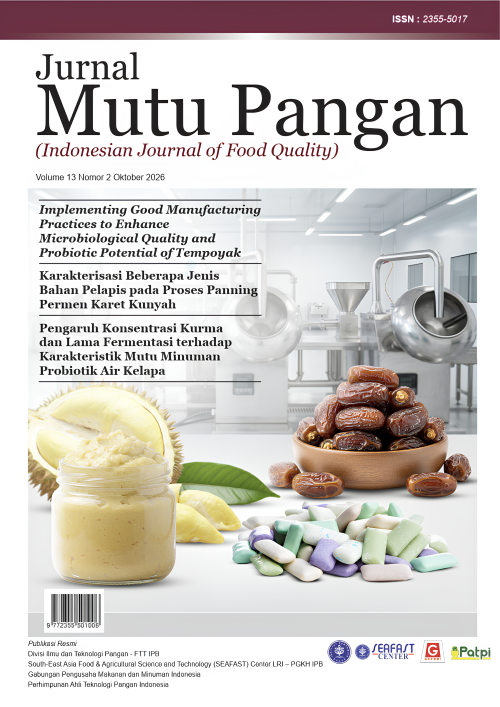
Implementing Good Hygiene Practices to Enhance Microbiological Quality and Probiotic Potential of Tempoyak
DOI:
https://doi.org/10.29244/jmpi.2026.13.2.127Keywords:
Durian, Fermented durian flesh, food safety, lactic acid bacteria, probioticAbstract
Tempoyak, a traditional fermented durian flesh product from Indonesia and Malaysia, is rich in phenolic bioactive compounds and lactic acid bacteria (LAB), including Fructobacillus durionis and Lactobacillus plantarum, which are associated with gut health, immune support, and anti-inflammatory activity. This study developed Good Hygiene Practices (GHP) for tempoyak production by observing and interviewing household tempoyak producers in Samarinda City and adapting their production method into a more hygienic laboratory process. GHP-produced tempoyak were made by fermenting ripe durian flesh with 1% or 2% salt and 1% sugar under anaerobic conditions in sterile containers at room temperature. The microbiological quality of the GHP-produced tempoyak was then compared to commercially available household-produced tempoyak. The results showed that tempoyak produced with the higher salt concentration (2%) had total LAB counts that met functional food standards, reaching 8.77 and 8.76 log CFU/g in GHP-produced and household-produced tempoyak, respectively. The developed GHP effectively eliminated contamination by pathogenic bacteria, including Vibrio cholerae and Salmonella spp., both of which were detected in the commercial tempoyak samples. These findings indicate that the developed GHP for tempoyak production can improve microbiological safety while maintaining the probiotic potential of tempoyak as a functional food.
Downloads
References
Anal AK. 2019. Quality ingredients and safety concerns for traditional fermented foods and beverages from Asia: A review. Fermentation. 5 (1): 1–12. doi:10.3390/fermentation5010008
Anggadhania L, Setiarto RHB, Yusuf D, Anshory L, Royyani MF. 2023b. Exploring tempoyak, fermented durian paste, a traditional Indonesian indigenous fermented food: typical of Malay tribe. J Ethnic Foods. 10 (1). doi:10.1186/s42779-023-00206-2
Ardilla YA, Anggreini KW, Rahmani TPD. 2022. The role of indigenous lactic acid Bacteria Genus Lactobacillus in the fermentation process of Durian (Durio zibethinus) for tempoyak production. Berkala Ilmiah Biologi. 13 (2): 42–52. doi:10.22146/bib.v13i2.4619
Astawan M, Wulandari N, Muhandri T, Mahdi SA. 2024 Agustus 05. Formulasi dan metode pembuatan serbuk minuman berbasis tepung tempe. Paten Indonesia.
Axelsson L, Bjerke GA, McLeod A, Berget I, Holck AL. 2020. Growth behavior of Listeria mono-cytogenes in a traditional norwegian fermented fish product (Rakfisk), and its inhibition through bacteriophage addition. Foods. 9 (2). doi: 10.3390/foods9020119
Blanchfield JR. 2005. Good manufacturing practice (GMP) in the food industry. Lelieveld HLM, Mostert MA, Holah J, editors. Handbook of Hygiene Control in the Food Industry. United Kingdom: Woodhead Publishing Limited. Pp. 324–347.
Borresen EC, Henderson AJ, Kumar A, Weir TL, Ryan EP. 2016. Fermented foods: Patented approaches and formulations for nutritional supplementation and health promotion. Recent Pat Food Nutr Agric. 12 (2): 263–266. doi: 10.2174/221279841120402 0134
Candra KP, Ningsih RS, Agustin S, Putri EM. 2019. Assessment of rhodamine B, microbiological quality and sanitation of street-vended food-snack around elementary school in Samarinda, Indonesia: Lesson to promote food safety in school environment. J Nutr Food Research. 42 (2): 49–56. doi:10.22435/pgm.v42i2.2372
CHROMagar. 2024a. CHROMagar Salmonella Plus. LF-EXT-016 Version 80. France. [accessed 2024 Nov 22]. https://www.chromagar.com/wp-conten t/uploads/2021/11/LF-EXT-016-V8.0.pdf.
CHROMagar. 2024b. CHROMagar Vibrio. LF-EXT-008 Version 70. France. [accessed 2024 Nov 22]. https://www.chromagar.com/wp-content/uploads/ 2021/11/LF-EXT-016-V8.0.pdf.
Chuah LO, Shamila-Syuhada AK, Liong MT, Rosma A, Thong KL, Rusul G. 2016. Physio-chemical, microbiological properties of tempoyak and molecular characterisation of lactic acid bacteria isolated from tempoyak. Food Microbiology. 58: 95–104. doi:10.1016/j.fm.2016.04.002
De Oliveira CAF, Da Cruz AG, Tavolaro P, Corassin CH. 2016. Food safety: Good Manufacturing Practices (GMP), Sanitation Standard Operating Procedures (SSOP), Hazard Analysis and Critical Control Point (HACCP). Barros-Velázquez J, editor. Antimicrobial Food Packaging. Academic Press. pp. 129–139.
Erkmen O. 2016. Microbiological Analysis of Foods and Food Processing Environments. Volume 6. Inggris: Academic Press.
Fatimah NA, Sofiana H, Purwandari H, Nurhayati R. 2023. Occupational health and safety knowledge correlated with the use of PPE among home industry furniture workers in the production process. J Ners dan Kebidanan. 10 (3): 368–373. doi:10.26699/jnk.v10i3.ART.p359-364
Feitosa JG, Andrade PL. 2022. Segurança dos alimentos e ferramentas da qualidade. Enciclo-pédia Biosfera. 19 (39): 5–19. doi:10.18677/EnciBio_2022A21
Finnegan Y, Krzyaniak S-A. 2024. Clean labels in the food industry: Regulatory considerations and challenges in balancing consumer. Food Sci Nutr Cases. doi:10.1079/fsncases.2024.0017
Geronikou A, Srimahaeak T, Rantsiou K, f G, Larsen N, Jespersen L. 2020. Occurrence of yeasts in white-brined cheeses: Methodologies for identification, spoilage potential and good manufacturing practices. Frontiers in Microbiology. 11: 1–21. doi:10.3389/fmicb.2020.582778
Holck A, Axelsson L, McLeod A, Rode TM, Heir E. 2017. Health and safety considerations of fermented sausages. J Food Qual. 25. doi: 10.1155/2017/9753894
Hong G, Lee S, Park E, Park K. 2021. Changes in microbial community by salt content in kimchi during fermentation. J Korean Soc of Food Sci Nutr. 50 (6): 648–653. doi:10.3746/jkfn.2021.5 0.6.648
Lamba J, Goomer S, Saxena SK. 2019. Study the lactic acid bacteria content in traditional fermented Indian drink: Kanji. Int J Gastron Food Sci. 16: 100143. doi:10.1016/j.ijgfs.2019.100143
Leisner JJ, Vancanneyt M, Rusul G, Pot B, Lefebvre K, Fresi A, Tee LK. 2001a. Identification of lactic acid bacteria constituting the predominating microflora in an acid-fermented condiment (tempoyak) popular in Malaysia. Int J Food Microbiol. 63 (1–2): 149–157. doi:10.1016/S0168-1605(00)00476-1
Liu X, Ma J, Fan G. 2023. Microbiological safety and quality of fermented products. Foods. 12 (11): 3–8. doi:10.3390/foods12112204
Lou Z, Almarshad A, Xie C, Ye S, Dong C, Ahmadi F, Suleria HAR. 2026. Exploring the polyphenolic profile and antioxidant potential of three durian (Durio zibethinus M.) cultivars. Int J Food Sci Technol. 61 (1). doi:10.1093/ijfood/vvaf234
Manurung H, Susanto D, Kusumawati E, Aryani R, Nugroho RA, Kusuma R, Rahmawati Z, Sari RD. 2022. Phytochemical, GC-MS analysis and antioxidant activities of leaf methanolic extract of Lai (Durio kutejensis), the endemic plant of Kalimantan, Indonesia. Biodivers J Biological Divesity. 23 (11): 5566–5573. doi:10.13057/biodiv/d231104
Marwati, Ave Maria Funan S, Rachmawati M, Emmawati A, Rohmah M, Sholeh Pujokaroni A, Agus Prayitno Y, Hamka. 2024. Respon sensorik tempoyak durian lai dan potensinya sebagai makanan fungsional. Buletin LOUPE. 20 (1): 1–6. doi:10.51967/buletinloupe.v20i01.2999
Muoneke CJ, Nwachukwu AA, Okoye AI. 2021. Food poisoning from local food processing methods: A review. Eur J Nutr Food Saf. 13 (5): 35–44. doi:10.9734/ejnfs/2021/v13i530417
Nurita SR, Perwitasari T, Julaecha J, Nurfitriani N. 2023. The influence of health education on the knowledge, attitudes and perceptions of breast-feeding mothers regarding tempoyak as a source of probiotics for maternal and child health. J Akademika Baiturrahim Jambi. 12 (2): 485–494. doi:10.36565/jab.v12i2.767
Ojo AO, de Smidt O. 2023. Lactic acid: A comprehensive review of production to purification. Processes. 11: 688. doi:10.3390/pr11030688
Okorie PC, Olasupo NA, Anike FN, Elemo GN, Isikhuemhen OS. 2017. Incidence of enteric pathogens in ugba, a traditional fermented food from african oil bean seeds (Pentaclethra macrophylla). Int J Food Contam. 4 (12). doi:10.1186/s40550-017-0057-7
Panghal A, Chhikara N, Sindhu N, Jaglan S. 2018. Role of food safety management systems in safe food production: A review. J of Food Safety. 38 (4): e12464. doi:10.1111/jfs.12464
Pop OL, Ciont C, Gabianelli R, Coldea TE, Pop CR, Mudura E, Min T, Rangnoi K, Yamabhai M, Vlaic R, Mureșan C, Suharoschi R. 2024. Deciphering contaminants and toxins in fermented food for enhanced human health safeguarding. Food Sci Food Saf. 23: 36. doi:10.1111/1541-4337.13428
Rajagukguk YV, Arnold M. 2021. Tempoyak: Fermented durian paste of Malay ethnic and its functional properties. Int J Gastron Food Sci. 23. doi:10.1016/j.ijgfs.2020.100297
Ramos CL, Bressani AP, Batista NN, Martinez SJ, Dias DR, Schwan RF. 2023. Indigenous fermented foods: nutritional and safety aspects. Curr Opin Food Sci. 53: 101075. doi:10.1016/j.cofs.2023.101075
Raquel de Pinho Ferreira Guiné, Silva ACF. 2016. Probiotics, prebiotics and synbiotics. Nelson DL, editor. Functional Foods: Sources, Health Effects and Future Perspectives. New York: Nova Science Publishers. pp. 43–107.
Salleh F, Lani MN, Ismail N. 2014. Antimicrobial activity of cell free supernatant of lactic acid bacteria isolated from fermented durian flesh against multiple antibiotic resistance’s Salmonella associated with food poisoning cases in Malaysia. Int J Pharm Biol Sci. 9 (6): 60–65. doi:10.9790/3008-09646065
Sheldon LK. 2019. The importance of PPE use. Am J Nurse. 119 (4): 10. doi:10.1097/01.NAJ.0000554528.24998.76
Siddiqui SA, Erol Z, Rugji J, Taşçı F, Kahraman HA, Toppi V, Musa L, Di Giacinto G, Bahmid NA, Mehdizadeh M, Castro-Muñoz R. 2023. An overview of fermentation in the food industry - looking back from a new perspective. Bioresour Bioprocess. 10 (85): 1–47. doi:10.1186/s40643-023-00702-y
Skowron K, Budzyńska A, Grudlewska-Buda K, Wiktorczyk-Kapischke N, Andrzejewska M, Wałecka-Zacharska E, Gospodarek-Komkowska E. 2022. Two faces of fermented foods—The benefits and threats of its consumption. Front Microbiol. 13: 1–17. doi:10.3389/fmicb.2022.84 5166
Sookhtanlou M, Allahyari MS. 2021. Farmers’ health risk and the use of personal protective equipment (PPE) during pesticide application. Environ Sci Pollut Res Int. 28: 28168–28178. doi:10.1007/s11356-021-12502-y
Sunaryo W, Pranoto H, Nurhasanah, Rahman. 2019. Interspecific grafting to solve the rootstock shortage in vegetative propagation of Lai-durian (Durio zibethinus × kutejensis) originated from East Kalimantan. Aust J Crop Sci. 13 (4): 642–648. doi:10.21475/ajcs.19.13.04.p1845
Tamang JP, Cotter PD, Endo A, Han NS, Kort R, Liu SQ, Mayo B, Westerik N, Hutkins R. 2020. Fermented foods in a global age: East meets West. Compr Rev Food Sci Food Saf. 19 (1): 184–217. doi:10.1111/1541-4337.12520
Tamang JP, Shin D, Jung S, Chae S. 2016. Functional properties of microorganisms in fermented foods. Front Microbiol. 7: 578. doi:10.3389/fmicb.2016.00578
Tategaki A, Murakami H. 2019 February 14. Fermented food composition production method. United States Patent Application Publication.
Tran HK, Nguyen NPN, Nguyen TTT, Nguyen KN, Do BD, Nguyen TVA, Tran AK, Nguyen TKC, Ho QT, Truong DH, Barrow CJ, Nguyen HC. 2024. Extraction of flavonoids from durian (Durio zibethinus) fruit rinds and evaluation of their antioxidant, anti-diabetic and anticancer properties. Int J Food Sci Technol. 59 (3): 1409–1420. doi:10.1111/ijfs.16 886
Vukicevic AM, Djapan M, Isailovic V, Milasinovic D. 2022. Generic compliance of industrial PPE by using deep learning techniques. Saf Sci. 148:105646. doi:10.1016/j.ssci.2021.105646
Wijayanti W, Rosalina D, Dahlan A. 2026. Karakteristik mikrobiologi dan pH tempoyak asal pasar tradisional di Kota Palembang. J Sains dan Teknologi Pangan. 11 (1): 177–185. doi:10.63071/jct98s63
Downloads
Published
Issue
Section
License
Copyright (c) 2026 Marwati, Krishna Purnawan Candra, Aswita Emmawati, Miftakhur Rohmah, Yuliani

This work is licensed under a Creative Commons Attribution-ShareAlike 4.0 International License.