
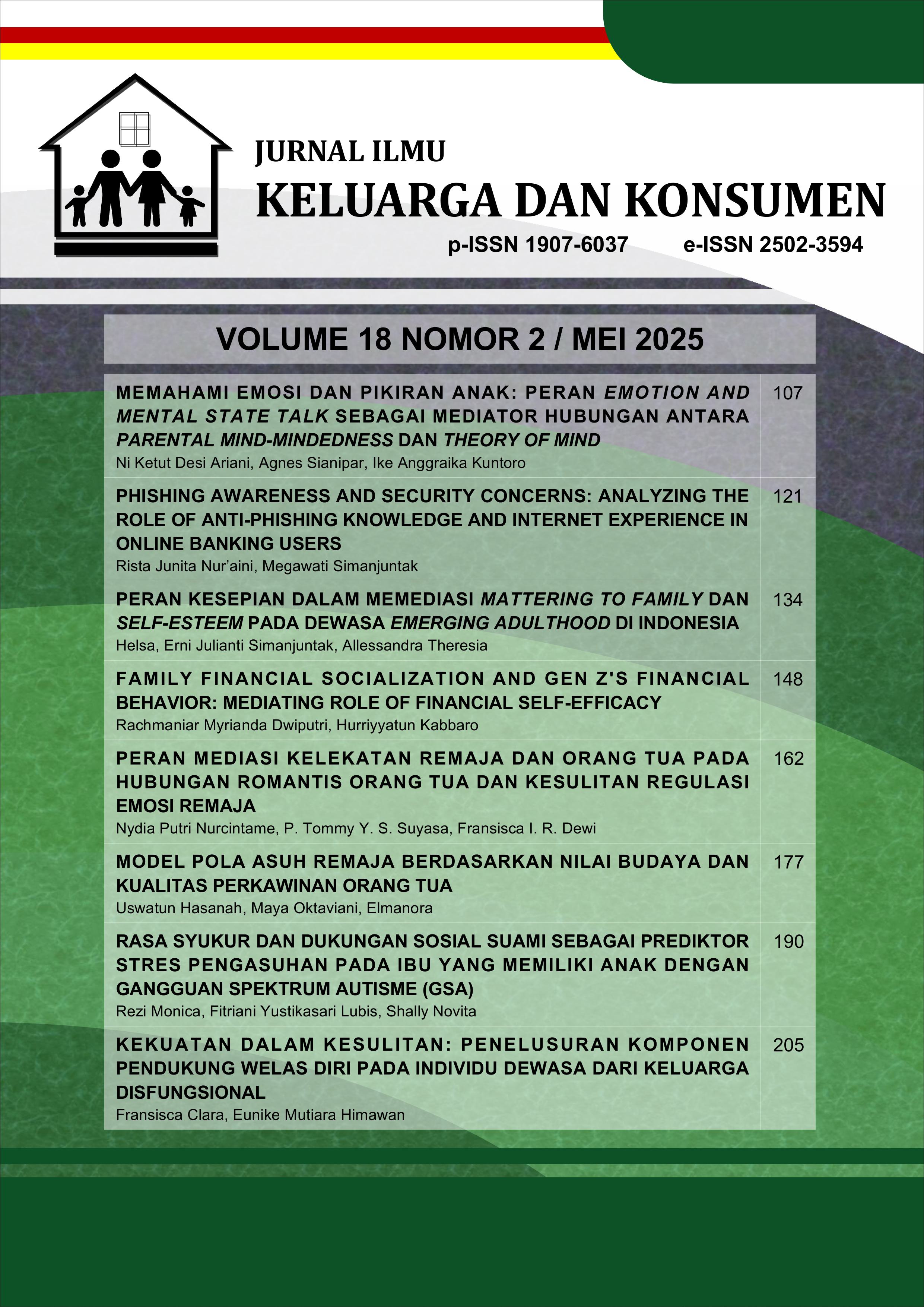
RASA SYUKUR DAN DUKUNGAN SOSIAL SUAMI SEBAGAI PREDIKTOR STRES PENGASUHAN PADA IBU YANG MEMILIKI ANAK DENGAN GANGGUAN SPEKTRUM AUTISME (GSA)
Gratitude and Husband's Social Support as Predictors of Parenting Stress in Mothers of Children with Autism Spectrum Disorder (ASD)
DOI:
https://doi.org/10.24156/jikk.2025.18.2.190Keywords:
dukungan sosial suami, gangguan spektrum autisme, ibu, rasa syukur, stres pengasuhanAbstract
Ibu yang mengasuh anak dengan Gangguan Spektrum Autisme (GSA) dihadapkan pada tuntutan dan tanggung jawab yang lebih kompleks dibandingkan dengan pengasuhan anak yang berkembang secara umum maupun anak dengan kebutuhan khusus lainnya. Penelitian ini bertujuan memperoleh data empiris untuk mengetahui apakah rasa syukur dan dukungan sosial suami memprediksi terjadinya stres pengasuhan pada ibu yang memiliki anak dengan GSA. Partisipan berjumlah 103 ibu dengan anak GSA berusia 6–12 tahun, memiliki surat keterangan diagnosis GSA dari dokter atau psikolog, tinggal serumah dengan suami, dan dipilih dengan teknik purposive sampling. Data penelitian dikumpulkan menggunakan Parental Stress Scale (PSS), Gratitude Questionnaire-6 (GQ-6), dan skala dukungan sosial suami. Hasil analisis regresi linear berganda menunjukkan bahwa model regresi secara simultan signifikan (F=7,479, p<0,05). Namun, secara parsial, rasa syukur tidak secara signifikan memprediksi stres pengasuhan (B=-0,072, SE=0,059, p=0,225), sedangkan dukungan sosial suami memprediksi stres pengasuhan secara signifikan (B=-0,059, SE=0,021, p=0,006). Temuan ini memiliki implikasi praktis bagi pengembangan strategi pengasuhan anak dengan GSA, khususnya dalam upaya mengurangi stres pengasuhan pada ibu sebagai pengasuh utama.
References
Abidin, R. R. (1992). The determinants of parenting behavior. Journal of Clinical Child Psychology, 21(4), 407–412. https://doi.org/10.1207/s15374424jccp2104_12
Acharya, S., & Sharma, K. (2021). Lived experiences of mothers raising children with autism in Chitwan District, Nepal. Autism Research and Treatment, 2021, 1–12. https://doi.org/10.1155/2021/6614490
Adams, D., Paynter, J., Clark, M., Roberts, J., & Keen, D. (2019). The Developmental Behaviour Checklist (DBC) profile in young children on the autism spectrum: The impact of child and family factors. Journal of Autism and Developmental Disorders, 49(8), 3426–3439. https://doi.org/10.1007/s10803-019-04067-0
Akmalia, N., & Febriani, A. (2021). Parenting stress pada ibu yang bekerja: Peran self compassion dan dukungan sosial. Jurnal Ilmu Perilaku, 5(2), 111–122. https://doi.org/10.25077/jip.5.2.111-122.2021
Al-Farsi, O. A., Al-Farsi, Y. M., Al-Sharbati, M. M., & Al-Adawi, S. (2016). Stress, anxiety, and depression among parents of children with autism spectrum disorder in Oman: A case–control study. Neuropsychiatric Disease and Treatment, 12, 1943–1951. https://doi.org/10.2147/ndt.s107103
Al-Zyadaat, M. A. (2019). Gratitude level and its relationship to psychological stress and adjustment to university life among first year jordanian university students. Mu’tah for Research and Studies: Humanities and Social Sciences Series, 35(4), 209–246.
Amalia, R. P., Abidin, F. A., & Lubis, F. Y. (2022). Stres pengasuhan, penilaian ibu terhadap Covid-19, dan pengasuhan suportif. Jurnal Ilmu Keluarga dan Konsumen, 15(1), 51–62. https://doi.org/10.24156/jikk.2022.15.1.51
American Psychiatric Association. (2022). Diagnostic and statistical manual of mental disorders : Fifth edition text revision DSM-5-TR (Fifth). American Psychiatric Association Publishing. https://doi.org/10.1176/appi.books.9780890425787
Andriani, R., & Sumargi, A. M. (2019). Hubungan antara kebersyukuran (gratitude) dengan stres pada ibu yang memiliki anak dengan gangguan spektrum autisme. Jurnal Experentia, 7(2), 26–32. https://doi.org/10.1111/J.14676494.1992.TB00970.X
Ati, M. R. S., Matulessy, A., & Farid, M. (2018). The relationship between gratitude and social support with the stress of parents who have children in special needs. Journal of Child Development Studies, 3(1), 44–58. https://doi.org/10.29244/jcds.3.1.44-58
Balasco, L., Provenzano, G., & Bozzi, Y. (2020). Sensory abnormalities in autism spectrum disorders: A focus on the tactile domain, from genetic mouse models to the clinic. Frontiers in Psychiatry, 10(January), 1–17. https://doi.org/10.3389/fpsyt.2019.01016
Batool, S. S., & Khurshid, S. (2015). Factors associated with stress among parents of children with autism. Journal of the College of Physicians and Surgeons Pakistan, 25(10), 752–756. https://doi.org/10.2015/JCPSP.752756
Berry, J. O., & Jones, W. H. (1995). The parental stress scale: Initial psychometric evidence. Journal of Social and Personal Relationships, 12(3), 463–472. https://doi.org/10.1177/0265407595123009
Bonis, S. (2016). Stress and parents of children with autism: A review of literature. Issues in Mental Health Nursing, 37(3), 153–163. https://doi.org/10.3109/01612840.2015.1116030
Chen, X., Tong, J., Jiang, B., Ma, S., Wang, X., Sun, X., Liu, Y., Yan, D., & Wang, L. (2023). Courtesy stigma among primary caregivers of children with autism spectrum disorder in eastern China. Frontiers in Psychiatry, 14, 1–10. https://doi.org/10.3389/fpsyt.2023.1236025
Choudhury, M., & Chandel, P. (2022). Impact of husband’s social support for mothers of children with autism in India. International Journal of Health Sciences, 6(S1), 8139–8151. https://doi.org/10.53730/ijhs.v6nS1.6745
Clauser, P., Ding, Y., Chen, E. C., Cho, S. J., Wang, C., & Hwang, J. (2021). Parenting styles, parenting stress, and behavioral outcomes in children with autism. School Psychology International, 42(1), 33–56. https://doi.org/10.1177/0143034320971675
Craig, F., Operto, F. F., De Giacomo, A., Margari, L., Frolli, A., Conson, M., Ivagnes, S., Monaco, M., & Margari, F. (2016). Parenting stress among parents of children with neurodevelopmental disorders. Psychiatry Research, 242, 121–129. https://doi.org/10.1016/j.psychres.2016.05.016
Dancey, C., & Reidy, J. (2017). Statistics without maths for psychology. Pearson Education.
Daulay, N. (2018). Parenting stress of mothers in children with autism spectrum disorder: A review of the culture in Indonesia. KnE Social Sciences, 3(5), 453–473. https://doi.org/10.18502/kss.v3i5.2349
Demirpençe Seçinti, D., Diş, D., Albayrak, Z. S., & Şen, E. (2024). Depression and parental distress among caregivers of autistic children: A serial mediator analysis in caregivers of autistic children. BMC Psychology, 12(1), 1–9. https://doi.org/10.1186/s40359-024-01704-x
Derguy, C., M’Bailara, K., Michel, G., Roux, S., & Bouvard, M. (2016). The need for an ecological approach to parental stress in autism spectrum disorders: The combined role of individual and environmental factors. Journal of Autism and Developmental Disorders, 46(6), 1895–1905. https://doi.org/10.1007/s10803-016-2719-3
Desiningrum, D. R., Suminar, D. R., Surjaningrum, E. R., Suryanto, & Hendriani, W. (2021). Husband’s social support for mother of children with autism spectrum disorder. The Family Journal: Counseling and Therapy for Couples and Families, 1–7. https://doi.org/10.1177/10664807211005086
Dewi, S., & Morawati, S. (2024). Gangguan autis pada anak. Scientific Journal, 3(6), 404–417. https://doi.org/10.56260/sciena.v3i6.177
Dong, L., Fan, R., Shen, B., Bo, J., Pang, Y., & Song, Y. (2024). A comparative study on fundamental movement skills among children with autism spectrum disorder and typically developing children aged 7–10. Frontiers in Psychology, 15(March), 1–8. https://doi.org/10.3389/fpsyg.2024.1287752
Drogomyretska, K., Fox, R., & Colbert, D. (2020). Brief report: Stress and perceived social support in parents of children with ASD. Journal of Autism and Developmental Disorders, 50, 4176–4182. https://doi.org/10.1007/s10803-020-04455-x
Emmons, R. A., & McCullough, M. E. (2003). Counting blessings versus burdens: An experimental investigation of gratitude and subjective well-being in daily life. Journal of Personality and Social Psychology, 84(2), 377–389. https://doi.org/10.1037/0022-3514.84.2.377
Estes, A., Munson, J., Dawson, G., Koehler, E., Zhou, X.-H., & Abbott, R. (2009). Parenting stress and psychological functioning among mothers of preschool children with autism and developmental delay. Autism, 13(4), 375–384. https://doi.org/10.1177/1362361309105658
Fernando, F. (2021). Bimbingan dan layanan terapi pada anak autis. Qalam: Jurnal Pendidikan Islam, 2(1), 59–69. https://doi.org/10.57210/qlm.v2i1.55
Fletcher, P. C., Markoulakis, R., & Bryden, P. J. (2012). The costs of caring for a child with an autism spectrum disorder. Issues in Comprehensive Child and Adolescent Nursing, 35(1), 45–69. https://doi.org/10.3109/01460862.2012.645407
Folkman, S., & Moskowitz, J. T. (2000). Positive affect and the other side of coping. American Psychologist, 55(6), 647–654. https://doi.org/10.1037/0003-066X.55.6.647
George, D., & Mallery, P. (2003). SPSS for windows step by step: A simple guide and reference. 11.0 update (4th ed.). Allyn & Bacon.
Ghanouni, P., Jarus, T., Zwicker, J. G., Lucyshyn, J., Chauhan, S., & Moir, C. (2019). Perceived barriers and existing challenges in participation of children with autism spectrum disorders: “He did not understand and no one else seemed to understand him.” Journal of Autism and Developmental Disorders, 49, 3136–3145. https://doi.org/10.1007/s10803-019-04036-7
Glazzarrd, J., Jane, S., Alison, H., Annette, N., & Lesley, N. (2016). Asih asah asuh: Anak berkebutuhan khusus di sekolah. PT. Kanisius.
Gong, Y., Du, Y., Li, H. L., Zhang, X. Y., An, Y., & Wu, B. L. (2015). Parenting stress and affective symptoms in parents of autistic children. Science China Life Sciences, 58(10), 1036–1043. https://doi.org/10.1007/s11427-012-4293-z
Grimaldy, D. V., & Haryanto, H. C. (2020). Adaptation of Gratitude Questionnaire-6 (GQ–6) in Indonesian context. Jurnal Psikologi, 47(1), 18–29. https://doi.org/10.22146/jpsi.39608
Herawati, T., Zubairi, B. K., Musthofa, M., & Tyas, F. P. S. (2018). Dukungan sosial, interaksi keluarga, dan kualitas perkawinan pada keluarga suami istri bekerja. Jurnal Ilmu Keluarga dan Konsumen, 11(1), 1–12. https://doi.org/10.24156/jikk.2018.11.1.1
Jang, M., Brown, R., & Park, M. (2021). Mediating effect of the parent-child relationship on the association between parenting stress and children’s eating behaviors. BMC Public Health, 21, 1–10. https://doi.org/10.1186/s12889-021-12052-5
Jose, P., Sundaram, S., & Varma, R. P. (2021). Buffering effect of spousal support on stress levels in mothers of children with a diagnosis of autism spectrum disorder in Kerala, India. Journal of Neurosciences in Rural Practice, 12(3), 535–542. https://doi.org/ 10.1055/s-0041-1727559
Kim, H. S., Sherman, D. K., & Taylor, S. E. (2008). Culture and social support. American Psychologist, 63(6), 518–526. https://doi.org/10.1037/0003-066X
Kimura, M., & Yamazaki, Y. (2015). Physical punishment, mental health and sense of coherence among parents of children with intellectual disability in Japan. Journal of Applied Research in Intellectual Disabilities: JARID, 29(5), 455–467. https://doi.org/10.1111/jar.12198
Kristiana, I. F., Hyoschamina, D. E., & Fatimah, N. (2018). The effect of gratitude on parental stress among mothers’ of early children. Journal of Education and Learning (EduLearn), 12(4), 610–616. https://doi.org/10.11591/edulearn.v12i4.7248
Kuo, S. S., Van Der Merwe, C., Fu, J. M., Carey, C. E., Talkowski, M. E., Bishop, S. L., & Robinson, E. B. (2022). Developmental variability in autism across 17000 autistic individuals and 4000 siblings without an autism diagnosis: Comparisons by cohort, intellectual disability, genetic etiology, and age at diagnosis. JAMA Pediatrics, 176(9), 915–923. https://doi.org/10.1001/jamapediatrics.2022.2423
Kurniadi, G., Atmodiwirjo, E. T., & Soetikno, N. (2019). Hubungan antara harapan dan stres orang tua yang memiliki anak dengan autisme. Jurnal Muara Ilmu Sosial, Humaniora, dan Seni, 3(2), 358–366. https://doi.org/10.24912/jmishumsen.v3i2.3860
Ladapase, E. M., & Nancy, M. N. (2024). Analysis study to gratitude and parenting stress on parents of children with special needs. G-COUNS: Jurnal Bimbingan dan Konseling, 8(2), 969–975. https://doi.org/10.31316/gcouns.v8i2.5932
Lima, M. B. S., Dos Santos Cardoso, V., & Da Costa Silva, S. S. (2016). Parental stress and social support of caregivers of children with cerebral palsy. Paideia, 26(64), 207–214. https://doi.org/10.1590/1982-43272664201608
Lin, C. C. (2015). Impact of gratitude on resource development and emotional well-being. Social Behavior and Personality, 43(3), 493–504. https://doi.org/10.2224/sbp.2015.43.3.493
Lin, C. C. (2016). The roles of social support and coping style in the relationship between gratitude and well-being. Personality and Individual Differences, 89, 13–18. https://doi.org/10.1016/j.paid.2015.09.032
Liu, Y., & Fisher, K. R. (2023). Struggle for recognition, rights, and redistribution: Understanding the identity of parents of children with autism spectrum disorder in China. Frontiers in Psychology, 13(January), 1–13. https://doi.org/10.3389/fpsyg.2022.981986
Maenner, M. J., Warren, Z., Williams, A. R., Amoakohene, E., Bakian, A. V., Bilder, D. A., Durkin, M. S., Fitzgerald, R. T., Furnier, S. M., Hughes, M. M., Ladd-Acosta, C. M., McArthur, D., Pas, E. T., Salinas, A., Vehorn, A., Williams, S., Esler, A., Grzybowski, A., Hall-Lande, J., … Shaw, K. A. (2023). Prevalence and characteristics of autism spectrum disorder among children aged 8 years-autism and developmental disabilities monitoring network, 11 sites, United States, 2020. MMWR Surveill Summ, 72(2), 1–14. https://doi.org/10.15585/mmwr.ss7202a1
Mawarpury, M., Setya Ningsih, D., & Rezeki, S. (2023). The role of gratitude on stress and psychological wellbeing among parent of children with cancer in Aceh. INSPIRA: Indonesian Journal of Psychological Research, 4(1), 77–84. https://doi.org/10.32505/inspira.v4i1.5376
McCullough, M. E., Emmons, R. A., & Tsang, J. A. (2002). The grateful disposition: A conceptual and empirical topography. Journal of Personality and Social Psychology, 82(1), 112–127. https://doi.org/10.1037/0022-3514.82.1.112
Miranda, A., Mira, A., Berenguer, C., Rosello, B., & Baixauli, I. (2019). Parenting stress in mothers of children with autism without intellectual disability. Mediation of behavioral problems and coping strategies. Frontiers in Psychology, 10(464), 1–12. https://doi.org/10.3389/fpsyg.2019.00464
Noor, A. M., & Aslamawati, Y. (2021). Hubungan parenting self-efficacy dengan parenting stress pada ibu dengan anak tunagrahita (pengasuhan di masa pandemi covid-19). Prosiding Psikologi, 640–646. https://doi.org/10.29313/.V0I0.28527
Nuha, F. A., Putri, A. M., & Triswanti, N. (2020). Hubungan antara karakteristik orang tua dengan stres pengasuhan pada orang tua anak gangguan spektrum autisme. Jurnal Psikologi Malahayati, 2(2), 36–47. https://doi.org/10.33024/jpm.v2i2.2953
Papadopoulos, D. (2021). Mothers’ experiences and challenges raising a child with autism spectrum disorder: A qualitative study. Brain Sciences, 11(309), 1–16. https://doi.org/10.3390/brainsci11030309
Pastor-Cerezuela, G., Fernández-Andrés, M. I., Pérez-Molina, D., & Tijeras-Iborra, A. (2021). Parental stress and resilience in autism spectrum disorder and down syndrome. Journal of Family Issues, 42(1), 3–26. https://doi.org/10.1177/0192513X20910192
Phetrasuwan, S., & Shandor Miles, M. (2009). Parenting stress in mothers of children with autism spectrum disorders. Journal for Specialists in Pediatric Nursing, 14(3), 157–165. https://doi.org/10.1111/j.1744-6155.2009.00188.x
Porter, N., & Loveland, K. A. (2018). An integrative review of parenting stress in mothers of children with autism in Japan. International Journal of Disability, Development and Education, 1–24. https://doi.org/10.1080/1034912X.2018.1439159
Pradana, A. P., & Kustanti, E. R. (2017). Hubungan antara dukungan sosial suami dengan psychological well-being pada ibu yang memiliki anak autisme. Jurnal Empati, 6(2), 83–90. https://doi.org/10.14710/empati.2017.19734
Purnomo, J. C., & Kristiana, I. F. (2016). Hubungan antara dukungan sosial suami dengan stres pengasuhan istri yang memiliki anak retardasi mental ringan dan sedang. Jurnal Empati, 5(3), 507–512. https://doi.org/10.14710/empati.2016.15392
Ratnasari, K. A. (2017). Hubungan parenting stress, pengasuhan dan penyesuaian dalam keluarga terhadap perilaku kekerasan anak dalam rumah tangga. Jurnal Manajemen Kesehatan Yayasan RS.Dr. Soetomo, 3(1), 86--98. https://doi.org/10.29241/jmk.v3i1.91
Rezendes, D. L., & Scarpa, A. (2011). Associations between parental anxiety/depression and child behavior problems related to autism spectrum disorders: The roles of parenting stress and parenting self-efficacy. Autism Research and Treatment, 2011(1), 1–10. https://doi.org/10.1155/2011/395190
Riany, Y. E., & Ihsana, A. (2021). Parenting stress, social support, self-compassion, and parenting practices among mothers of children with ASD and ADHD. Psikohumaniora: Jurnal Penelitian Psikologi, 6(1), 47–60. https://doi.org/10.21580/pjpp.v6i1.6681
Rivas, G. R., Arruabarrena, I., & de Paúl, J. (2021). Parenting stress index-short form: Psychometric properties of the Spanish version in mothers of children aged 0 to 8 years. Psychosocial Intervention, 30(1), 27–34. https://doi.org/10.5093/PI2020A14
Safaria, T. (2005). Autisme: Pemahaman baru untuk hidup bermakna bagi orang tua. Graha Ilmu.
Salomone, E., Leadbitter, K., Aldred, C., Barrett, B., Byford, S., Charman, T., Howlin, P., Green, J., Le Couteur, A., McConachie, H., Parr, J. R., Pickles, A., Slonims, V., & PACT Consortium. (2018). The association between child and family characteristics and the mental health and wellbeing of caregivers of children with autism in mid-childhood. Journal of Autism and Developmental Disorders, 48(4), 1189–1198. https://doi.org/10.1007/s10803-017-3392-x
Samuel, M., Bantu, E., & Nakalema, F. (2024). Understanding and addressing the impact of parental stress and stigma in raising children with Autism Spectrum Disorder (ASD) in low-resource settings. IAA Journal of Biological Sciences, 12(2), 56–60. https://doi.org/10.59298/iaajb/2024/122.566011
Sarafino, E. P., Smith, T. W., King, D. B., & Longis, A. De. (2020). Health psychology biopsychosocial interactions. John Wiley & Sons Canada, Ltd.
Scahill, L., Bearss, K., Lecavalier, L., Smith, T., Swiezy, N., Aman, M. G., Sukhodolsky, D. G., McCracken, C., Minshawi, N., Turner, K., Levato, L., Saulnier, C., Dziura, J., & Johnson, C. (2016). Effect of parent training on adaptive behavior in children with autism spectrum disorder and disruptive behavior: Results of a randomized trial. Journal of the American Academy of Child & Adolescent Psychiatry, 55(7), 602–609. https://doi.org/10.1016/j.jaac.2016.05.001
Sim, A., Vaz, S., Cordier, R., Joosten, A., Parsons, D., Smith, C., & Falkmer, T. (2017). Factors associated with stress in families of children with autism spectrum disorder. Developmental Neurorehabilitation, 21(3), 1–11. https://doi.org/10.1080/17518423.2017.1326185
Song, S.-M., Park, B., Lee, W. K., Park, N.-S., & Kim, M. N. (2022). Examining the relationship between social support, parenting stress, and depression in South Korean single mothers. Journal of Child and Family Studies, 31(5), 1232–1245. https://doi.org/10.1007/s10826-021-02084-1
Stanojevic, N., Nenadovic, V., Fatic, S., & Stokic, M. (2017). Exploring factors of stress level in parents of children with autistic spectrum disorder. Specijalna Edukacija i Rehabilitacija, 16(4), 445–463. https://doi.org/10.5937/specedreh16-13861
Su, W. C., Mutersbaugh, J., Huang, W. L., Bhat, A., & Gandjbakhche, A. (2024). Using deep learning to classify developmental differences in reaching and placing movements in children with and without autism spectrum disorder. Scientific Reports, 14(1), 1–11. https://doi.org/10.1038/s41598-024-81652-z
Tim PPID Ditbalnak. (2024, November 13). Kajian epidemiologis, anak dengan autisme di Indonesia. https://www.orangtuahebat.id/kajian-epidemiologis-anak-autisme/
Triandis, H. C. (1995). Individualism and collectivism (new directions in social psychology). Taylor & Francis.
Wahyu, P. N., Baihaqi, M., & Damaianti, L. F. (2023). Pengaruh dukungan sosial terhadap stres pada orang tua dengan anak tunagrahita yang dimoderasi oleh status sosial ekonomi di SLB-C Kota Bandung. Jurnal Psikologi Insight, 5(2), 183–192. https://doi.org/10.17509/insight.v5i2.62802
Wang, R., Liu, Q., & Zhang, W. (2022). Coping, social support, and family quality of life for caregivers of individuals with autism: Meta-analytic structural equation modeling. Personality and Individual Differences, 186, 1–9. https://doi.org/10.1016/j.paid.2021.111351
Wasay, S., & Khan, M. A. (2023). Perceived stigma, social support, care giving burden and marital adjustment among mothers of children diagnosed with autism spectrum disorder. Bahria Journal of Professional Psychology, 22(1), 17–29.
Watkins, P. C. (2014). Gratitude and the good life: Toward a psychology of appreciation. Springer. https://doi.org/10.4324/9780203816943-3
Weiss, R. S. (1974). The provisions of social relationships. In Z. Rubin (Ed.), Doing unto others (pp. 17–26). Prentice Hall.
Whelan, S., Caulfield, N., O’Doherty, S., Mannion, A., & Leader, G. (2025). Parental experiences of raising an autistic child in Ireland: A qualitative thematic analysis. Autism, 29(2), 395–407. https://doi.org/10.1177/13623613241277040
Wood, A. M., Joseph, S., & Maltby, J. (2009). Gratitude predicts psychological well-being above the big five facets. Personality and Individual Differences, 46(4), 443–447. https://doi.org/10.1016/j.paid.2008.11.012
World Health Organization. (2023, November 15). Autism. https://www.who.int/news-room/fact-sheets/detail/autism-spectrum-disorders
Yuniar, H. F., Suroso, S., & Farid, M. (2023). The effectiveness of gratitude training on reducing parenting stress in parents who have children with special needs. International Journal of Research in Counseling, 2(2), 15–24. https://doi.org/10.55849/ijrc.v2i2.56
Zimet, G. D., Dahlem, N. W., Zimet, S. G., & Farley, G. K. (1988). The multidimensional scale of perceived social support. Journal of Personality Assessment, 52(1), 30–41. https://doi.org/10.1207/s15327752jpa5201_2
Downloads
Published
Issue
Section
License
Copyright (c) 2025 Jurnal Ilmu Keluarga dan Konsumen

This work is licensed under a Creative Commons Attribution-ShareAlike 4.0 International License.






















 This work is licensed under a