
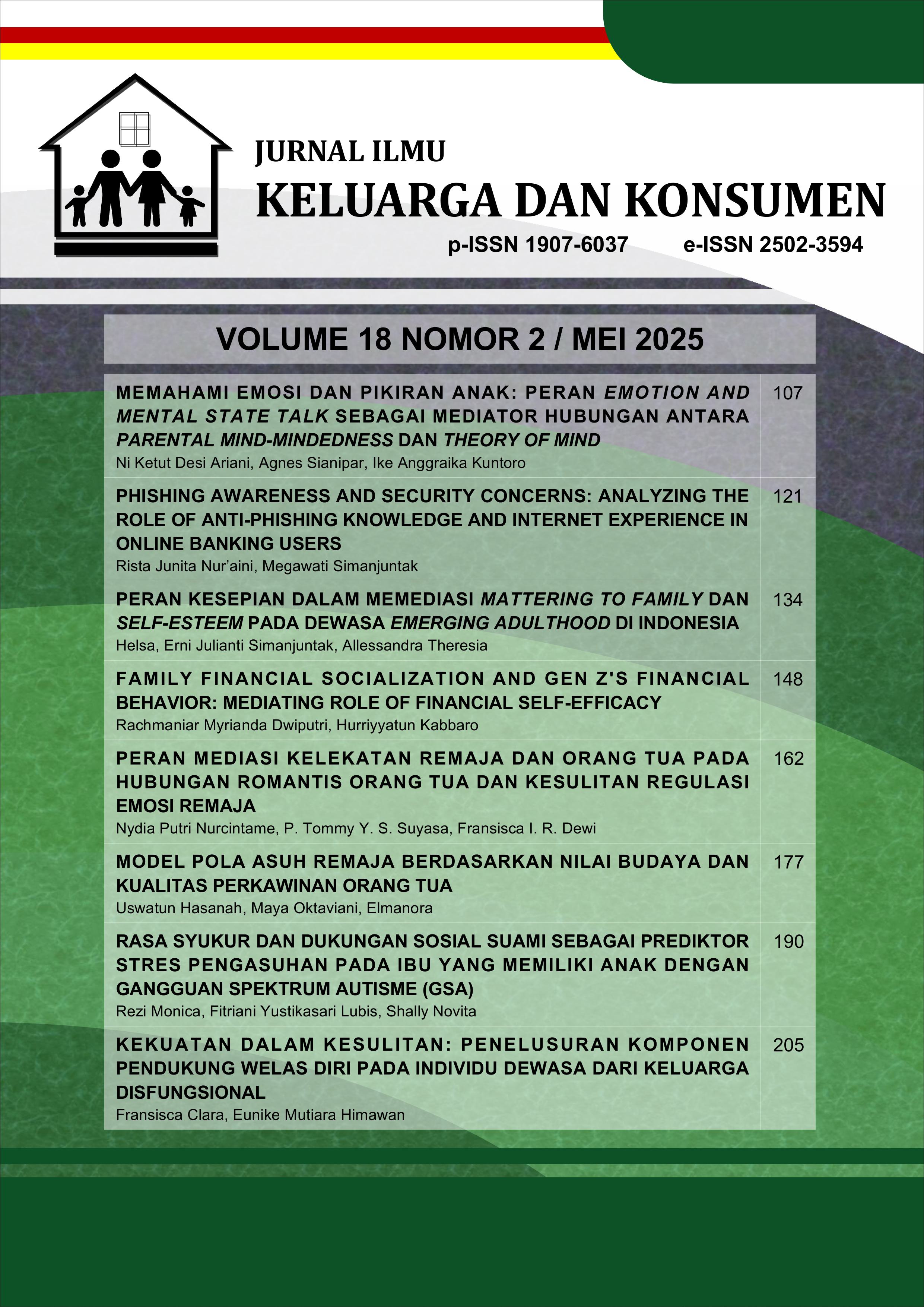
PERAN MEDIASI KELEKATAN REMAJA DAN ORANG TUA PADA HUBUNGAN ROMANTIS ORANG TUA DAN KESULITAN REGULASI EMOSI REMAJA
The Mediating Role of Parent–Adolescent Attachment in the Relationship Between Parents’ Romantic Relationship and Adolescents’ Emotion Regulation Difficulties
DOI:
https://doi.org/10.24156/jikk.2025.18.2.162Keywords:
agresi pada remaja, hubungan romantis orang tua, kedekatan emosional, kelekatan remaja dan orang tua, regulasi emosiAbstract
Perilaku agresif di kalangan remaja, yang disebabkan oleh kesulitan dalam mengendalikan emosi, menjadi masalah yang memerlukan perhatian serius. Penelitian kuantitatif non-eksperimental ini bertujuan untuk menganalisis apakah kelekatan remaja dan orang tua berperan sebagai mediator pada hubungan romantis orang tua dan kesulitan regulasi emosi remaja. Penelitian ini melibatkan 216 remaja berusia 12 hingga 21 tahun (M = 18,43; SD = 2,80), dengan sebagian besar peserta berjenis kelamin perempuan (78,24%), yang tinggal bersama kedua orang tua mereka setidaknya selama enam bulan terakhir. Partisipasi dilakukan melalui metode daring maupun luring. Hasil analisis menggunakan Structural Equation Modeling (SEM) menunjukkan bahwa model kelekatan remaja dan orang tua sebagai mediator pada hubungan romantis orang tua dan kesulitan regulasi emosi memiliki kecocokan yang baik. Dengan demikian, dapat disimpulkan bahwa persepsi remaja terhadap hubungan romantis orang tua berperan dalam membentuk kelekatan remaja dan orang tua, yang kemudian memprediksi tingkat kesulitan regulasi emosi mereka. Hasil penelitian ini memiliki implikasi praktis sebagai acuan dalam merancang program pengasuhan yang memprioritaskan komunikasi terbuka melalui peningkatan kualitas hubungan suami istri dan penguatan kelekatan remaja dan orang tua, sehingga dapat membantu mencegah munculnya kesulitan regulasi emosi pada remaja.
References
Annisa, M., Nur, H., & Ansar, W. (2024). Pengaruh peer attachment terhadap regulasi emosi pada remaja. Edukatif: Jurnal Ilmu Pendidikan, 6(3), 1851–1859. https://doi.org/10.31004/edukatif.v6i3.6571 DOI: https://doi.org/10.31004/edukatif.v6i3.6571
Bandura, A. (1977). Social learning theory. Prentice-Hall.
Boullion, A., Linde-Krieger, L. B., Doan, S. N., & Yates, T. M. (2023). Parental warmth, adolescent emotion regulation, and adolescents’ mental health during the COVID-19 pandemic. Frontiers in Psychology, 14. https://doi.org/10.3389/fpsyg.2023.1216502 DOI: https://doi.org/10.3389/fpsyg.2023.1216502
Bowen, M. (1978). Family therapy in clinical practice. J. Aronson.
Bowlby, J. (1982). Attachment and loss: Retrospect and prospect. American Journal of Orthopsychiatry, 52(4), 664–678. https://doi.org/10.1111/j.1939-0025.1982.tb01456.x DOI: https://doi.org/10.1111/j.1939-0025.1982.tb01456.x
Bronfenbrenner, U. (2000). Ecological systems theory. Cambridge Press. DOI: https://doi.org/10.1037/10518-046
Calderón-García, A., Álvarez-Gallardo, E., Belinchón-deMiguel, P., & Clemente-Suárez, V. J. (2024). Gender differences in autonomic and psychological stress responses among educators: A heart rate variability and psychological assessment study. Frontiers in Psychology, 15. https://doi.org/10.3389/fpsyg.2024.1422709 DOI: https://doi.org/10.3389/fpsyg.2024.1422709
Chan, K. M. Y., Hong, R.Y., Ong, X. L., & Cheung, H. S. (2022). Emotion dysregulation and symptoms of anxiety and depression in early adolescence: Bidirectional longitudinal associations and the antecedent role of parent–child attachment. British Journal of Developmental Psychology, 41(3), 291–305. https://doi.org/10.1111/bjdp.12445 DOI: https://doi.org/10.1111/bjdp.12445
Chen, X., Gong, H., Zhang, Z., & Wang, W. (2021). Factor influencing adolescent anxiety: The roles of mothers, teachers, and peers. International Journal of Environmental Research and Public Health, 18(24). https://doi.org/10.3390/ijerph182413234 DOI: https://doi.org/10.3390/ijerph182413234
Danasasmita, F. S., Pandia, V., Fitriana, E., Afriandi, I., Purba, F. D., Ichsan, A., Pradana, K., Santoso, A. H. S., Mardhiyah, F. S., & Engellia, R. (2024). Validity and reliability of the Difficulties in Emotion Regulation Scale Short Form in Indonesian non-clinical population. Frontiers in Psychology, 15. https://doi.org/10.3389/fpsyt.2024.1380354 DOI: https://doi.org/10.3389/fpsyt.2024.1380354
Ferreira, T., Matias, M., Carvalho, H., & Matos, P. M. (2024). Parent-partner and parent-child attachment: Links to children’s emotion regulation. Journal of Applied Developmental Psychology, 91. https://doi.org/10.1016/j.appdev.2023.101617 DOI: https://doi.org/10.1016/j.appdev.2023.101617
Fraley, R. C., Heffernan, M. E., & Vicary, A. M. (2011). The experiences in close relationships structures questionnaire: A method for assessing attachment orientations across relationships. Psychological Assessment, 23(3), 615–625. https://doi.org/10.1037/a0022898 DOI: https://doi.org/10.1037/a0022898
Gutiérrez-Cobo, M. J., Megías-Robles, A., Gómez-Leal, R., Cabello, R., & Fernández-Berrocal, P. (2023). Emotion regulation strategies and aggression in youngsters: The mediating role of negative affect. Heliyon, 9(3). https://doi.org/10.1016/j.heliyon.2023.e14048 DOI: https://doi.org/10.1016/j.heliyon.2023.e14048
Hadori, R., Hastuti, D., & Puspitawati, H. (2020). Self-esteem remaja pada keluarga utuh dan tunggal: Kaitannya dengan komunikasi dan kelekatan orang tua-remaja. Jurnal Ilmu Keluarga dan Konsumen, 13(1), 49–60. https://doi.org/10.24156/jikk.2020.13.1.49 DOI: https://doi.org/10.24156/jikk.2020.13.1.49
Hasanah, R. A., & Latifah, M. (2021). Investigasi online resilience remaja: Eksplanasi peranan karakteristik remaja, karakteristik keluarga, kelekatan remaja-orang tua, regulasi emosi, dan hubungan persahabatan. Jurnal Ilmu Keluarga dan Konsumen, 14(3), 2502–3594. https://doi.org/10.24156/jikk.2021.14.3.270 DOI: https://doi.org/10.24156/jikk.2021.14.3.270
Havighurst, S. S., Radovini, A., Hao, B., & Kehoe, C. E. (2020). Emotion-focused parenting interventions for prevention and treatment of child and adolescent mental health problems: A review of recent literature. Current Opinion in Psychiatry, 33(6), 586–601. https://doi.org/10.1097/YCO.0000000000000647 DOI: https://doi.org/10.1097/YCO.0000000000000647
Hazan, C., & Shaver, P. (1987). Romantic love conceptualized as an attachment process. Journal of Personality and Social Psychology, 52(3), 511–524. https://doi.org/10.1037/0022-3514.52.3.511 DOI: https://doi.org/10.1037//0022-3514.52.3.511
Kahar, M. K. S. J., Situmorang, N. Z., & Urbayatun, S. (2022). Hubungan antara regulasi emosi dengan perilaku agresif pada siswa SMA di Yogyakarta. Psyche 165 Journal, 15(1), 7–12. https://doi.org/10.35134/jpsy165.v15i1.143 DOI: https://doi.org/10.35134/jpsy165.v15i1.143
Kaufman, E. A., Xia, M., Fosco, G., Yaptangco, M., Skidmore, C. R., & Cowell, S. E. (2015). The Difficulties in Emotion Regulation Scale Short Form (DERS-SF): Validation and replication in adolescent and adult samples. Journal of Psychopathology and Behavioral Assessment, 38, 443–455. https://doi.org/10.1007/s10862-015-9529-3 DOI: https://doi.org/10.1007/s10862-015-9529-3
Li, M., Chen, X., Gong, H., Ji, W., Wang, W., Liang, S., & Kong, A. (2021). The predictive effect of parental adult attachment on parent–adolescent attachment: The mediating role of harsh parenting. Frontiers in Psychology, 12. https://doi.org/10.3389/fpsyg.2021.710167 DOI: https://doi.org/10.3389/fpsyg.2021.710167
Li, M., Chen, X., Gong, H., Zhang, H., Chen, Y., & Zhang, C. (2023). Maternal adult attachment and mother-adolescent attachment: The chain mediating role of marital satisfaction and harsh parenting. Frontiers in Psychiatry, 14. https://doi.org/10.3389/fpsyt.2023.1170137 DOI: https://doi.org/10.3389/fpsyt.2023.1170137
Maureen, C. L., & Febrieta, D. (2024). Peran kelekatan orang tua untuk meningkatkan regulasi emosi pada remaja akhir. Schema Journal of Psychological Research, 9(1), 37–45. https://doi.org/10.29313/schema.v9i01.4136 DOI: https://doi.org/10.29313/schema.v9i01.4136
Morris, A. S., Criss, M. M., Silk, J. S., & Houltberg, B. J. (2017). The impact of parenting on emotion regulation during childhood and adolescence. Child Developmental Perspectives, 11(4), 233–238. https://doi.org/10.1111/cdep.12238 DOI: https://doi.org/10.1111/cdep.12238
Pan, Y., Zhang, Q., Liu, G., Li, B., & Liu, C. (2022). Parents’ attachment styles and adolescents’ regulatory emotional self-efficacy: The mediating role of adolescents’ attachment to parents in China. Applied Research in Quality of Life, 17, 2637–2656. https://doi.org/10.1007/s11482-021-09991-x DOI: https://doi.org/10.1007/s11482-021-09991-x
Pratiwi, D. A., & Paramita, P. P. (2024). Peran kelekatan orang tua terhadap regulasi emosi remaja akhir yang memiliki orang tua bercerai. Liberosis: Jurnal Psikologi dan Bimbingan Konseling, 2(3), 31–40. https://doi.org/10.3287/liberosis.v2i3.2763
Pu, D. F., & Rodriguez, C. M. (2021). Bidirectional spillover in the family across the transition to parenthood. Family Process, 60(1), 235–250. https://doi.org/10.1111/famp.12549 DOI: https://doi.org/10.1111/famp.12549
Ratliff, E. L., Morris, A. S., Cui, L., Jespersen, J. E., Sik, J. S., & Criss, M. M. (2023). Supportive parent adolescent relationships as a foundation for adolescent emotion regulation and adjustment. Frontiers in Psychology, 14. https://doi.org/10.3389/fpsyg.2023.1193449 DOI: https://doi.org/10.3389/fpsyg.2023.1193449
Sasmitha, S. A., Khumas, A., & Siswanti, D. N. (2023). Hubungan kelekatan orangtua dengan perilaku agresi remaja di kota Makassar. PESHUM: Jurnal Pendidikan, Sosial, dan Humaniora, 2(3), 445–451. https://ulilalbabinstitute.id/index.php/PESHUM/article/view/1506/1332 DOI: https://doi.org/10.56799/peshum.v2i3.1506
Sukkar, H., Dunst, C. J., & Kirkby, J. (2017). Family systems and family-centred practices in early childhood intervention. In H. Sukkar, C. J. Dunst, & J. Kirkby (Eds.), Early childhood intervention: Working with families of young children with special needs (pp. 3–14). Routledge/Taylor & Francis Group. DOI: https://doi.org/10.4324/9781315688442
Synder, A. L., Taylor, L. B., & Cingel, D. P. (2025). The family context and the use of media for emotion regulation during early childhood: Testing the tripartite model of children’s emotion regulation and adjustment. Journal of Child and Family Studies, 34, 328–339. https://doi.org/10.1007/s10826-024-03005-8 DOI: https://doi.org/10.1007/s10826-024-03005-8
Tarigan, R. (2025, January 1). Stop kekerasan pada remaja!. Anak Indonesia Sehat. Retrieved June 19, 2025 from https://anakindonesiasehat.com/stop-kekerasan-pada-remaja/
Theurel, A., & Gentaz, E. (2018). The regulation of emotions in adolescents: Age differences and emotion-specific patterns. PLOS ONE, 13(6). https://doi.org/10.1371/journal.pone.0195501 DOI: https://doi.org/10.1371/journal.pone.0195501
West, M., Rose, M. S., Spreng, S., Sheldon-Keller, A., & Adam, K. (1998). Adolescent attachment questionnaire: Assessment of attachment in adolescence. Journal of Youth and Adolescence, 27(5), 661–673. https://doi.org/10.1023/A:1022891225542 DOI: https://doi.org/10.1023/A:1022891225542
Witzel, D. D., Chandler, K. D., & Stawski, R. S. (2022). Affective reactions to daily interpersonal stressors: Moderation by family involvement and gender. Journal of Social and Personal Relationship, 40(3). https://doi.org/10.1177/02654075221125431 DOI: https://doi.org/10.1177/02654075221125431
Yan, N., Dai, X., Ding, X., & Bi, S. (2024). Spillover between daily marital interactions and parenting practices: Sensory processing sensitivity as moderators. Social Psychological and Personality Science. https://doi.org/10.1177/1948550624123409 DOI: https://doi.org/10.1177/19485506241234093
Zou, S., & Wu, X. (2019). Coparenting conflict behavior, parent–adolescent attachment, and social competence with peers: An investigation of developmental differences. Journal of Youth and Adolescence, 49, 267–282. https://doi.org/10.1007/s10964-019-01131-x DOI: https://doi.org/10.1007/s10964-019-01131-x
























 This work is licensed under a