
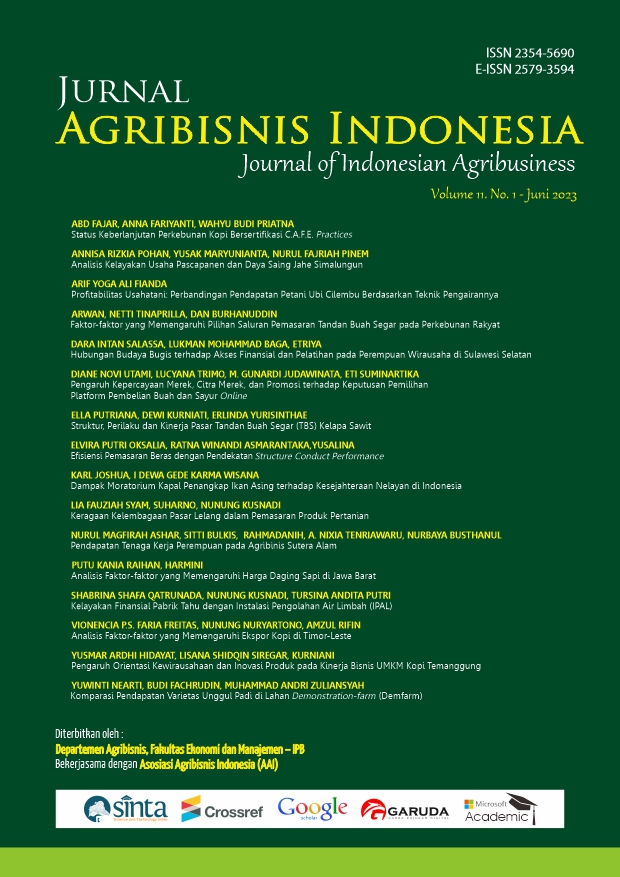
Hubungan Budaya Bugis Terhadap Akses Finansial dan Pelatihan Pada Perempuan Wirausaha di Sulawesi Selatan
Article Sidebar
Main Article Content
Abstract
Local culture is expected to be related to women entrepreneurs, including access to finance and training activities. Bugis is one of the Indonesian ethnicities that have cultural values related to women's entrepreneurship. This paper aims to: (1) explain the characteristics of women entrepreneurs and Bugis cultural values: reso (hard work), macca (smart and skilled), passibijaang (kinship), and barani (courage to take risks) in women entrepreneurs; and (2) measure the correlations between Bugis cultural values (reso, macca, passibijaang, and barani) and access to finance and training. Primary data were obtained from online surveys and surveys by face-to-face interviews. The sampling technique used simple random sampling with a sample size of 205 respondents. The data were analyzed using descriptive statistics and correlation with Person's rank. The results show that (1) The reso and macca cultures of entrepreneurial women tend to be high, while the passibijaang and barani cultures of women entrepreneurs tend to be medium; (2) Macca and barani cultures are positively correlated with access to finance. Macca culture is weakly correlated with financial access, while Barani culture is pretty strongly correlated with access to finance. Passibijaang culture is weakly positively correlated with access to training. The paper recommends establishing a community that helps rural women entrepreneurs enhance entrepreneurship knowledge and skills.
Article Details
Section
Jurnal Agribisnis Indonesia (JAI) is an Open Access Journal. The authors who publish the manuscript in this journal agree to the following terms:
Creative Commons License
JAI is licensed under a Creative Commons Attribution 4.0 International License. This permits anyone to copy, redistribute, remix, transmit, and adapt the work provided the original work and source are appropriately cited.
This means:
(1) Under the CC-BY license, authors retain ownership of the copyright for their article, but authors grant others permission to use the content of publications in Jurnal Agribisnis Indonesia in whole or in part provided that the original work is properly cited. Users (redistributors) of JAI are required to cite the original source, including the author's name, JAI as the initial source of publication, year of publication, volume number, issue, and Digital Object Identifier (DOI); (2) Authors grant JAI the right of first publication. Although authors remain the copyright owner.
How to Cite
References
Adijah, A. (2020). Upaya Pelestarian Pengetahuan Lokal dalam Entrepreneur Bugis. JSBPSDM, 1(3), 288–299.
Agustina, T. S. (2016). Mengungkap Perilaku Inovatif 3 Etnis Wanita Pedagang di Surabaya. Jurnal Manajemen Teori dan Terapan| Journal of Theory and Applied Management, 7(1), 23–37.
https://doi.org/10.20473/jmtt.v7i1.2683. DOI: https://doi.org/10.20473/jmtt.v7i1.2683
Amir, E., & Hasan, M. (2019). Perbandingan Kompetensi Wirausaha Mahasiswa melalui Pembelajaran Kewirausahaan Berbasis Budaya Lokal dengan yang Tidak Berbasis Budaya Lokal. Lentera pendidikan, 22(1), 110–125.
Basit, A., Hassan, Z., & Sethumadhavan, S. (2020). Entrepreneurial Success: Key Challenges Faced by Malaysian Women Entrepreneurs in 21st Century. International Journal of Business and Management, 15(9), 122–138. https://doi.org/10.5539/ijbm.v15n9p122. DOI: https://doi.org/10.5539/ijbm.v15n9p122
Batool, H., & Ullah, K. (2017). Successful Antecedents of Women Entrepreneurs: A Case of Underdeveloped Nation. Entrepreneurship Research Journal, 7(2). https://doi.org/10.1515/erj-2016-0066. DOI: https://doi.org/10.1515/erj-2016-0066
Dewantoro, S., & Maria, M. (2022). Motivasi Generasi Muda terhadap Pekerjaan Sektor Pertanian di Desa Jumo Kecamatan Kedungjati Kabupaten Grobogan. Jurnal Agribisnis Indonesia, 10(1), 152–158. https://doi.org/10.29244/jai.2022.10.1.152-158. DOI: https://doi.org/10.29244/jai.2022.10.1.152-158
[DISKOP] Dinas Koperasi dan Usaha Kecil Menengah. 2021. Data Usaha Kecil dan Menengah. Dinas Koperasi Dan Usaha Kecil Menengah Provinsi Sulawesi Selatan. Makassar.
Fredin, S., & Jogmark, M. (2017). Local Culture As A Context for Entrepreneurial Activities. European Planning Studies, 25(9), 1556–1574. https://doi.org/10.1080/09654313.2017.1306028. DOI: https://doi.org/10.1080/09654313.2017.1306028
Goyal, K., & Kumar, S. (2021). Financial Literacy: A Systematic Review and Bibliometric Analysis. International Journal of Consumer Studies, 45(1), 80–105. https://doi.org/10.1111/ijcs.12605. DOI: https://doi.org/10.1111/ijcs.12605
Gundry, L. K., & Ben-Yoseph, M. (2016). Women Entrepreneurs in Romania, Poland, and The United States: Cultural and Family Influences on Strategy and Growth. Family Business Review, 11(1), 61–73. https://doi.org/10.1111/j.1741-6248.1998.00061.x. DOI: https://doi.org/10.1111/j.1741-6248.1998.00061.x
Hakim, L. N. (2020). Urgensi Revisi Undang-Undang tentang Kesejahteraan Lanjut Usia. Aspirasi: Jurnal Masalah-masalah Sosial, 11(1), 43–55. https://doi.org/10.46807/aspirasi.v11i1.1589. DOI: https://doi.org/10.46807/aspirasi.v11i1.1589
Hoogendoorn, B., van der Zwan, P., & Thurik, R. (2019). Sustainable Entrepreneurship: The Role of Perceived Barriers and Risk. Journal of Business Ethics, 157(4), 1133–1154. https://doi.org/10.1007/s10551-017-3646-8. DOI: https://doi.org/10.1007/s10551-017-3646-8
Igwe, P. A., Newbery, R., Amoncar, N., White, G. R. T., & Madichie, N. O. (2018). Keeping It in The Family: Exploring Igbo Ethnic Entrepreneurial Behaviour in Nigeria. International Journal of Entrepreneurial Behavior & Research, 26(1), 34–53. https://doi.org/10.1108/IJEBR-12-2017-0492 DOI: https://doi.org/10.1108/IJEBR-12-2017-0492
Iswanto, B., H. Kara, M., Amiruddin, A., & Sabri AR, Moh. (2017). Nilai Falah pada Kearifan Lokal dalam Perdagangan Perbatasan Indonesia-Malaysia. Jurnal Diskursus Islam, 5(2), 242–260. https://doi.org/10.24252/jdi.v5i2.7027. DOI: https://doi.org/10.24252/jdi.v5i2.7027
Jannah, S., Siradjuddin, S., & Syaharuddin, S. (2020). Internalisasi Nilai-Nilai Macca Na Malempu’ dalam Etika Bisnis Islam Sebagai Upaya Meningkatkan Kepuasan Pelanggan CV. Idlan Waranie Perkasa (Mabello Indonesia). Al-Mashrafiyah: Jurnal Ekonomi, Keuangan, dan Perbankan Syariah, 4(2), 42–56. https://doi.org/10.24252/al-mashrafiyah.v4i2.15194. DOI: https://doi.org/10.24252/al-mashrafiyah.v4i2.15194
Kapinga, A. F., & Montero, C. S. (2017). Exploring The Socio-Cultural Challenges of Food Processing Women Entrepreneurs in Iringa, Tanzania and Strategies Used To Tackle Them. Journal of Global Entrepreneurship Research, 7(1), 1–24. https://doi.org/10.1186/s40497-017-0076-0. DOI: https://doi.org/10.1186/s40497-017-0076-0
Kappal, J. M., & Rastogi, S. (2020). Investment Behaviour of Women Entrepreneurs. Qualitative Research in Financial Markets, 12(4), 485–504. https://doi.org/10.1108/QRFM-04-2020-0053 DOI: https://doi.org/10.1108/QRFM-04-2020-0053
Kemkar, M., & Sharma, J. (2016). Women Entrepreneurship-Factors Leading to Success of Women Led Enterprises. Research Journal of Management Sciences, 5(9), 46–50.
Kesuma, A. I. 2012. Moral Ekonomi Manusia Bugis. Ed. ke-1. Makassar: Rayhan intermedia.
Lily, Z., Fanzhu, K., & Xiurang, Y. (2022). Study on The Relationship Between Confucian Filial Piety Culture and Chinese Youth’s Entrepreneurial Intention. Frontiers in psychology, 12, 1–9. https://doi.org/10.3389/fpsyg.2021.783399. DOI: https://doi.org/10.3389/fpsyg.2021.783399
Majenga, A., & Mashenene, R. G. (2014). Socio-Cultural Factors and Financial Performance Among Women Small and Medium Enterprises in Tanzania. European Journal of Business and Management, 6(32), 153–164.
Mazonde, N. B., & Carmichael, T. (2016). The Influence of Culture on Female Entrepreneurs in Zimbabwe. The Southern African Journal of Entrepreneurship and Small Business Management, 8(1), 1–10. https://doi.org/10.4102/sajesbm.v8i1.101 DOI: https://doi.org/10.4102/sajesbm.v8i1.101
Mbiti, F. M. (2015). The Influence of Socio-Cultural Factors on Growth of Women-Owned Micro and Small Enterprises in Kitui County, Kenya. International Journal of Business and Social Science, 6(7), 242–250.
Miftakhuljanah, O., Priatna, W. B., & Suharno, S. (2016). Karakter Wanita Wirausaha pada Industri Kecil Kerupuk Kemplang di Kabupaten Ogan Ilir. Jurnal Agribisnis Indonesia, 4(2), 123. https://doi.org/10.29244/jai.2016.4.2.123-136 DOI: https://doi.org/10.29244/jai.2016.4.2.123-136
MIWE. 2022. The Mastercard Index of Women Entrepreneurs 2021/2022 Report. Mastercard Index of Women Entrepreneurs. London.
Muin, S. 2020. Kinerja Usaha Pelaku UMKM Etnis Bugis Makassar: Suatu Tinjauan Kemampuan Usaha, Budaya Berusaha, dan Kewirausahaan. Ed. ke-1. Indramayu: Adanu Abimata CV.
Naidu, S., & Chand, A. (2017). National Culture, Gender Inequality and Women’s Success in Micro, Small and Medium Enterprises. Social Indicators Research, 130(2), 647–664. https://doi.org/10.1007/s11205-015-1203-3. DOI: https://doi.org/10.1007/s11205-015-1203-3
Ondiba, H. A., & Matsui, K. (2019). Social Attributes and Factors Influencing Entrepreneurial Behaviors among Rural Women in Kakamega County, Kenya. Journal of Global Entrepreneurship Research, 9(1), 1–10. https://doi.org/10.1186/s40497-018-0123-5. DOI: https://doi.org/10.1186/s40497-018-0123-5
Ramadhan, B. 2022. Pelaku UMKM Sulsel terus bertambah sejak pandemi. http://www. republika.co.id. [10 Oktober 2022].
Sahni, J. (2020). Managerial Training Effectiveness:An Assessment through Kirkpatrick Framework. TEM Journal, 9(3), 1227–1233. https://doi.org/10.18421/TEM93-51. DOI: https://doi.org/10.18421/TEM93-51
Sari, I. M. (2020). Faktor-Faktor Sukses Wirausaha Wanita di Sumatera Barat. Jurnal Manajemen Stratejik dan Simulasi Bisnis, 1(2), 91–111. https://doi.org/10.25077/mssb.1.2.91-111.2020. DOI: https://doi.org/10.25077/mssb.1.2.91-111.2020
Suaib, H. 2017. Suku Moi: Nilai-Nilai Kearifan Lokal Dan Modal Sosial Dalam Pemberdayaan Masyarakat. Jakarta: An1mage.
Sugiyono. 2017. Metode Penelitian Kuantitatif, Kualitatif, dan R&D. Bandung: Alfabeta.
Sutanto, O., & Nurrachman, N. (2020). Makna Kewirausahaan pada Etnis Jawa, Minang, dan Tionghoa: Sebuah Studi Representasi Sosial. Jurnal Psikologi Ulayat, 5(1), 86–108. https://doi.org/10.24854/jpu73 DOI: https://doi.org/10.24854/jpu73
Tandean, J., Said, & Mediaty. (2020). Kearifan Lokal Suku Kajang: Sebuah Dasar Etika dalam Praktik Bisnis dan Akuntansi. Paradoks: Jurnal ilmu ekonomi, 3(2), 18–29. DOI: https://doi.org/10.33096/paradoks.v3i2.438
Tandelilin, E. (2020). Entrepreneurial values of Indonesian Chinese and Javanese on Micro and Small Enterprises. Proceedings of the 17 Th International Symposium on Management (INSYMA 2020). Proceedings of the 17 th International Symposium on Management (INSYMA). (2020). Vung Tau City, Vietnam: Atlantis Press (251-255). DOI: https://doi.org/10.2991/aebmr.k.200127.051
Thomas, A. S., & Mueller, S. L. (2000). A Case for Comparative Entrepreneurship: Assessing the Relevance of Culture. Journal of International Business Studies, 31(2), 287–301. https://doi.org/10.1057/palgrave.jibs.8490906. DOI: https://doi.org/10.1057/palgrave.jibs.8490906
Zahra, A., Fakhrisadat, N., & Narges, I. (2014). Explaining the Role of Managerial Skills of Entrepreneurship in Business Success. International Journal of Management Sciences, 4(1), 42–52.