
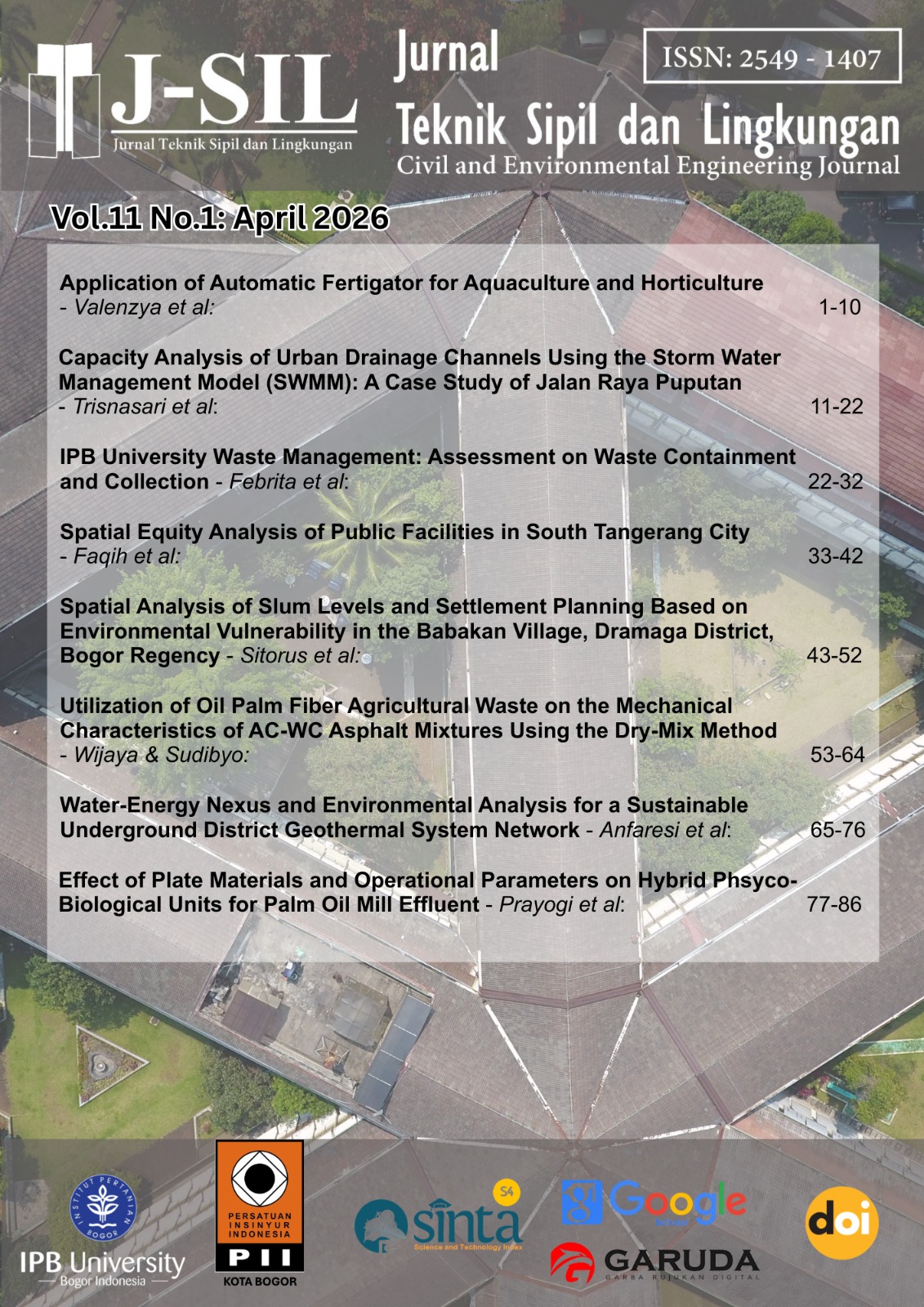
Utilization of Oil Palm Fiber Agricultural Waste on the Mechanical Characteristics of AC-WC Asphalt Mixtures Using the Dry-Mix Method
DOI:
https://doi.org/10.29244/jsil.11.1.53-64Keywords:
AC-WC, dry mix, EFB fibers, MarshallAbstract
Early pavement distress due to permanent deformation and fatigue cracking remains a major challenge for flexible pavement infrastructure in Indonesia, particularly under high traffic loading and tropical climatic conditions. Meanwhile, the Indonesian palm oil industry generates more than 23 million tons annually of Empty Fruit Bunch (EFB), which has not yet been optimally utilized as agro-industrial waste. This study investigates the utilization of EFB fibers treated with NaOH alkali and coated with asphalt emulsion as an additive in Asphalt Concrete Wearing Course (AC-WC) mixtures using the dry-mix method. The experimental variables include two fiber lengths (0.5 cm and 1 cm) and three fiber contents (0.2%, 0.4%, and 0.6%), while maintaining a constant Optimum Asphalt Content (OAC) of 6%. Marshall testing was conducted in accordance with SNI 2489:2018, referring to the Bina Marga General Specifications 2025. The results indicate that fiber incorporation enhances stability up to 1,748.80 kg and increases the Marshall Quotient (MQ) to 530.24 kg/mm, compared to the control mixture with stability of 1,666.16 kg and MQ of 512.33 kg/mm. Volumetric analysis shows a reduction in VIM (4.14-4.32%) and VMA (18.76-18.86%), along with an increase in VFA (77.08-77.92%). The Optimum Fiber Content (OFC) is identified at 0.5 cm fiber length with 0.4% fiber content, yielding stability of 1,748.80 kg, MQ of 530.24 kg/mm, VFA of 77.66%, and an Immersion Residual Strength (IRS) of 90.79%.
References
[1] Direktorat Jenderal Bina Marga. Laporan Kondisi Jalan Nasional. 2023.
[2] Wu J, Zhao Z, Jiang C, Yang Y, Sun Z, Yuang J, et al. Recent development and application of natural fiber in asphalt pavement. J Clean Prod 2024;449:141832. https://doi.org/https://doi.org/10.1016/j.jclepro.2024.141832.
[3] Alnadish AM, Singh NSS, Alawag AM. Applications of Synthetic, Natural, and Waste Fibers in Asphalt Mixtures: A Citation-Based Review. Polymers (Basel) 2023;15. https://doi.org/10.3390/polym15041004.
[4] Sudibyo T, Sutoyo, Arif C, Erizal, Suwarto F. Rutting Resistance of Agricultural-Waste-Plastic Based Modified Bitumen. Civil Engineering and Architecture 2025;13:1647–55. https://doi.org/10.13189/cea.2025.130315.
[5] Mahardika M, Zakiyah A, Ulfa SM, Ilyas RA, Hassan MZ, Amelia D, et al. Recent Developments in Oil Palm Empty Fruit Bunch (OPEFB) Fiber Composite. Journal of Natural Fibers 2024;21. https://doi.org/10.1080/15440478.2024.2309915.
[6] BADAN PUSAT STATISTIK BPS-STATISTICS INDONESIA 2024.
[7] Aravindh M, Sathish S, Ranga Raj R, Karthick A, Mohanavel V, Patil PP, et al. A Review on the Effect of Various Chemical Treatments on the Mechanical Properties of Renewable Fiber-Reinforced Composites. Advances in Materials Science and Engineering 2022;2022. https://doi.org/10.1155/2022/2009691.
[8] Mulla MH, Norizan MN, Rawi NFM, Kassim MHM, Abdullah N, Norrrahim MNF. Surface and Interfaces Effects of Concentrations and Alkaline Treatment Durations on Sugar Palm Fiber as Structural Reinforcement in Polymer Composites. Journal of Natural Fibers 2025;22. https://doi.org/10.1080/15440478.2025.2527277.
[9] Latip NA, Sofian AH, Ali MF, Ismail SN, Idris DMND. Structural and morphological studies on alkaline pre-treatment of oil palm empty fruit bunch (OPEFB) fiber for composite production. vol. 17. 2019.
[10] Hui Y, Men G, Xiao P, Tang Q, Han F, Kang A, et al. Recent Advances in Basalt Fiber Reinforced Asphalt Mixture for Pavement Applications. Materials 2022;15. https://doi.org/10.3390/ma15196826.
[11] Liu H, Li Y, Li J, Wang F, Peng L, Li C, et al. Fiber-Reinforced Asphalt Mixture Design on Anti-Skid Surfacing for Field Testing High-Speed Vehicles on Pavements. Materials 2023;16. https://doi.org/10.3390/ma16020549.
[12] Alifuddin A, Massara A, Muhammad V, Mardin NI. Optimizing the Use of Palm Fiber to Increase Stability and Deformation Resistance in Asphalt Concrete Mixes. INTEK: Jurnal Penelitian 2024;11:13–25. https://doi.org/10.31963/intek.v11i1.4745.
[13] Direktorat Jenderal Bina Marga. Spesifikasi Umum 2025 untuk Pekerjaan Konstruksi Jalan dan Jembatan. Jakarta: 2025.
[14] Sukirman S. Beton Aspal Campuran Panas. 2016.
[15] Idarto D, Pongtuluran EH, Sulistyo T, Teknik J, Politeknik S, Balikpapan N. The Influence of Asphalt Concentration Addition in Hot Mix to the Characteristics of Laston (AC-WC). vol. 1. 2022.
[16] Guo F, Li R, Lu S, Bi Y, He H. Evaluation of the effect of fiber type, length, and content on asphalt properties and asphalt mixture performance. Materials 2020;13. https://doi.org/10.3390/ma13071556.
[17] Ruiwen G, Fuhu H, Yaseen M, Zhaorong Z, Zhenxia Z, Lu H, et al. Applying Adsorption Kinetics of Modified Fiber to Four Components of Asphalt. Journal of Materials in Civil Engineering 2023;35:04023353. https://doi.org/10.1061/JMCEE7.MTENG-15907.
[18] Zhang M, Zhang J, Lyu L, Li Y, Tan X, Li Z, et al. Durable and Environmental Asphalt Pavement with Plant Fiber: A State-of-the-Art Review. Journal of Materials in Civil Engineering 2024;36. https://doi.org/10.1061/jmcee7.mteng-17074.
[19] Chen H, Xu Q, Chen S, Zhang Z. Evaluation and design of fiber-reinforced asphalt mixtures. Mater Des 2009;30:2595–603. https://doi.org/https://doi.org/10.1016/j.matdes.2008.09.030.
[20] Mahmood OT, Ahmed SA. Influence of Natural Fibers on the Performance of Hot Mix Asphalt for the Wearing Course of Pavement. ARO-THE SCIENTIFIC JOURNAL OF KOYA UNIVERSITY 2020;8:57–63. https://doi.org/10.14500/aro.10710.
Downloads
Published
Issue
Section
License
Copyright (c) 2026 Jurnal Teknik Sipil dan Lingkungan

This work is licensed under a Creative Commons Attribution-NonCommercial-NoDerivatives 4.0 International License.
Authors who publish with Jurnal Teknik Sipil dan Lingkungan, JSIL agree to the following terms:
a. Authors retain copyright and grant the journal right of first publication with the work simultaneously licensed under a Creative Commons Attribution License that allows others to share the work with an acknowledgment of the work's authorship and initial publication in this journal.
b. Authors are able to enter into separate, additional contractual arrangements for the non-exclusive distribution of the journal's published version of the work (e.g., post it to an institutional repository or publish it in a book), with an acknowledgment of its initial publication in this journal.
c. Authors are permitted and encouraged to post their work online (e.g., in institutional repositories or on their website) prior to and during the submission process, as it can lead to productive exchanges, as well as earlier and greater citation of published work (See The Effect of Open Access).