Peer-Review Process
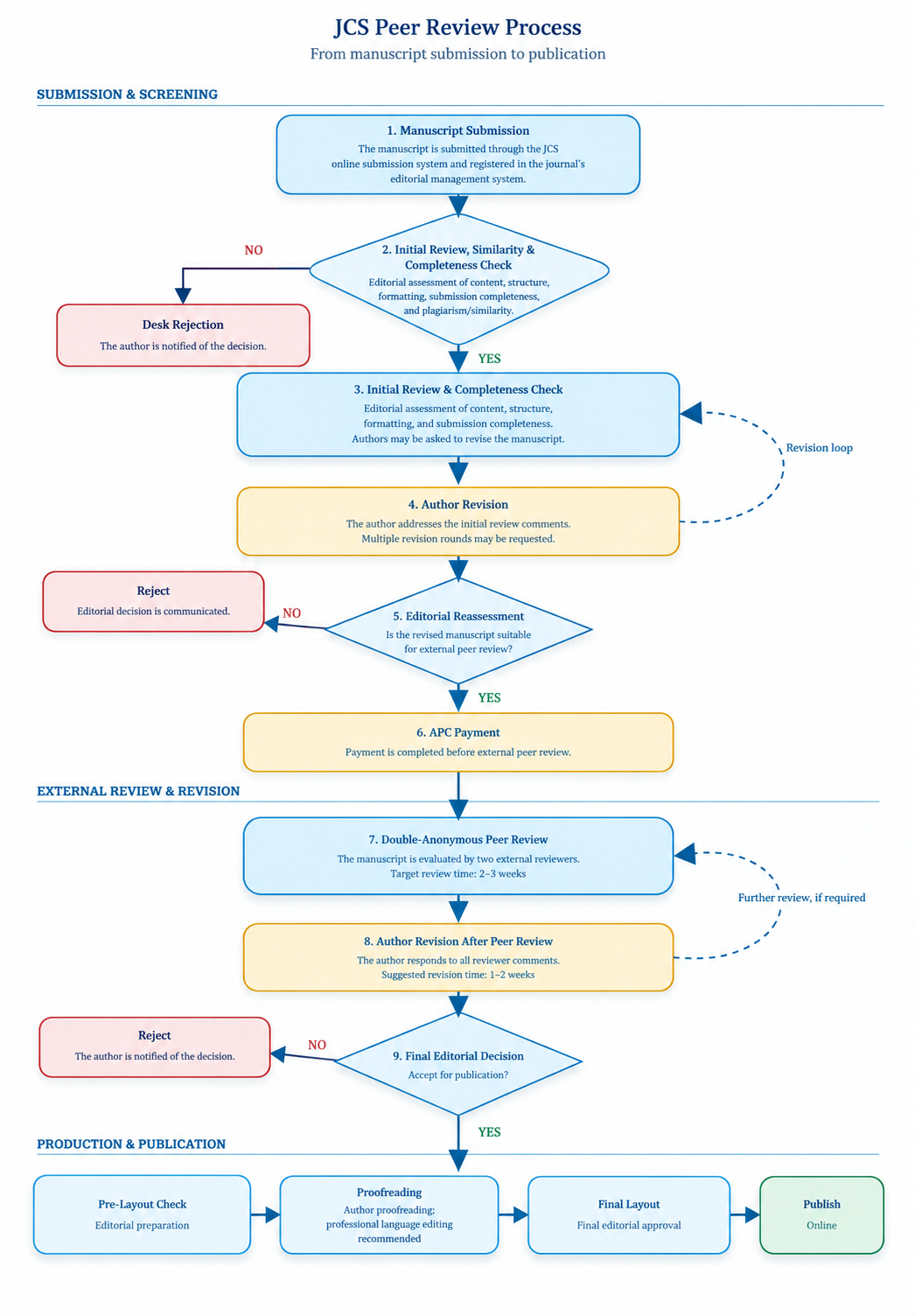
The Journal of Consumer Sciences (JCS) applies a structured and double-anonymous peer-review process to ensure the quality, originality, relevance, and academic integrity of all manuscripts submitted for publication. The review process consists of several stages, beginning with manuscript submission and initial screening, followed by editorial assessment, external peer review, revision, final editorial decision, and production.
1. Manuscript Submission
Authors submit their manuscripts through the JCS online submission system. Upon submission, the manuscript is registered in the journal's editorial management system and undergoes an initial editorial assessment. To avoid confusion regarding portal requirements, JCS mandates the submission of the following
five (5) documents:
1. Manuscript File: Strictly following the 8-chapter structure (Paper Template).
2. AI Usage Statement: Mandatory disclosure form.
3. Ethical Clearance/Self-Declaration: Proof of ethical compliance.
4. Author Profile: Include a one-paragraph bio for each author, a formal photo with a blue background for the corresponding author, and a Public Interest Statement (detailing the specific challenges faced during the research process).
5. Statement originality
2. Editorial Initial Screening
The editorial team conducts an initial screening to determine whether the manuscript is suitable for further consideration. At this stage, the manuscript is assessed for its scope, relevance, basic quality, ethical considerations, and compliance with the journal's submission requirements.
A plagiarism/similarity check (Turnitin) is also conducted at this stage to assess the originality of the submitted manuscript. The editorial team also checks the completeness of the submission, including the manuscript structure, formatting, required components, and other applicable submission requirements.
If the manuscript does not meet the journal's basic requirements or is considered unsuitable for further consideration, it may be rejected at this stage (desk rejection). The author will be notified of the editorial decision.
3. Initial Review and Completeness Check
Manuscripts that pass the initial screening proceed to an editorial review of their content, structure, formatting, and submission completeness. The editorial team may request the author to make revisions to address issues identified during this stage.
The author is required to respond to the editorial comments and revise the manuscript accordingly. Multiple rounds of initial revision may be requested when necessary.
After the revision is submitted, the editorial team reassesses the manuscript to determine whether it has sufficiently addressed the issues raised and is suitable for external peer review.
4. Editorial Reassessment and APC Payment
Following the initial revision and reassessment, manuscripts that are considered suitable for external peer review proceed to the next stage. The applicable Article Processing Charge (APC) is completed before the manuscript is sent to external reviewers.
If the revised manuscript does not meet the required standards or is still considered unsuitable for external peer review, the manuscript may be rejected at this stage.
5. Double-Anonymous External Peer Review
Manuscripts that pass the editorial reassessment are sent to two external reviewers under a double-anonymous (double-blind) peer-review process. The identities of the authors and reviewers are kept confidential throughout the review process.
The reviewers evaluate the manuscript based on its academic quality, relevance, methodology, analysis, discussion, originality, and overall contribution to the field. The target review period is 2–3 weeks.
Based on the reviewers' comments and recommendations, the manuscript may require revision before a final editorial decision can be made.
6. Author Revision After Peer Review
The author is required to respond to the reviewers' comments and revise the manuscript accordingly. Authors should address each substantive comment and provide appropriate explanations or revisions.
The suggested revision period is 1–2 weeks. When necessary, the manuscript may undergo further rounds of review to determine whether the revisions adequately address the reviewers' concerns.
7. Final Editorial Decision
After the revised manuscript has been evaluated, the editorial team makes the final editorial decision.
The manuscript may be:
- Accepted for publication, if it meets the journal's academic and editorial standards; or
- Rejected, if the manuscript does not sufficiently meet the required standards after the review and revision process.
The final decision is communicated to the author through the journal's editorial communication system.
8. Production and Publication
Accepted manuscripts proceed to the production stage. The editorial team conducts a pre-layout check to ensure that the accepted manuscript is complete and ready for production.
Before final layout, authors are encouraged to conduct professional proofreading and language editing, particularly to ensure the clarity, accuracy, consistency, and quality of the English language used in the manuscript. Authors may use the services of a qualified or professional proofreader to improve the linguistic quality of their articles.
Following the proofreading and necessary corrections, the manuscript proceeds to final layout and editorial approval. The final version is reviewed for formatting and production consistency before being approved for publication.
Once the final version has been approved, the article is published online as part of the appropriate issue of the Journal of Consumer Sciences (JCS).