Digital halal ecosystem development: Applications and institutions in Japan, 2010–2025
DOI:
https://doi.org/10.29244/hass.2.3.26-29Keywords:
Certification standardization, Digital ecosystem, Halal applications, Japan, Muslim minorityAbstract
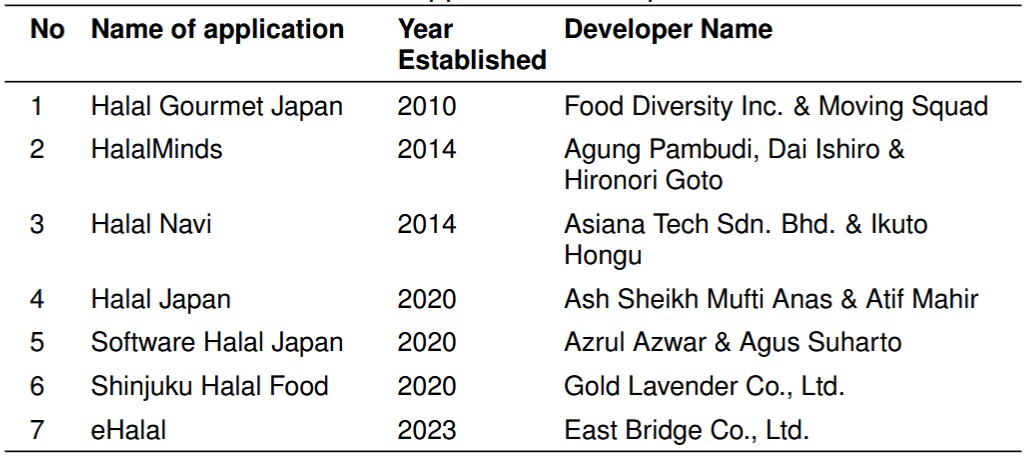
The development of digital halal applications and the institutional frameworks in Japan from 2010 to 2025 has been driven by the expanding Muslim community, comprising both residents and tourists, who require reliable digital access to halal products, restaurants, and other services. Therefore, this qualitative descriptive study conducted a literature review, application testing, and secondary data analysis from academic articles, association reports, and online sources to identify seven key halal applications in Japan, namely Halal Gourmet Japan, Halal Navi, Halal Japan, software Halal Japan, Shinjuku Halal Food, and eHalal. A comparative overview of their technological features was also presented, including barcode scanning, GPS integration, AI-based functions, and optical character recognition capabilities. Institutions such as the Japan Halal Association, Japan Islamic Trust, Japan Muslim Association, Nippon Asia Halal Association, Muslim Professional Japan Association, and the diaspora-led Halal International Trust Organization provided certification, standardization, and training, supported by government tourism initiatives since 2016. Ongoing challenges included fragmented certification standards in the absence of a national halal authority, data silos lacking AI and blockchain integration, and cultural adaptation within Japan’s non-Muslim majority, where halal was increasingly perceived as a hygienic lifestyle choice. These seven halal software applications contributed to tourism, economic growth, and community cohesion, positioning Japan as an inclusive halal model through government, private, and diaspora collaboration.
References
Al-Samarrai S. Islam in Japan: history, spread and institutions in the country. Tokyo: Islamic Centre of Japan; 2009.
Cahyadi ER, Azahra RN, Fabian H, Latisya P. From Tokyo to Manila: the adaptation of halal Japan application system in promoting halal awareness in the Philippines. Halal Studies and Society. 2024;1(3):37-40. https://doi.org/10.29244/hass.1.3.37-40 DOI: https://doi.org/10.29244/hass.1.3.37-40
Ery AP, Rahmawati R, Wijaya DH. Pemahaman masyarakat Jepang tentang wisata halal. In: Prosiding Seminar Nasional Pariwisata. 2020.
Gandhi P, Hidayat MM, Hapsari KF. Establishment of a community-based halal certification body: a case study of Halal International Trust Organization (HITO) in Japan. Halal Studies and Society. 2025;2(1):25-28. https://doi.org/10.29244/hass.2.1.25-28 DOI: https://doi.org/10.29244/hass.2.1.25-28
Handayani DI, Vanany I. Blockchain application in halal supply chain: literature review and future research. In: 2021 IEEE International Conference on Industrial Engineering and Engineering Management (IEEM). 2021. p. 1387-1391. https://doi.org/10.1109/IEEM50564.2021.9673084 DOI: https://doi.org/10.1109/IEEM50564.2021.9673084
Hasnan N, Kohda Y. Halal supply chain: challenges of halal certification in Japan. European Proceedings of Social and Behavioural Sciences. 2023;11(2):150-170.
Imelda SM. Peran Halal Media Japan dalam mempromosikan halal ala Jepang. Indonesia Journal of Halal. 2023;6(1):1-9.
Imronnatsir M. Transformasi nilai konsumen: analisis perkembangan studi Islam dan industri halal di Jepang dalam perspektif teori perilaku konsumen. Journal of Business and Financial Economics. 2023;2(3):45-56.
Japan National Tourism Organization. Number of visitor arrivals to Japan in December 2025: Preliminary figures estimated by JNTO. Tokyo: Japan National Tourism Organization; 2026.
Lam MC, Nizam SSM, Arshad H, Shukri SAIA, Abidin RZ, Hashim NC, Putra HM. A framework for halal products checking interactive application with OCR and AR technologies. Journal of Telecommunication, Electronic and Computer Engineering (JTEC). 2017;9(2-11):91-96.
Rahmah N. Narasi industri pariwisata halal di negara Jepang. J Sos Polit. 2023;10(2):310-320.
Ramdani H. Religious-cultural mediation in technology adoption: a qualitative study of Islamic communities in Indonesia. Journal of Islamic Cultural Studies. 2025;15(1):100-110. https://doi.org/10.63919/surau.v1i2.33 DOI: https://doi.org/10.63919/surau.v1i2.33
Salleh NZM, Nor RM, Azmin NAM, Samori Z, Anas N. Exploring challenges in providing Muslim-friendly tourism services in northern Japan: a case study in Akita prefecture. Malaysian Journal of Consumer and Family Economics. 2019;22(4):42-53.
Downloads
Published
Issue
Section
License
Copyright (c) 2025 Prima Gandhi, Muhammad Nasir, Triyanto

This work is licensed under a Creative Commons Attribution-ShareAlike 4.0 International License.
How to Cite