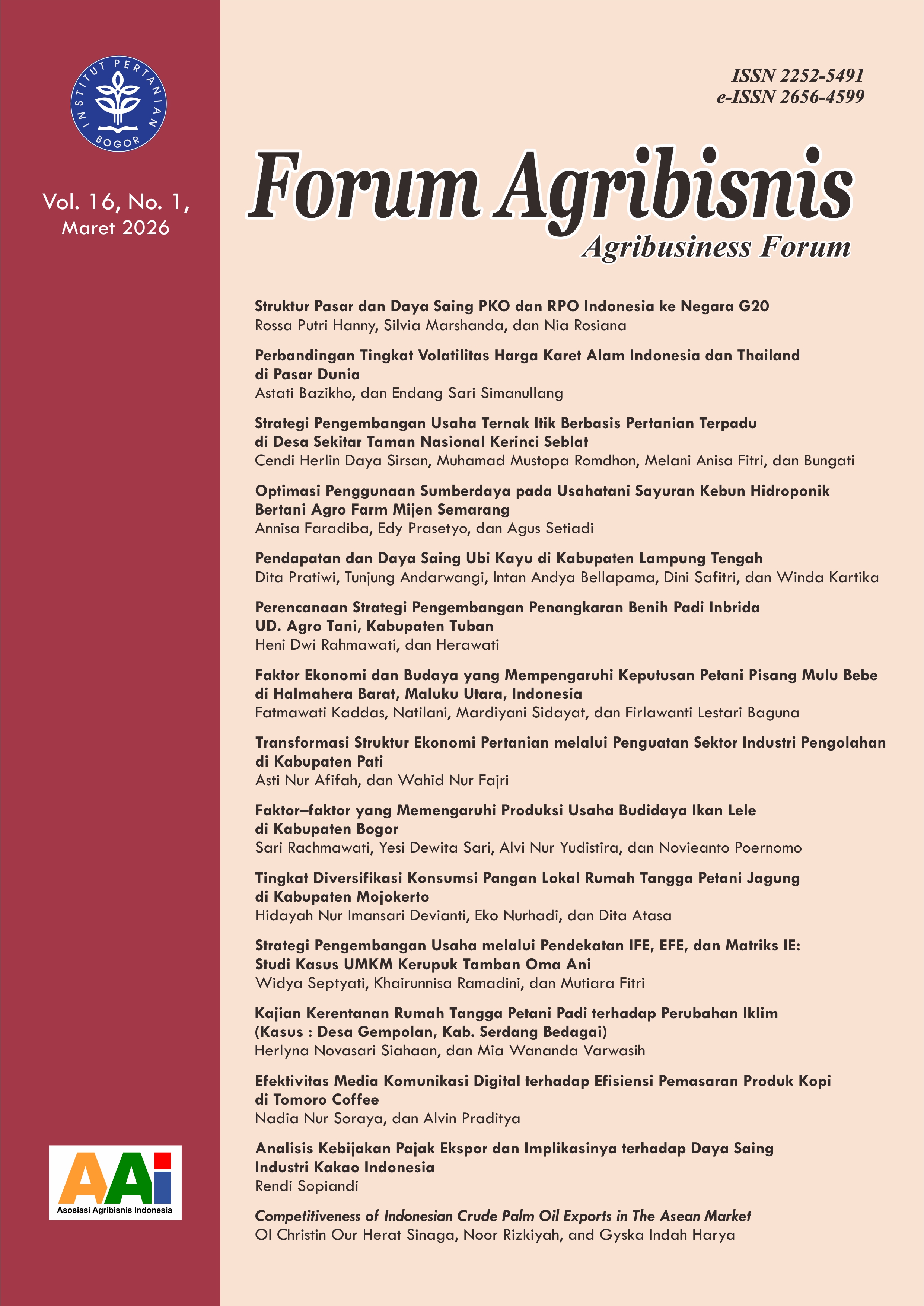
Efektivitas Media Komunikasi Digital terhadap Efisiensi Pemasaran Produk Kopi di Tomoro Coffee
DOI:
https://doi.org/10.29244/fagb.16.1.135-146Keywords:
coffee, digital communication media, digital marketing, marketing efficiency, SEM-PLSAbstract
The transformation of digital communication media has driven significant changes in marketing strategies for agribusiness products, particularly coffee commodities, which face increasingly dynamic market competition. As a modern coffee business, Tomoro Coffee uses digital communication media as its main way to market itself. This study aims to analyze the effectiveness of digital communication media on the marketing efficiency of agribusiness coffee products by examining its contribution to marketing cost savings, increasing market reach, and strengthening relationships with consumers. The study used a quantitative approach with the Partial Least Squares-based Structural Equation Modeling (SEM-PLS) method on 50 consumer respondents who had purchased the product and were exposed to the company's digital promotions. The variables analyzed included cost efficiency, market reach, marketing effectiveness, and consumer response and engagement. The analysis results showed that digital communication media had a positive and significant effect on cost efficiency and market reach, while marketing effectiveness and consumer response and engagement did not show a significant effect. The coefficient of determination (R²) value of 0.1 indicates that the model only explains a small portion of the variation in marketing efficiency, so there are other factors outside the model that also influence marketing performance. These findings indicate that the use of digital communication media can support marketing efficiency, especially through cost savings and expanding the reach of information, but has not directly increased marketing effectiveness and consumer engagement.
Downloads
References
Barney, J. (1991). Firm resources and sustained competitive advantage. Journal of Management. 17(1): 99–120. DOI: https://doi.org/10.1177/014920639101700108. DOI: https://doi.org/10.1177/014920639101700108
Belch, G. E., & Belch, M. A. (2021). Advertising and Promotion: An Integrated Marketing Communications Perspective. New York (US): McGraw-Hill Education.
Catyanadika, P. E. (2020). Optimasi lokasi instalasi digester biogas skala komunitas Desa Pudak Wetan Ponorogo. Forum Agribisnis: Agribusiness Forum. 10(2): 106–117. DOI: https://doi.org/10.29244/fagb.10.2.106-117. DOI: https://doi.org/10.29244/fagb.10.2.106-117
Chaffey, D., & Ellis-Chadwick, F. (2019). Digital Marketing: Strategy, Implementation and Practice. Harlow (UK): Pearson Education Limited.
Chaffey, D., & Ellis-Chadwick, F. (2022). Digital Marketing. Harlow (UK): Pearson Education Limited.
Collan, M., Fedrizzi, M., & Luukka, P. (2022). Digital transformation in agribusiness: Opportunities and challenges. Agricultural Systems. 198: 103386. DOI: https://doi.org/10.1016/j.agsy.2022.103386. DOI: https://doi.org/10.1016/j.agsy.2022.103386
Dwivedi, Y. K., Ismagilova, E., Hughes, D. L., Carlson, J., Filieri, R., Jacobson, J., & Wang, Y. (2021). Setting the future of digital and social media marketing research: Perspectives and research propositions. International Journal of Information Management. 59: 102168. DOI: https://doi.org/10.1016/j.ijinfomgt.2020.102168. DOI: https://doi.org/10.1016/j.ijinfomgt.2020.102168
Felix, R., Rauschnabel, P. A., & Hinsch, C. (2017). Elements of strategic social media marketing: A holistic framework. Journal of Business Research. 70: 118–126. DOI: https://doi.org/10.1016/j.jbusres.2016.05.001. DOI: https://doi.org/10.1016/j.jbusres.2016.05.001
Hair, J. F., Hult, G. T. M., Ringle, C. M., & Sarstedt, M. (2021). A Primer on Partial Least Squares Structural Equation Modeling (PLS-SEM). Thousand Oaks (US): Sage Publications. DOI: https://doi.org/10.1007/978-3-030-80519-7
Hollebeek, L. D., Srivastava, R. K., & Chen, T. (2022). Consumer engagement in digital environments: Conceptual foundations and research directions. Journal of Interactive Marketing. 57: 1–15. DOI: https://doi.org/10.1016/j.intmar.2021.10.001.
Kannan, P. K., & Li, H. (2021). Digital marketing: A framework, review and research agenda. International Journal of Research in Marketing. 38(1): 22–45. DOI: https://doi.org/10.1016/j.ijresmar.2020.08.001. DOI: https://doi.org/10.1016/j.ijresmar.2016.11.006
Kotler, P., & Keller, K. L. (2016). Marketing Management. New Jersey (US): Pearson Education.
Kotler, P., Kartajaya, H., & Setiawan, I. (2021). Marketing 5.0: Technology for Humanity. Hoboken (US): Wiley.
Nasution, A., Krisnamurthi, B., & Rachmina, D. (2020). Analisis permintaan pangan rumah tangga penerima manfaat bantuan pangan non tunai di Kota Bogor. Forum Agribisnis: Agribusiness Forum. 10(1): 1–10. DOI: https://doi.org/10.29244/fagb.10.1.1-10. DOI: https://doi.org/10.29244/fagb.10.1.1-10
Pauwels, K., & Stephen, A. T. (2021). The effect of social media on firm performance. International Journal of Research in Marketing. 38(1): 79–95. DOI: https://doi.org/10.1016/j.ijresmar.2020.07.007.
Ringle, C. M., Wende, S., & Becker, J.-M. (2015). SmartPLS 3. Boenningstedt (DE): SmartPLS GmbH.
Tiago, M. T. P. M. B., & Veríssimo, J. M. C. (2014). Digital marketing and social media: Why bother? Business Horizons. 57(6): 703–708. DOI: https://doi.org/10.1016/j.bushor.2014.07.002. DOI: https://doi.org/10.1016/j.bushor.2014.07.002
Tuten, T. L., & Solomon, M. R. (2023). Social Media Marketing. Thousand Oaks (US): Sage Publications.
Downloads
Published
Issue
Section
License
Copyright (c) 2026 Forum Agribisnis

This work is licensed under a Creative Commons Attribution-ShareAlike 4.0 International License.
The author submitting the manuscript must understand and agree that the copyright of the article manuscript must be submitted/transferred to the Journal Forum Agribisnis. This work is licensed under the Creative Commons Attribution-ShareAlike 4.0 (CC BY-SA) International License in which the Author and Reader can copy and redistribute the material in any media or format, and remix, modify and build material for any purpose, but they must provide appropriate credit (citing articles or content), provide a link to the license, and indicate whether there is a change. If you mix, change, or create material, you must distribute your contribution under the same license as the original.