Correlation between immunoglobulin and growth hormone with age and gender in Iraqi celiac disease patients
DOI:
https://doi.org/10.29244/currbiomed.4.2.45Keywords:
celiac disease, growth hormone, age, gender, immunoglobulinAbstract
Background An enteropathy mediated by the autoimmune system is celiac disease (CD) caused by dietary gluten and related polyamines in people with the HLA-DQ2 or HLA-DQ8 haplotype. It presents in a variety of clinical manifestations and is associated with multiple CD-specific antibodies.
Objective To assess the impact of age and gender on growth hormone, IgA, and IgG levels in Iraqi patients with celiac disease.
Methods This study included 100 patients diagnosed with celiac disease (CD) and 50 healthy controls. Patients and controls were stratified by age (<10 years and ≥10 years) and gender (females and males). Serum growth hormone, IgA, and IgG levels were measured in all participants. Growth hormone was analyzed using the Dirui CM-180 apparatus, while IgA and IgG concentrations were determined by ELISA kits.
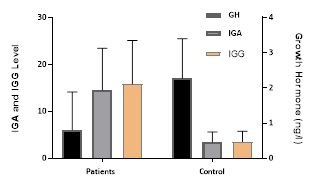
Results This study found that patients aged <10 years and female patient groups have lower growth hormone levels compared to controls, whereas IgA and IgG levels significantly increased in patients' groups than in the control group. A moderate negative correlation was observed between IgG and growth hormone levels in the patient group.
Conclusion Patients aged ≥10 years had lower growth hormone levels compared to controls. It is lower in female and male patient groups compared to the control group. Furthermore, IgA and IgG levels were higher in the patient group compared to the control group. These results highlight the importance of integrating demographic and serological characteristics to improve diagnosis, risk assessment, and understanding of the pathophysiology of celiac disease.
Downloads
Downloads
Published
Issue
Section
License

This work is licensed under a Creative Commons Attribution 4.0 International License.
This journal is published under a Creative Commons Attribution (CC BY 4.0) International License. This license enables reusers to distribute, remix, adapt, and build upon the material in any medium or format, so long as attribution is given to the creator.

How to Cite