mTOR signaling in airway epithelial homeostasis, aging, and diseases
DOI:
https://doi.org/10.29244/currbiomed.4.1.30Keywords:
airway epithelial homeostasis, mTOR signaling, dysregulation, aging, diseasesAbstract
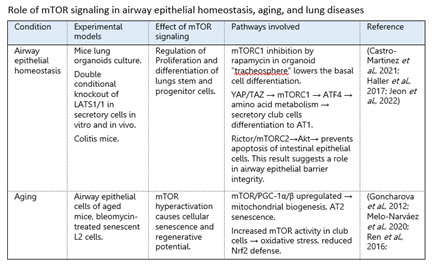
Through the proliferation, differentiation, and survival of various stem and progenitor cells, the airway epithelium preserves homeostasis. To regulate these activities, mTOR signaling combines metabolic and environmental factors. The study reviews the role of mTOR signaling in airway epithelial homeostasis and its dysregulation in airway aging, emphysema, ARDS, and lung cancer. This review combines experimental and clinical data from lineage tracing, organoid systems, genetic mouse models, and patient-derived samples to identify the cell-specific roles of mTORC1 and mTORC2 signaling in airway epithelial stem/progenitor cell homeostasis, aging, and the pathology of disease. Balanced mTOR signaling is crucial for airway epithelial integrity by regulating basal stem cell proliferation, differentiation, and epithelial cell survival. Temporary activation of mTORC1 promotes proper differentiation during organoid formation, whereas persistent hyperactivation leads to stem cell exhaustion, cellular senescence, and impaired regeneration during aging. Aberrant mTOR activation contributes to alveolar degradation in emphysema, worsens inflammation and autophagy suppression in ARDS, and promotes carcinogenesis through PI3K/AKT/mTOR pathway dysregulation in lung cancer. Pharmacological manipulation of mTOR, particularly context-specific and dose-controlled inhibition, explains therapeutic potential but also contains risks of compromised tissue repair when used over an extended period of time. In conclusion, the mTOR signaling is a key modulator of aging, disease progression, and airway epithelial homeostasis. Its dual function emphasizes that accurate disease-specific stage adjustment is more important than widespread inhibition. Understanding cell-type-specific mTOR activities will allow future research on targeted therapeutic strategies to maintain epithelial healing and reduce bad outcomes.
Downloads
Downloads
Published
Issue
Section
License
Copyright (c) 2026 Ziasmin Khatun, Shoaib Saikat, Shaila Haque

This work is licensed under a Creative Commons Attribution 4.0 International License.
This journal is published under a Creative Commons Attribution (CC BY 4.0) International License. This license enables reusers to distribute, remix, adapt, and build upon the material in any medium or format, so long as attribution is given to the creator.

How to Cite