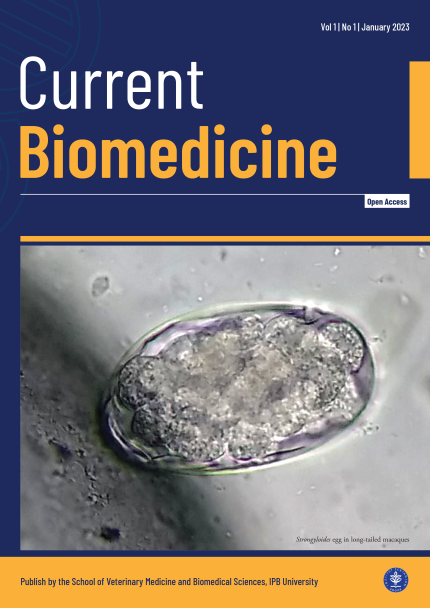
Incidence of gastrointestinal nematodosis in long-tailed macaque (Macaca fascicularis) at the Primate Research Center of LPPM IPB
DOI:
https://doi.org/10.29244/currbiomed.1.1.33-45Keywords:
gastrointestinal nematode, intensity of infection, long-tailed macaque, prevalenceAbstract
Background: The long-tailed macaque (Macaca fascicularis) is often used as a model animal in biomedical research. Nematodosis is common among non-human primates. Gastrointestinal nematodosis may affect study results or be a potential source of transmission to humans (zoonosis). Objective: The study aimed to identify the type, calculate the degree of infection, and the prevalence of gastrointestinal nematode worms in long-tailed macaques in captivity at the Primate Research Center, Institute for Research and Community Service (PSSP LPPM) IPB University. Methods: Faeces samples from 24 long-tailed macaques were examined using the McMaster and Kato-Katz simple flotation methods. Results: Nine (37.5%) of the 24 samples were infected by trichurid (20.8%), ascarid (12.5%), and strongylid (4.2%), each with an average degree of infection 833.3 ± 923.8, 32 ± 27.7, and 12 ± 17 eggs per gram of faeces (EPG), respectively. The prevalence of nematodosis in long-tailed macaques based on age group and sex was in infants 50%, children 50%, adolescents 16.7%, adults 33.3%, males 33.3%, and females 41.7%. Conclusion: The incidence and degree of gastrointestinal nematodosis infection in long-tailed macaques showed a moderate to low level. These results can be considered in maintenance management, biomedical research, and mitigation of potential transmission risk to humans.
Downloads
Downloads
Published
Issue
Section
License
This journal is published under a Creative Commons Attribution (CC BY 4.0) International License. This license enables reusers to distribute, remix, adapt, and build upon the material in any medium or format, so long as attribution is given to the creator.

How to Cite