
Peer Review Process
Peer Review Process
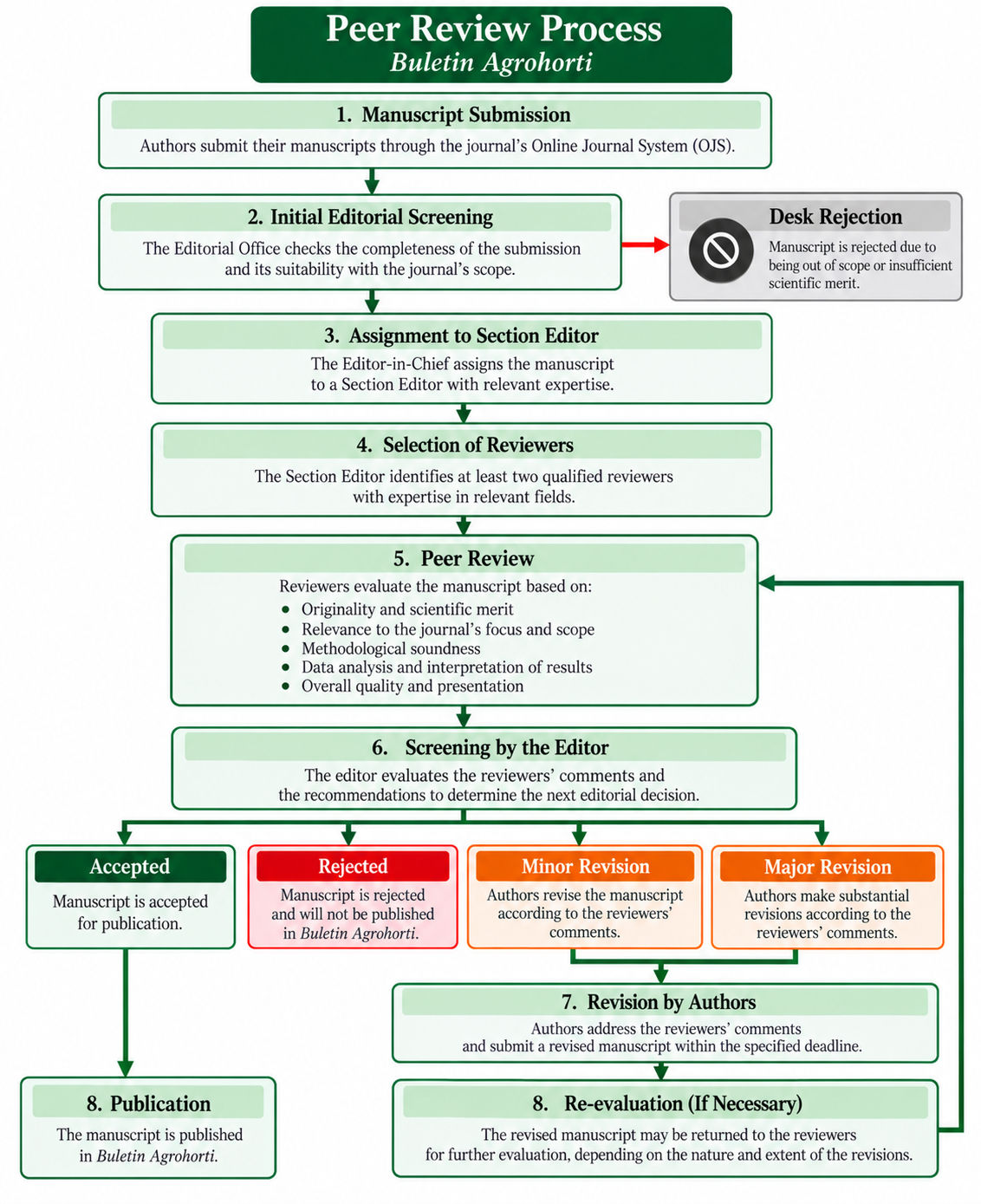
Buletin Agrohorti implements a double-blind peer review process to ensure the scientific quality, originality, and integrity of all manuscripts submitted for publication. Under this system, the identities of authors and reviewers remain confidential throughout the review process to maintain objectivity and impartiality. Each manuscript that passes the initial editorial screening is evaluated by at least two qualified reviewers with expertise relevant to the journal's focus and scope.
Submission and Initial Editorial Screening
All manuscripts must be submitted through the journal's Online Journal System (OJS) and comply with the journal's author guidelines and publication ethics policies.
The Editorial Office conducts an initial screening to assess the completeness of the submission, compliance with the journal's requirements, and suitability for its focus and scope. Manuscripts that do not meet these requirements may be returned to the authors for correction or rejected without proceeding to peer review (desk rejection).
Manuscripts that pass the initial screening are forwarded to the Editor-in-Chief, who assigns them to a Section Editor with relevant expertise to coordinate the peer review process.
Double-Blind Peer Review
The Section Editor selects at least two qualified reviewers with expertise in agronomy, horticulture, or other relevant fields. The journal employs a double-blind peer review system, ensuring that the identities of both authors and reviewers remain confidential throughout the review process.
Reviewers independently evaluate manuscripts based on the following criteria:
- Originality and scientific merit.
- Relevance to the journal's focus and scope.
- Methodological soundness.
- Appropriateness of data analysis and interpretation of results.
- Overall quality, clarity, and presentation of the manuscript.
Reviewers provide constructive comments, suggestions, and recommendations to improve the scientific quality of the manuscript. The Section Editor communicates the reviewers' comments to the authors for revision.
Editorial Evaluation and Decision
Following the peer review process, the Section Editor evaluates the reviewers' comments and recommendations and provides an assessment to the Editor-in-Chief. The Editor-in-Chief makes the editorial decision based on the reviewers' evaluations and the Section Editor's recommendation.
The possible editorial decisions include:
- Acceptance: The manuscript is accepted for publication.
- Rejection: The manuscript does not meet the journal's scientific or editorial standards and is rejected for publication.
- Minor Revision: The manuscript requires minor corrections or improvements based on the reviewers' and editors' comments.
- Major Revision: The manuscript requires substantial revisions to address scientific, methodological, or presentation-related concerns.
Revision and Re-evaluation
For manuscripts requiring minor or major revisions, the reviewers' and editors' comments are communicated to the corresponding author. Authors are expected to carefully address all comments and submit a revised manuscript within the specified deadline.
The revised manuscript should be accompanied by a point-by-point response explaining how each comment has been addressed or providing justification for suggestions that have not been incorporated.
The Section Editor evaluates the revised manuscript to determine whether the revisions adequately address the comments. Depending on the nature and extent of the revisions, the manuscript may be returned to the reviewers for further evaluation.
Additional rounds of revision and re-evaluation may be required before the Editor-in-Chief makes a final decision.
Final Acceptance and Publication
Once a manuscript receives final acceptance, it proceeds to the publication stage, where it undergoes copyediting and layout preparation. A galley proof is then sent to the authors for final review and approval before publication in Buletin Agrohorti. Throughout this process, the corresponding author will be notified of each stage via email and the journal's online submission system (OJS).