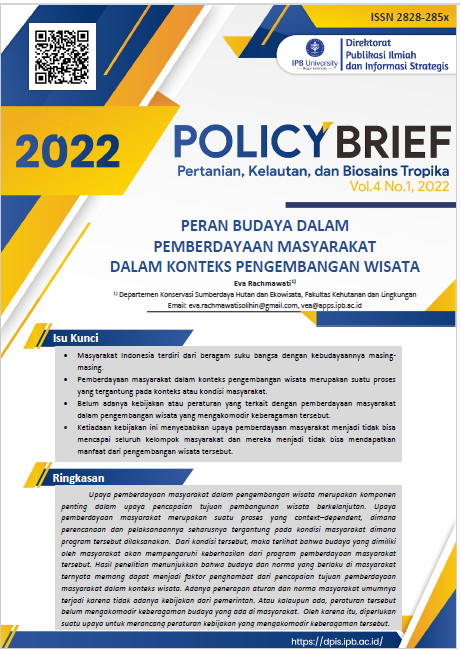
Peran Budaya Dalam Pemberdayaan Masyarakat Dalam Konteks Pengembangan Wisata
DOI:
https://doi.org/10.29244/agro-maritim.0401.230-234Keywords:
Pemberdayaan Masyarakat, Wisata, Perencanaan, Pemerintah, KebijakanAbstract
Upaya pemberdayaan masyarakat dalam pengembangan wisata merupakan komponen penting dalam upaya pencapaian tujuan pembangunan wisata berkelanjutan. Upaya pemberdayaan masyarakat merupakan suatu proses yang context dependent, dimana perencanaan dan pelaksanaannya seharusnya tergantung pada kondisi masyarakat dimana program tersebut dilaksanakan. Dari kondisi te rsebut, maka terlihat bahwa budaya yang dimiliki oleh masyarakat akan mempengaruhi keberhasilan dari program pemberdayaan masyarakat tersebut. Hasil penelitian menunjukkan bahwa budaya dan norma yang berlaku di masyarakat ternyata memang dapat menjadi faktor penghambat dari pencapaian tujuan pemberdayaan masyarakat dalam konteks wisata. Adanya penerapan aturan dan norma masyarakat umumnya terjadi karena tidak adanya kebijakan dari pemerintah. Atau kalaupun ada, peraturan tersebut belum mengakomodir keberagaman budaya yang ada di masyarakat. Oleh karena itu, diperlukan suatu upaya untuk merancang peraturan kebijakan yang mengakomodir keberagaman tersebut.
References
Alison, M. B., & Nobles, J. (2009). Ethnic diversity, traditional norms, and marriage behaviour in Indonesia. Population Studies. 63(3), 277–294. https://doi.org/10.2307/40646425 DOI: https://doi.org/10.1080/00324720903137224
Alsop, R., & Heinsohn, N. (2005). Measuring Empowerment in Practice: Structuring Analysis and Framing Indicators. World Bank Policy Research Working Paper 3510. DOI: https://doi.org/10.1596/1813-9450-3510
Ayscue, E. P., Boley, B. B., Maruyama, N., & Woosnam, K. M. (2016). Testing for gender discrepancies using the Resident Empowerment through Tourism Scale.
Batson, C. D., Ahmad, N., & Tsang, J. (2002). Four motives for community involvement. Journal of Social Issues. 58(3), 429–445. DOI: https://doi.org/10.1111/1540-4560.00269
Blanke, J., & Chiesa, T. (2013). The travel & tourism competitiveness report 2013: reducing barriers to economic growth and job creation. World Economic Forum.
Cao, X. (2015). Challenges and potential improvements in the policy and regulatory framework for sustainable tourism planning in China: The case of Shanxi Province. Journal of Sustainable Tourism. 23(3), 455–476. https://doi.org/10.1080/09669582.2014.957207 DOI: https://doi.org/10.1080/09669582.2014.957207
Carson, D. A., Carson, D. B., & Hodge, H. (2014). Understanding local innovation systems in peripheral tourism destinations. Tourism Geographies. 16(3): 457–473. https://doi.org/10.1080/14616688.2013.868030 DOI: https://doi.org/10.1080/14616688.2013.868030
Cole, S. (2007). Beyond authenticity and commodification. Annals of Tourism Research. 34(4): 943–960. https://doi.org/doi:10.1016/j.annals.2007.05.004 DOI: https://doi.org/10.1016/j.annals.2007.05.004
Dolezal, C. (2015). Questioning empowerment in community-based tourism in rural Bali: Vol. Doctor of. the University of Brighton.
Forshee, J. (2006). Culture and Customs of Indonesia. Greenwood Publishing Group. DOI: https://doi.org/10.5040/9798400635434
Giampiccoli, A., & Hayward Kalis, J. (2012). Community-based tourism and local culture: the case of the amaMpondo. DOI: https://doi.org/10.25145/j.pasos.2012.10.017
Knight, D. W., & Cottrell, S. P. (2016). Evaluating tourism-linked empowerment in Cuzco, Peru. Annals of Tourism Research. 56: 32–47. https://doi.org/http://dx.doi.org/10.1016/j.annals.2015.11.007 DOI: https://doi.org/10.1016/j.annals.2015.11.007
Macbeth, J., Carson, D., & Northcote, J. (2008). Social capital, tourism and regional development: SPCC as a basis for innovation and sustainability. Current Issues in Tourism. 7(6): 502–522. https://doi.org/10.1080/1368350050408668200 DOI: https://doi.org/10.1080/1368350050408668200
Maruyama, N. U., Woosnam, K. M., & Boley, B. B. (2016). Residents’ attitudes toward ethnic neighborhood tourism (ENT): perspectives of ethnicity and empowerment. Tourism Geographies: 1–22. https://doi.org/10.1080/14616688.2016.1258432 DOI: https://doi.org/10.1080/14616688.2016.1258432
Mehring, M., Seeberg-Elverfeldt, C., Koch, S., Barkmann, J., Schwarze, S., & Stoll-Kleemann, S. (2011). Local institutions: Regulation and valuation of forest use—Evidence from Central Sulawesi, Indonesia. Land Use Policy. 28(4): 736–747. https://doi.org/http://dx.doi.org/10.1016/j.landusepol.2011.01.001 DOI: https://doi.org/10.1016/j.landusepol.2011.01.001
Moscardo, G., Schurmann, A., Konovalov, E., & McGehee, N. G. (2013). Using tourism to build social capital in communities: New pathways to sustainable tourism futures.
Rachmawati, E. (2018). Tourism and community empowerment: Critical insights from Indonesia [Lincoln University]. http://researcharchive.lincoln.ac.nz/handle/10182/11036
Reisinger, Y., & Turner, L. W. (2003). Cross-Cultural Behaviour in Tourism: Concepts and Analysis. Elsevier.
Scheyvens, R., & Scheyvens, R. (2015). Ecotourism and the Empowerment of Local Communities Ecotourism and the empowerment of local communities. Tourism Management.
Timothy, D. J. (2007). Empowerment and Stakeholder Participation in Tourism Destination Communities. In A. C. and T. Coles (Ed.), Tourism, power and space (pp. 199–216). Routledge.
Walpole, M. J., & Goodwin, H. J. (2000). Local economic impacts of dragon tourism in Indonesia. Annals of Tourism Research. 27(3): 559–576. https://doi.org/http://dx.doi.org/10.1016/S0160-7383(99)00088-2 DOI: https://doi.org/10.1016/S0160-7383(99)00088-2
Downloads
Published
Issue
Section
License
 This license enables reusers to distribute, remix, adapt, and build upon the material in any medium or format, so long as attribution is given to the creator. The license allows for commercial use. CC BY includes the following elements:
 BY: credit must be given to the creator.