Role of Stakeholders’ Knowledge in Designing Successful Interpretation Services in Conserving Natural Resources
Article Sidebar
-
tourism resources, tourist, programme, interpretation, trail
Abstract
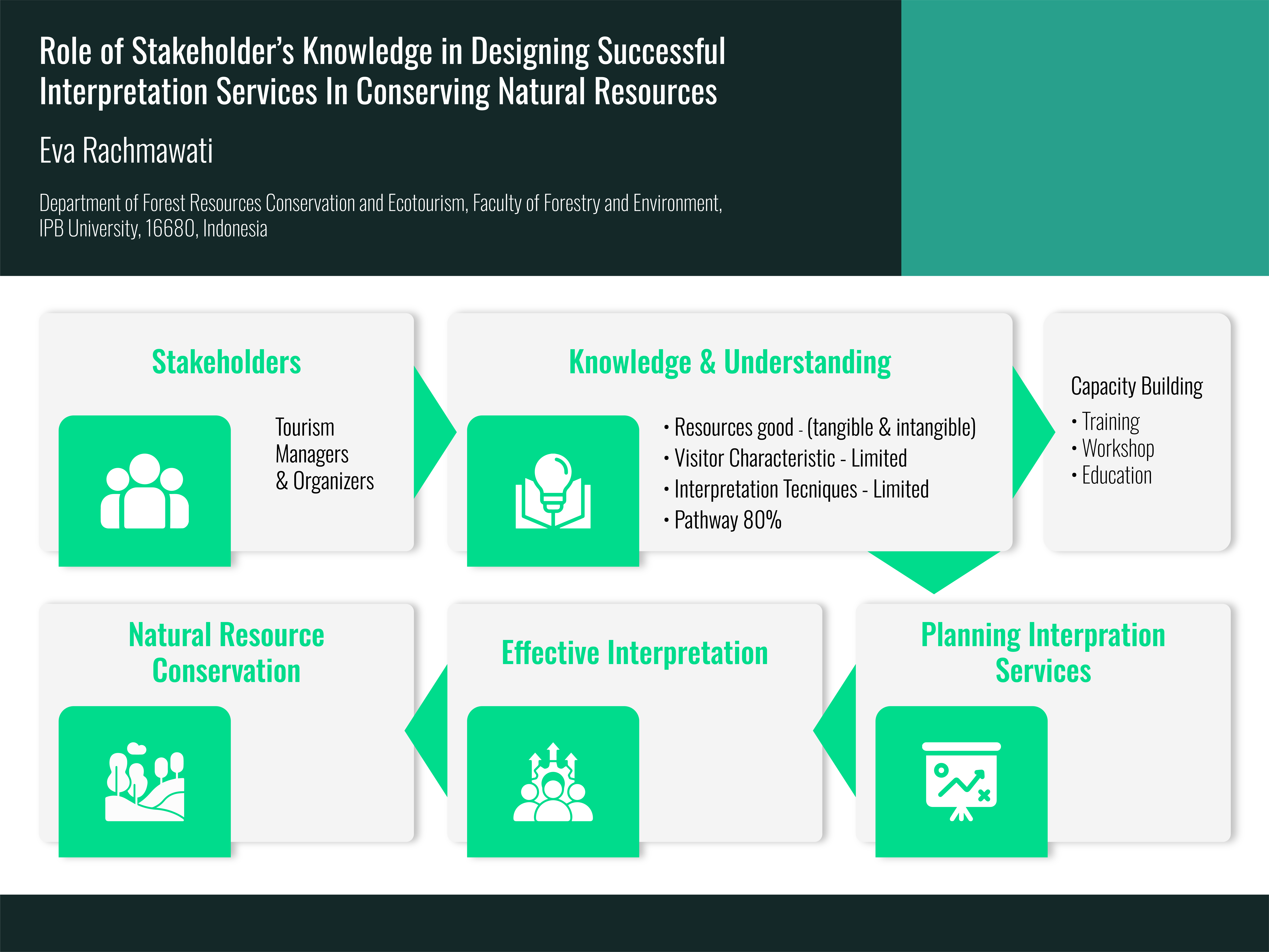
The goals of interpretation activities can be achieved if interpretation service planning is carried out correctly. The planning process could succeed if the planner has adequate knowledge and understanding of interpretation services. Knowledge and understanding are crucial to determining what to do. This research aims to measure the knowledge and understanding of tourism managers and organizers, as well as their interpretations of important aspects of interpretation, including interpretation resources, visitors' characteristics, and interpretation techniques. The research method used is qualitative. Data were collected through structured interviews with 15 informants (managers and organizers of interpretation activities). The interviews reveal that the managers and implementers of tourism activities and/or interpretations already possess a good knowledge and understanding of the interpretation resources available in the area, particularly regarding their tangible and intangible values. However, they still need to understand the universal concept of these resources. Additionally, all informants still need to gain more knowledge and understanding of the characteristics and backgrounds of visitors, as well as interpretation techniques. Only 80% of informants were aware of interpretation pathways, and 60% were aware of interpretation programs. This limited knowledge and understanding are assumed to be one of the inhibiting factors in the formulation of a good interpretation service. Ultimately, it becomes an inhibiting factor in creating public awareness regarding preserving natural resources. This research highlights the need to enhance the knowledge and understanding of interpretation stakeholders regarding the key aspects required for planning interpretation services through training, workshops, or formal education.
Full text article
References
1. Juma, L.O.; Khademi-Vidra, A. Nature Interpretation as an Environmental Educational Approach in Visitor Management; The Application Dilemma for Different Target Groups at Masai Mara National Reserve, Kenya. Sustain. 2022, 14, doi:10.3390/su14052935.
2. Tilden, F. Interpreting Our Heritage; The University of North Carolina Press: Washington, D.C., 1977; ISBN 0807840165.
3. Apps, K.; Dimmock, K.; Huveneers, C. Turning Wildlife Experiences into Conservation Action: Can White Shark Cage-Dive Tourism Influence Conservation Behaviour? Mar. Policy 2018, 88, 108–115, doi:10.1016/j.marpol.2017.11.024.
4. Alazaizeh, M.M.; Jamaliah, M.M.; Mgonja, J.T.; Ababneh, A. Tour Guide Performance and Sustainable Visitor Behavior at Cultural Heritage Sites. J. Sustain. Tour. 2019, 27, 1708–1724, doi:10.1080/09669582.2019.1658766.
5. Cheng, I.N.Y.; Cheung, L.T.O.; Chow, A.S.Y.; Fok, L.; Cheang, C.C. The Roles Interpretative Programmes in Supporting the Sustainable Operation of the Nature-Based Activities. J. Clean. Prod. 2018, 200, 380–389, doi:10.1016/j.jclepro.2018.07.293.
6. Sibian, A.R.; Untaru, E.N. An Overview of Interpretation in Tourism and It’s Role in Sustainable Tourism Development. J. Smart Econ. Growth 2023, 8, 127–146.
7. Lee, T.H.; Jan, F.H.; Chen, J.C. Influence Analysis of Interpretation Services on Ecotourism Behavior for Wildlife Tourists. J. Sustain. Tour. 2021, 0, 1–19, doi:10.1080/09669582.2021.1949016.
8. Zatori, A.; Smith, M.K.; Puczko, L. Experience-Involvement, Memorability and Authenticity: The Service Provider’s Effect on Tourist Experience. Tour. Manag. 2018, 67, 111–126, doi:10.1016/j.tourman.2017.12.013.
9. Poudel, S.; Nyaupane, G.P. The Role of Interpretative Tour Guiding in Sustainable Destination Management: A Comparison between Guided and Nonguided Tourists. J. Travel Res. 2013, 52, 659–672, doi:10.1177/0047287513478496.
10. Harun, R.; Chiciudean, G.O.; Sirwan, K.; Arion, F.H.; Muresan, I.C. Attitudes and Perceptions of the Local Community towards Sustainable Tourism Development in Kurdistan Regional Government, Iraq. Sustain. 2018, 10, 1–13, doi:10.3390/su10092991.
11. Cheng, T.M.; Wu, H.C. How Do Environmental Knowledge, Environmental Sensitivity, and Place Attachment Affect Environmentally Responsible Behavior? An Integrated Approach for Sustainable Island Tourism. J. Sustain. Tour. 2015, 23, 557–576, doi:10.1080/09669582.2014.965177.
12. Moscardo, G.; Hughes, K. Rethinking Interpretation to Support Sustainable Tourist Experiences in Protected Natural Areas. J. Interpret. Res. 2023, 28, 76–94, doi:10.1177/10925872231158988.
13. Malik, Y.M. Cultural Tourism Destination Elements and Attributes: An Interpretive Planning. J. Int. Coop. Dev. 2020, 3, 74, doi:10.36941/jicd-2020-0016.
14. Taylor, P. What Factors Make Rail Trails Successful as Tourism Attractions? Developing a Conceptual Framework from Relevant Literature. J. Outdoor Recreat. Tour. 2015, 12, 89–98, doi:http://dx.doi.org/10.1016/j.jort.2015.11.005.
15. MacLeod, N. Self-Guided Trails - A Route to More Responsible Tourism? Tour. Recreat. Res. 2016, 41, 134–144, doi:10.1080/02508281.2016.1147222.
16. Nevřelová, M.; Ružicková, J. Educational Potential of Educational Trails in Terms of Their Using in the Pedagogical Process (Outdoor Learning). Eur. J. Contemp. Educ. 2019, 8, 550–561, doi:10.13187/ejced.2019.3.550.
17. Coghlan, A.; Carter, L. Serious Games as Interpretive Tools in Complex Natural Tourist Attractions. J. Hosp. Tour. Manag. 2020, 42, 258–265, doi:10.1016/j.jhtm.2020.01.010.
18. Pye, S. Wildlife Tourism: Extending Post-Experience Conservation Engagement Through Interpretive Nonfiction Narratives. J. Responsible Tour. Manag. 2022, 2, 55–72, doi:10.47263/jrtm.02-02-04.
19. Tang, T.; Zhao, M.; Wang, D.; Chen, X.; Chen, W.; Xie, C.; Ding, Y. Does Environmental Interpretation Impact Public Ecological Flow Experience and Responsible Behavior? A Case Study of Potatso National Park, China. Int. J. Environ. Res. Public Health 2022, 19, doi:10.3390/ijerph19159630.
20. Frías-Jamilena, D.M.; Fernández-Ruano, M.L.; Polo-Peña, A.I. Gamified Environmental Interpretation as a Strategy for Improving Tourist Behavior in Support of Sustainable Tourism: The Moderating Role of Psychological Distance. Tour. Manag. 2022, 91, doi:10.1016/j.tourman.2022.104519.
21. Lim, W.M. What Is Qualitative Research? An Overview and Guidelines. Australas. Mark. J. 2025, 33, 199–229, doi:10.1177/14413582241264619.
22. Veverka, J.A. Interpretive Master Planning: Strategies for the New Millennium-Philosophy, Theory and Practice; Museums, 2015; ISBN 1910144495.
23. MacLeod, N. The Role of Trails in the Creation of Tourist Space. J. Herit. Tour. 2017, 12, 423–430, doi:10.1080/1743873X.2016.1242590.
24. Pereira, E.M.; Mykletun, R.J. Guides as Contributors to Sustainable Tourism? A Case Study from the Amazon. Scand. J. Hosp. Tour. 2012, 12, 74–94, doi:10.1080/15022250.2012.663558.
25. Veverka, J.A. Interpretive Master Planning: Philosophy, Theory and Practice; MuseumsEtc, 2018; Vol. Volume Two; ISBN 1560442743.
26. Nowacki, M. Heritage Interpretation and Sustainable Development: A Systematic Literature Review. Sustain. 2021, 13, doi:10.3390/su13084383.
27. Smith, J.R.; Witherington, B.; Heimlich, J.E.; Lindborg, R.J.; Neidhardt, E.; Savage, A. Public Sea Turtle Watches Serve as Effective Environmental Education. Environ. Educ. Res. 2019, 25, 292–308, doi:10.1080/13504622.2018.1509300.
28. Jacobs, M.H.; Harms, M. Influence of Interpretation on Conservation Intentions of Whale Tourists. Tour. Manag. 2014, 42, 123–131, doi:http://dx.doi.org/10.1016/j.tourman.2013.11.009.
29. Stewart, M.A. Managing Heritage Site Interpretation for Older Adult Visitors. SYMPHONYA Emerg. Issues Manag. 2016, 2, 93–107.
30. Wyatt, B.; Leask, A.; Barron, P. Designing Dark Tourism Experiences: An Exploration of Edutainment Interpretation at Lighter Dark Visitor Attractions. J. Herit. Tour. 2021, 16, 433–449, doi:10.1080/1743873X.2020.1858087.
31. Zhao, M.; Dong, S.; Wu, H.C.; Li, Y.; Su, T.; Xia, B.; Zheng, J.; Guo, X. Key Impact Factors of Visitors’ Environmentally Responsible Behaviour: Personality Traits or Interpretive Services? A Case Study of Beijing’s Yuyuantan Urban Park, China. Asia Pacific J. Tour. Res. 2018, 23, 792–805, doi:10.1080/10941665.2018.1493518.
32. Cheng, I.N.Y.; Cheung, L.T.O.; Chow, A.S.Y.; Fok, L.; Cheang, C.C. The Roles Interpretative Programmes in Supporting the Sustainable Operation of the Nature-Based Activities. J. Clean. Prod. 2018, 200, 380–389, doi:10.1016/j.jclepro.2018.07.293.
33. Wan Mohamad Ariffin, W.N.S.; Ching, G.H. The Effectiveness of Environmental Interpretation in Influencing Visitors’ Knowledge in Kinabalu Park. Asian J. Environ. Stud. 2019, 4, 67–80, doi:10.21834/aje-bs.v4i14.355.
34. Gaede, D.; Strickert, D.; Jurin, R.R. Nature-Based Tourism Businesses in Colorado: Interpreting Environmental Ethics and Responsible Behavior. J. Tour. Insights 2011, 1, 6.
35. Harun, S.N.; Mat Zin, M.R. Assessing the Rural Cultural Significance for Heritage Tourism Development in Perak Tengah District. Malaysian J. Sustain. Environ. 2018, 4, 37, doi:10.24191/myse.v4i1.5605.
36. Powell, R.B.; Vezeau, S.L.; Stern, M.J.; Moore, D.W.D.; Wright, B.A. Does Interpretation Influence Elaboration and Environmental Behaviors? Environ. Educ. Res. 2018, 24, 875–888, doi:10.1080/13504622.2017.1339302.
Authors
Copyright (c) 2025 Eva Rachmawati

This work is licensed under a Creative Commons Attribution 4.0 International License.
Media Konservasi is an open access journal, meaning that all content is freely available without charge to the user or their institution. Users are allowed to read, download, copy, distribute, print, search, or link to the full texts of the articles in this journal without needing to request prior permission from the publisher or the author.
All articles published by Media Konservasi are licensed under the Creative Commons Attribution 4.0 International License. This allows for unrestricted use, distribution, and reproduction in any medium, provided proper credit is given to the original authors.
Authors submitting manuscripts should understand and agree that the copyright of published manuscripts is retained by the authors. Copyright encompasses the exclusive rights of authors to reproduce, distribute, and sell any part of the journal articles in all forms and media. Reproduction of any part of this journal, its storage in databases, and its transmission by any form or media is allowed without written permission from Media Konservasi.
Article Details
How to Cite



