Evaluation of Catechin Content in Gambir Leaf Herbal Tea Using NIR Spectroscopy with PLS and MLR
DOI:
https://doi.org/10.19028/jtep.014.1.64-80Keywords:
calibration models, catechin, gambir leaves, NIRSAbstract
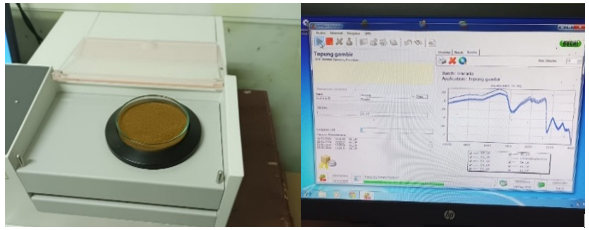
Several factors, including drying duration, leaf maturity level, and drying temperature, can influence the catechin content of gambir herbal tea. Therefore, evaluating the quality of gambir herbal tea is essential. The commonly used method involves laboratory chemical analysis, which is destructive, generates chemical waste, and requires considerable time. The objective of this study was to develop an NIR model capable of rapidly, nondestructively, and environmentally friendly predicting the catechin content of gambir herbal tea. The reflectance of herbal tea samples was measured using a Büchi NIRFlex N500 spectrophotometer over 1000–2500 nm. The catechin content was determined through chemical analysis using ethanol as the solvent. Spectral data were calibrated against the actual catechin values using Partial Least Squares (PLS) and Multiple Linear Regression (MLR) in The Unscrambler X software. The pretreatments applied included Standard Normal Variate (SNV), Multiplicative Scatter Correction (MSC), and Baseline correction. The best model was obtained using the MLR method combined with MSC pretreatment, yielding Rc² = 0.91, Rp² = 0.92, RMSEC = 1.78, RMSEP = 1.79, SEC = 1.69, SEP = 1.77, RPD = 3.44, and RER = 10.77. The PLS model with Baseline pretreatment also produced reliable predictions with Rc² = 0.93, Rp² = 0.89, RMSEC = 1.50, RMSEP = 2.09, SEC = 1.52, SEP = 2.08, RPD = 3.00, and RER = 9.56. This study successfully developed an NIR model capable of predicting catechin content in gambir leaves herbal tea with strong predictive performance
Downloads
Downloads
Published
Issue
Section
License
Copyright (c) 2026 Jurnal Keteknikan Pertanian

This work is licensed under a Creative Commons Attribution-ShareAlike 4.0 International License.
Authors submitting manuscripts should understand and agree that copyright of manuscripts of the article shall be assigned/transferred to Jurnal Keteknikan Pertanian. This work is licensed under a Creative Commons Attribution-ShareAlike 4.0 International License (CC BY-SA) where Authors and Readers can copy and redistribute the material in any medium or format, as well as remix, transform, and build upon the material for any purpose, but they must give appropriate credit (cite to the article or content), provide a link to the license, and indicate if changes were made. If you remix, transform, or build upon the material, you must distribute your contributions under the same license as the original.
Jurnal Keteknikan Pertanian is an open access journal.