Application NIR Spectroscopy for Prediction Soluble Solids Content and Classification of Tomatoes During Storage
DOI:
https://doi.org/10.19028/jtep.013.4.653-666Keywords:
Nir spectroscopy, Soluble Solids Content, Tomato, Storage Temperature, Ripeness LevelAbstract
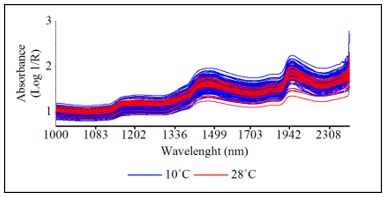
Tomatoes are a horticultural commodity that is highly susceptible to quality degradation after harvest; therefore, appropriate postharvest handling is required to maintain quality. This study aims to evaluate the potential of near-infrared (NIR) spectroscopy for assessing tomato quality by applying partial least squares (PLS) to predict soluble solids content (SSC) and linear discriminant analysis (LDA) for classification based on storage temperature and ripeness level, with SNV pretreatment. Tomato samples were stored at 10 °C and 28 °C and observed at the breaker and pink ripeness stages. The best PLS model was obtained with SNV pretreatment and 10 latent variables, yielding R² calibration = 0.89, RMSEC = 0.19°Brix, R² prediction = 0.80, and RMSEP = 0.26 °Brix. The RPD value of 2.04 and the RER of 8.08 indicate that the model has a good predictive ability for evaluating tomato SSC. Meanwhile, LDA distinguished storage temperature better (accuracy 89.13%) than ripeness level (accuracy 65.21%). These results demonstrate that NIR spectroscopy can be used as an effective nondestructive method for analyzing the SSC of tomatoes during storage, reflecting the levels of sugars, organic acids, and other soluble compounds that contribute to the taste and overall fruit quality.
Keywords: NIR Spectroscopy, Soluble Solids Content, Storage Temperature, Ripeness Level, Tomato.
Downloads
Downloads
Published
Issue
Section
License
Copyright (c) 2026 Andasuryani Andasuryani, Raisal Maulana, Dinah Cherie

This work is licensed under a Creative Commons Attribution-ShareAlike 4.0 International License.
Authors submitting manuscripts should understand and agree that copyright of manuscripts of the article shall be assigned/transferred to Jurnal Keteknikan Pertanian. This work is licensed under a Creative Commons Attribution-ShareAlike 4.0 International License (CC BY-SA) where Authors and Readers can copy and redistribute the material in any medium or format, as well as remix, transform, and build upon the material for any purpose, but they must give appropriate credit (cite to the article or content), provide a link to the license, and indicate if changes were made. If you remix, transform, or build upon the material, you must distribute your contributions under the same license as the original.
Jurnal Keteknikan Pertanian is an open access journal.