Prediction of Chemical Content in Robusta Coffee Beans Using Near Infrared Spectroscopy and Artificial Neural Network
DOI:
https://doi.org/10.19028/jtep.013.2.318-339Keywords:
Kalibrasi, kopi, NIRS, PCA-ANN, validasiAbstract
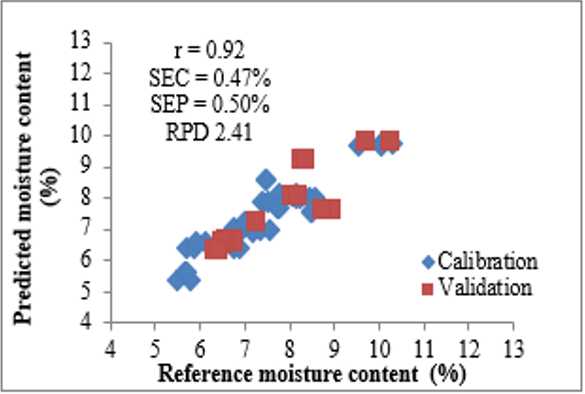
A rapid method to predict chemical content of robusta coffee is necessity, instead of chemical method that time consuming and expensive. This research aimed to predict chemical content of Pagar Alam robusta coffee beans using Near Infrared Spectroscopy (NIRS) and calibration through Principal Component Analysis-Artificial Neural Network (PCA-ANN). Reflectance of coffee bean was measured using NIR Flex N500 Spectrometer (1000–2500 nm), followed by determination of its chemical content using chemical method. The reflectance data were processed using spectra pre-treatment, then calibrated and validated with chemical content using PCA-ANN. The best model for moisture content was achieved with No1SG1 pre-treatment and 8 PC (r = 0.95; RPD = 2.95; consistency = 90.36%). Protein content can be predicted using 8 PC and No1SG1 pre-treatment (r = 0.92; RPD = 2.38; consistency = 96.78%). Good fat prediction employed No1SG1 pre-treatment and 10 PC (r = 0.93; RPD = 2.19; consistency = 80.08%). Ash content can be predicted using 8 PC and SG1 pre-treatment (r = 0.93; RPD = 2.29; consistency = 83.78%). The best carbohydrate prediction was obtained with No1SG1 pre-treatment and 5 PC (r = 0.93; RPD = 2.73; consistency = 108.85%). The results indicate that NIR spectroscopy can be used to predict accurately the chemical content of Pagar Alam robusta coffee beans.
Downloads
Downloads
Published
Issue
Section
License
Authors submitting manuscripts should understand and agree that copyright of manuscripts of the article shall be assigned/transferred to Jurnal Keteknikan Pertanian. This work is licensed under a Creative Commons Attribution-ShareAlike 4.0 International License (CC BY-SA) where Authors and Readers can copy and redistribute the material in any medium or format, as well as remix, transform, and build upon the material for any purpose, but they must give appropriate credit (cite to the article or content), provide a link to the license, and indicate if changes were made. If you remix, transform, or build upon the material, you must distribute your contributions under the same license as the original.
Jurnal Keteknikan Pertanian is an open access journal.