Portable Minapadi Model and Its Performance for Urban Farming
DOI:
https://doi.org/10.19028/jtep.013.2.195-210Keywords:
automatic irrigation, minapadi, revenue, rice and fish production, urban agricultureAbstract
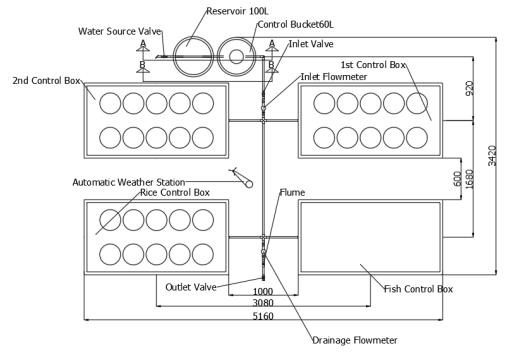
The conversion of agricultural land to non-agricultural uses has threatened the food supply of urban areas. While there are many unused open spaces in the areas that would have the potential to produce certain foods that are regularly consumed. It is then necessary to introduce cultivation techniques that match the area’s conditions and operable by the people with no, or less experience in farming. This study aims to come up with a portable Minapadi (paddy and fish) culture deemed suitable for urban farming and identify its performance to produce rice as well as fish. The model was tested for one season (99 days) with the main parameters observed being water balances, rice and fish production and revenue. Applying automatic irrigation without using electricity, the irrigation water consumption was 738 mm with an efficiency of 54%. Land and water productivity were 3.62 tons/ha and 0.96 kg/m³, respectively. The fish survival rate was 85% with total production of 3.34 kg and feed efficiency of 2.74. This model earned IDR7,054.94/m³ for rice and IDR36,989.82/m³ for fish with total revenue of IDR44,044.76/m³. These results confirmed that this minapadi model has potential application to support the development of urban agriculture.
Downloads
Downloads
Published
Issue
Section
License
Authors submitting manuscripts should understand and agree that copyright of manuscripts of the article shall be assigned/transferred to Jurnal Keteknikan Pertanian. This work is licensed under a Creative Commons Attribution-ShareAlike 4.0 International License (CC BY-SA) where Authors and Readers can copy and redistribute the material in any medium or format, as well as remix, transform, and build upon the material for any purpose, but they must give appropriate credit (cite to the article or content), provide a link to the license, and indicate if changes were made. If you remix, transform, or build upon the material, you must distribute your contributions under the same license as the original.
Jurnal Keteknikan Pertanian is an open access journal.