Utilization of Greenhouse Solar Dryer For Curing Process of Sweet Potato
DOI:
https://doi.org/10.19028/jtep.013.2.179-194Keywords:
curing, greenhouse solar dryer, ubi jalar, umbi-umbianAbstract
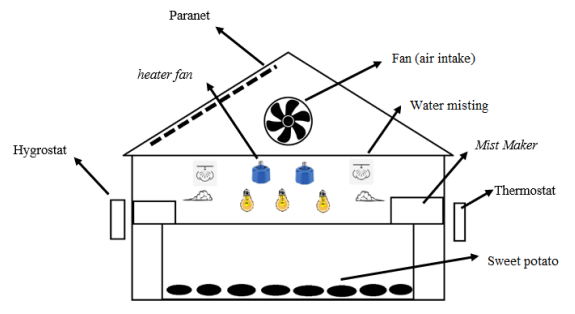
Sweet potato (Ipomoea batatas L.) Cilembu is an export commodity with a high economic value. However, approximately 50% of Cilembu sweet potato harvests do not meet export quality. One of the reasons was uncontrolled curing process. Temperature and Relative Humidity (RH) are environmental factors that significantly influence the curing process. The purpose of this study was to develop a control method and conduct a temperature and RH performance test in a drying house in accordance with the needs of the curing process, and to analyze the effects of temperature, RH, and curing time on the quality of sweet potatoes. The study was conducted experimentally in three stages: tool performance testing, preliminary research, and main research. The experimental design used was a completely randomized factorial design with three factors: temperature (30°C and 35°C), RH (80% and 90%), and curing time (3 days and 5 days). The quality parameters observed were physical damage, skin color, texture, water content, and Total soluble solids. The results of the study showed that the drying house with additional controllers connected to the thermostat and hygrostat was able to control the temperature and RH in the drying house according to the needs of the curing process in the drying house for 24 h. During the storage period, treatment with the curing process increased the Total Soluble Solids value when compared to the control. The curing process at a temperature of 30°C (T1), humidity of 90% (H2), and curing period of 3 days (D3) was able to maintain the quality of sweet potatoes during storage.
Downloads
Downloads
Published
Issue
Section
License
Authors submitting manuscripts should understand and agree that copyright of manuscripts of the article shall be assigned/transferred to Jurnal Keteknikan Pertanian. This work is licensed under a Creative Commons Attribution-ShareAlike 4.0 International License (CC BY-SA) where Authors and Readers can copy and redistribute the material in any medium or format, as well as remix, transform, and build upon the material for any purpose, but they must give appropriate credit (cite to the article or content), provide a link to the license, and indicate if changes were made. If you remix, transform, or build upon the material, you must distribute your contributions under the same license as the original.
Jurnal Keteknikan Pertanian is an open access journal.