
Descriptive GC–MS Profiling of Volatile Compounds in Cendana (Santalum album L.) Wood from Three Gunungkidul Sites: Silvicultural Implications for Site Matching
Article Sidebar
-
GC-MS profiling, Gunung Kidul, Santalum album, silvicultural implications, wood volatile compounds
Abstract
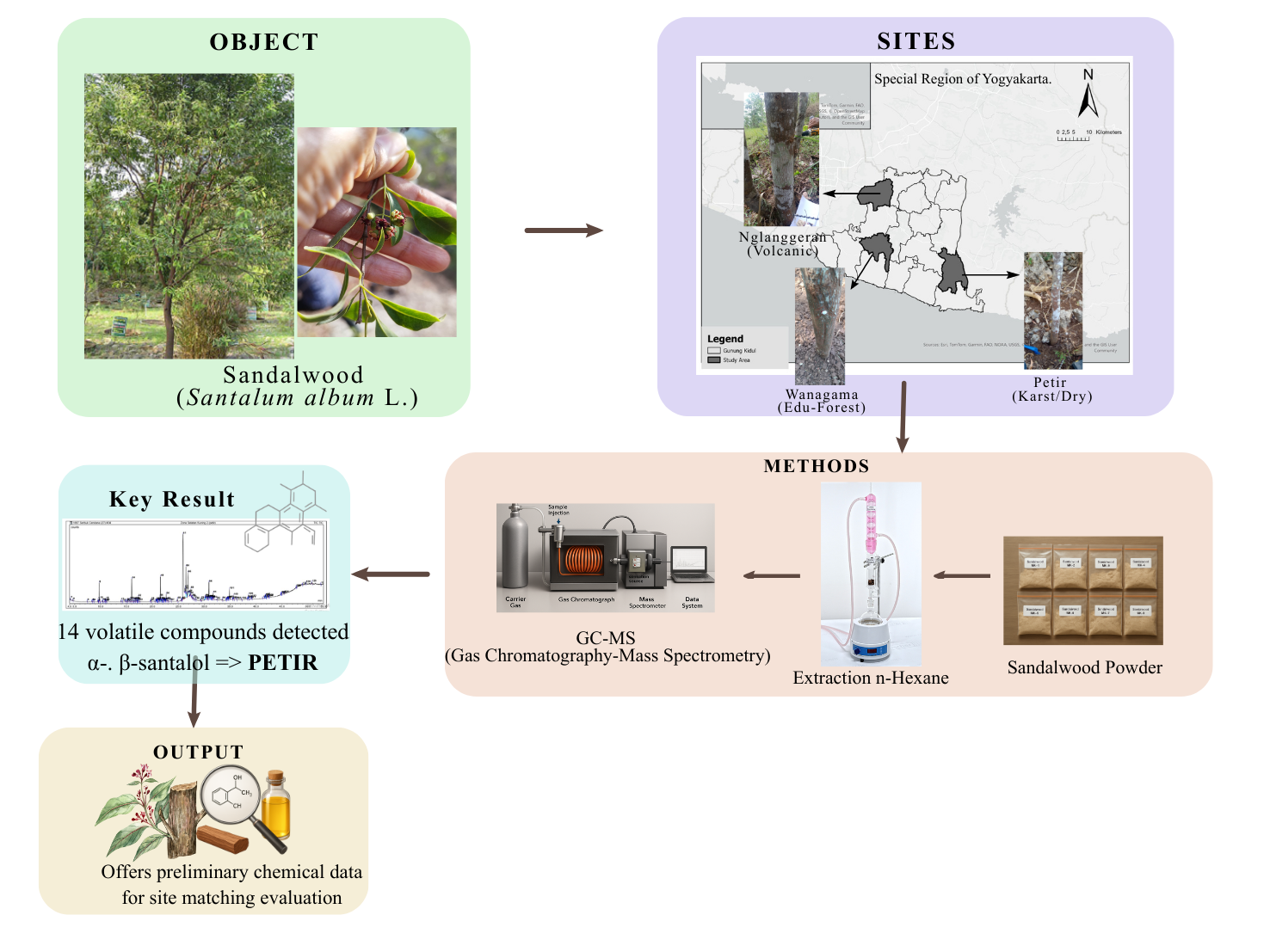
Santalum album L. (sandalwood) is one of the world’s most valuable aromatic tree species, with oil quality largely determined by α- and β-santalol content. Despite extensive studies in India and Australia, little is known about how ecological variation in Java shapes the chemical composition of S. album wood. This research objective is to identify volatile compounds in the outerwood of
S.album from Nglanggeran, Wanagama, and Petir, Gunungkidul, as a preliminary study with implications for S. album silviculture. Samples were obtained from three mature trees per site, extracted with n-hexane, and analyzed using Gas Chromatography-Mass Spectrometry. Fourteen volatile compounds were detected across sites, comprising aliphatic hydrocarbons (undecane,
pentadecane, dodecane, trimethyl isomers, hexadecane) and sesquiterpene alcohols (α- and β-santalol). The results show that the S. album compound profile differs across the 3 research sites. In this research, α-santalol (21.18 ± 12.87 %) and β-santalol (6.54 ± 4.19 %) were detected only in samples from Petir and Nglanggeran. The dominant compounds in the samples from Nglanggeran
and Wanagama are alkane groups. The results stipulate that Petir has the prospective to produce good sandalwood oil. This preliminary study also shows the use of applying a phytochemistry profile to specify area-specific chemical expression in sandalwood. While the present results are based on a limited set of detectable compounds, they provide an initial foundation for identifying promising production areas, and more extensive, replicated research will be vital to boost and validate these initial findings.
Full text article
References
[2] ISO 3518-2025, “International Standard ISO 3518 Essential oil of sandalwood iTeh Standards iTeh Standards,” 2025.
[3] S. Agarwal, R. Arif, K. Singh, L. McGregor, and V. Tomar, “Investigating the Volatilome of Sandalwood Powder Using Comprehensive Two-Dimensional Gas Chromatography Coupled with Time-of-Flight Mass Spectrometry.,” South East Eur J Public Heal., vol. 26, 2025.
[4] S. Tripathi, P. Kumar, P. Kumar, S. Kumar, and S. Naik, “Materials Today : Proceedings Comparison of yield and quality of sandalwood oil extracted from heartwood of trees cultivated in different states of India,” Mater. Today Proc., vol. 57, pp. 2400–2405, 2022, doi: 10.1016/j.matpr.2021.12.536.
[5] X. Liu, Q. Zhang, Z. Hong, and D. Xu, “Induction of Heartwood Formation in Young Indian Sandalwood (Santalum Album L.) by Gas Elicitors.,” Front. Plant Sci., vol. 13, p. 961391, 2022, [Online]. Available: doi:10.3389/fpls.2022.961391.
[6] M. . Ariyanti and Y. Asbur, “Cendana ( Santalum album L .) sebagai tanaman penghasil minyak atsiri Sandalwood ( Santalum album L .) as essential oil producing plant,” Kultivasi, vol. 17, no. 1, pp. 558–567, 2018, [Online]. Available: doi:10.24198/kultivasi.v17i1.15804.
[7] S. S. Bisht, M. Ravindra, and D. N. Gayathri, “Variability in yield and composition of oil from Indian Sandalwood ( Santalum album L .) trees grown in homogeneous conditions,” vol. 6, no. 1, pp. 31–36, 2019, doi: 10.22271/tpr.2019.v6.i1.006.
[8] X. H. Zhang, Y. X. Jia, J. T. Zhao, and G. H. Ma, “Chemical Composition of Volatile Oils from the Pericarps of Indian Sandalwood (Santalum album) by Different Extraction Methods,” Nat. Prod. Commun. Vol., vol. 7, no. 1, pp. 93–96, 2012, doi: 10.1177/1934578X1200700132.
[9] C. G. Jones, E. L. Ghisalberti, J. A. Plummer, and E. L. Barbour, “Quantitative Co-Occurrence of Sesquiterpenes; a Tool for Elucidating Their Biosynthesis in Indian Sandalwood, Santalum Album.,” Phytochemistry, vol. 67, pp. 2463–2468, 2006, [Online]. Available: doi:10.1016/j.phytochem.2006.09.013.
[10] Y. Matsuo, H. Sakagami, and Y. Mimaki, “A Rare Type of Sesquiterpene and β -Santalol Derivatives from Santalum album and Their Cytotoxic Activities,” Chem. Pharm. Bull., vol. 62, no. 12, pp. 1192–1199, 2014.
[11] M. C. Cancellieri, D. Maggioni, L. Di Maio, D. Fiorito, E. Brenna, and F. G. Gatti, “Biocatalytic Approaches for a More Sustainable Synthesis of Sandalwood Fragrances.,” Green Chem. 2024, vol. 26, pp. 6150–6159, 2024, doi: 10.1039/d4gc00746h.
[12] H. Ofori, “Characterisation of sandalwood essential oils using high performance thin- layer chromatography and high resolution gas chromatography mass,” Edith Cowan University: Perth, 2020, pp. 4–7.
[13] B. B. Misra and S. Dey, “Quantitative and Qualitative Evaluation of Esquiterpenoids from Essential Oil and in Vitro Somatic Embryos of East Indian Sandalwood (Santalum Album) Tree by HPTLC and GC.,” J. Med. Aromat. Plants, vol. 4, 2013, [Online]. Available: doi:10.1016/j.phytochem.2006.09.013.
[14] R. Kumar, S. Ray, V. Varatharaj, and L. Ku, “Axial and Radial Variation in Oil Yield and Santalol Content of Santalum Album L. (Indian Sandalwood).,” Int. Wood Prod. J., vol. 15, pp. 39–43, 2024, doi: 10.1177/20426445231221066.
[15] G. Chen, M. Li, N. Huang, C. Wen, and A. Wang, “Determination of Aroma Composition of Santalum Album Linn by Solid-Phase Microextraction-Gas Chromatography-Mass Spectrometry.,” AgEcon Search, vol. 12, 2021.
[16] K. Swandiyasa, N. M. Puspawati, and I. A. R. A. Asih, “POTENSI EKSTRAK DAUN CENDANA (Santalum Album L.) SEBAGAI SENYAWA PENGHAMBAT JAMUR Candida Albicans.,” J. Kim., pp. 159–165, 2019, [Online]. Available: doi:10.24843/JCHEM.2019.v13.i02.p06
[17] A. Gürgen, İ. Uysal, N. Ünlü, and M. SEVİNDİK, “The Power of Sandalwood ( Santalum album ): Industrial Use , Biological Activity , and Phytochemical Contents,” Drewno. Pr. Nauk. Doniesienia, Komun. = wood. Res. Pap. Reports, Announc., 2025, doi: 10.53502/wood-202680.
[18] R. Arifriana, S. Indrioko, and A. Syahbudin, “Variation of sandalwood (Santalum album Linn.) based on leaf and flower morphology in Petir Village, Rongkop, Gunungkidul.,” J. Ilmu Kehutan., vol. 11, pp. 36–43, 2017, [Online]. Available: doi: 10.22146/jik.24905.
[19] J. Moniodis et al., “Sesquiterpene Variation in West Australian Sandalwood (Santalum Spicatum).,” Molecules, vol. 22, p. 940, 2017, doi: 10.3390/molecules22060940.
[20] S. Agarwal, R. Arif, S. K. Joshi, I. Jahan, A. Sharma, and S. Dhoke, “Exploring Traditional Uses, Phytochemistry, Pharmacology and Future Prospectives of Santalum album.,” J. Neonatal Surg., vol. 14, no. 4, pp. 337–351, 2025.
[21] G. N. Njurumana, “Pelestarian cendana ( Santalum album ) berbasis masyarakat di Kabupaten Sumba Tengah , Nusa Tenggara Timur Community based conservation of sandalwood ( Santalum album ) in Central Sumba District,” vol. 1, no. BanoEt 2001, pp. 1605–1609, 2015, doi: 10.13057/psnmbi/m010711.
[22] E. Bunney et al., “Safeguarding sandalwood : A review of current and emerging tools to support sustainable and legal forestry,” Plants People Planet, vol. 5, pp. 190–202, 2023, doi: 10.1002/ppp3.10349.
[23] T. Page, J. Doran, J. Tungon, M. Tabi, and T. Page, “Restoration of Vanuatu sandalwood ( Santalum austrocaledonicum ) through participatory domestication participatory domestication,” Aust. For., vol. 83, no. 4, pp. 216–226, 2020, doi: 10.1080/00049158.2020.1855382.
[24] X. Liu, D. Xu, Z. Yang, N. Zhang, and Y. Lijun, “Preliminary Analysis of Growth and Oil Composition from a 6-Year-Old Sandal (Santalum Album L.) Plantation in Gaoyao, Guangdong, South China.,” Sandalwood Res. Newsl., vol. 26, pp. 1–5, 2011.
[25] S. R. D. Ariani and T. Lestari, “H a y at iChemical Components of Essential Oils from Woods of Cinnamomum burmanii (Ness) BL, Santalum album Linn., and Cryptocarya massoia (Oken) Kosterm and Their Application as Antibacterial Additives in Transparent Herbal Soaps,” Hayati, vol. 32, no. 3, pp. 632–641, 2025, doi: 10.4308/hjb.32.3.632-641.
[26] A. Kaya, H. Nugroho, and R. Setiawan, “Regosol Characteristics and Their Agricultural Implications in Volcanic Regions.,” Soil Sci. J., vol. 12, pp. 101–110, 2025.
[27] A. Mustofa, S. Nuryani, H. Utami, and B. H. Purwanto, “Soil quality index in some cropping systems in plot 17 of Wanagama forest , Gunungkidul , Yogyakarta , Indonesia,” SAINS TANAH – J. Soil Sci. Agroclimatol., vol. 21, no. 1, pp. 1–14, 2024.
[28] S. A. Siradz, Application of Soil Taxonomy classification system for grouping and evaluating soils in the karst area of Gunungkidul. DIY. Doctoral dissertation, Universitas Gadjah Mada, 2006.
[29] S. Meng et al., “The AREB transcription factor SaAREB6 promotes drought stress-induced santalol biosynthesis in,” Hortic. Res., vol. 12, no. September 2024, 2025, [Online]. Available: doi:10.1093/hr/uhae347.
[30] A. N. Arunkumar, A. Dhyani, and G. Joshi, “IUCN Red List of Threatened Species 2018.,” 2018.
Authors
Copyright (c) 2026 Joko Ariyanto, Sugiyarto, Solichatun, Soerya Dewi Marliyana

This work is licensed under a Creative Commons Attribution 4.0 International License.
Authors who publish with this journal agree to the following terms:
- Authors retain copyright and grant the journal right of first publication with the work simultaneously licensed under a Creative Commons Attribution License that allows others to share the work with an acknowledgement of the work's authorship and initial publication in this journal.
- Authors are able to enter into separate, additional contractual arrangements for the non-exclusive distribution of the journal's published version of the work (e.g., post it to an institutional repository or publish it in a book), with an acknowledgement of its initial publication in this journal.
- Authors are permitted and encouraged to post their work online (e.g., in institutional repositories or on their website) prior to and during the submission process, as it can lead to productive exchanges, as well as earlier and greater citation of published work (See The Effect of Open Access).
Article Details
How to Cite



