Spatial and Quantitative Analysis of Historical Pollution Incidents: Sulfur Dioxide Emissions from Copper Smelting during Japan's Modernization Era
Article Sidebar
-
air pollution, copper, Japan, simulation, smelting, sulfur dioxide
Abstract
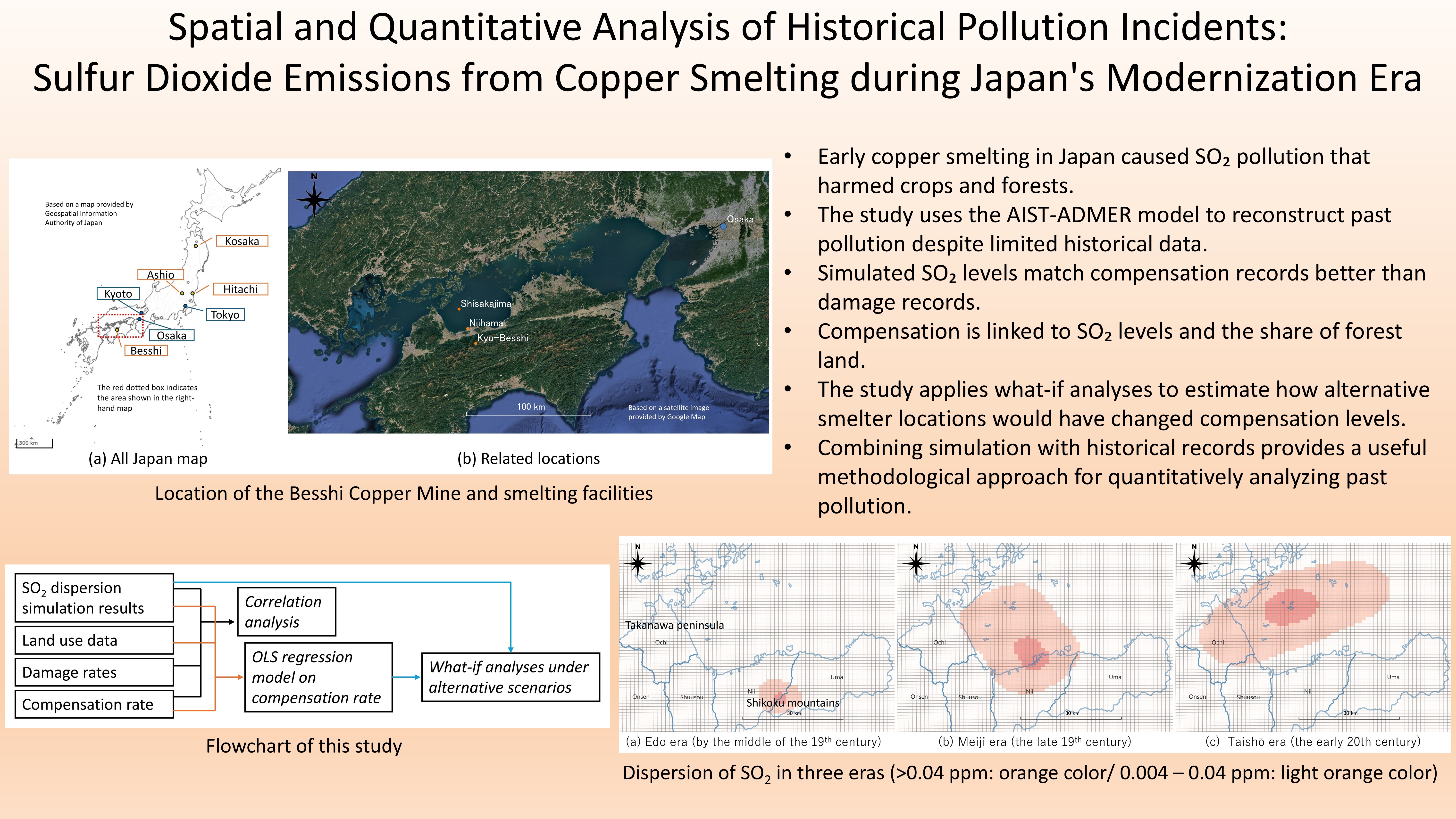
During Japan’s modernization and westernization over a century ago, copper mining and smelting became a key export industry. However, the resulting sulfur dioxide emissions caused significant damage to crops and forests. Due to the limited availability of historical environmental records, this study utilizes the atmospheric dispersion simulation tool AIST-ADMER, developed by the National Institute of Advanced Industrial Science and Technology, to reconstruct pollution patterns associated with the Besshi Copper Mine in Ehime Prefecture. We assess the plausibility of the simulated dispersion patterns by examining their correlation with historical records of environmental damage and compensation. The results reveal a moderate correlation between simulated sulfur dioxide concentrations and compensation levels, whereas the correlation with recorded damage is relatively weak. Regression analysis further indicates that compensation amounts are significantly associated with both concentration levels and the proportion of forest land use. Applying this model to counterfactual scenarios, we estimate that relocating the smelting facilities to alternative sites, such as a coastal onshore site or a mountainous inland area which could have increased compensation payments by approximately three and five times, respectively. These findings shed light on how corporate decisions shaped responses to environmental damage and compensation, highlighting the complex trade-offs companies faced in managing pollution under evolving social and environmental pressures. This research fills a significant gap in the literature by establishing a quantitative framework that links simulated pollution patterns with historical evidence, enabling a deeper understanding of past environmental impacts and corporate responses.
Full text article
References
2. Pfister, C.; Wanner, H. Climate and society in Europe: the last thousand years; Haupt Verlag: Bern, 2021; ISBN 3258082340.
3. Søndergaard, J.; Mosbech, A. Mining pollution in Greenland - the lesson learned: A review of 50 years of environmental studies and monitoring. Sci. Total Environ. 2022, 812.
4. Winter, J. A Historical Perspective Review of the Environmental Pollution. Sci. Insights 2024, 44, 1253–1261, doi:10.15354/si.24.re916.
5. Stradling, D. Smokestacks and Progressives; Johns Hopkins University Press: Baltimore, 1999; ISBN 0801860830.
6. DuBay, S.; Weeks, B.C.; Davis-Kean, P.E.; Fuldner, C.; Harris, N.C.; Hughes, S.; O’Brien, B.; Perkins, M.; Weyant, C. Measuring historical pollution: Natural history collections as tools for public health and environmental justice research. Proc. Natl. Acad. Sci. 2025, 122, doi:10.1073/pnas.2403781122.
7. Kobayashi, H. Minamata: how a policy maker addressed a very wicked water quality policy problem. In Wicked Problems of Water Quality Governance; Nickum, J.E., Stephan, R.M., Bjornlund, H., Eds.; Routledge: London, 2022; pp. 83–102 ISBN 9781003331438.
8. Nohara, K.; Akiba, S.; Ishizuka, M.; Nakajima, T. What we Have Learned from the Pollution that Occurred in Japan a Half Century Ago. In Overcoming Environmental Risks to Achieve Sustainable Development Goals. Current Topics in Environmental Health and Preventive Medicine.; Nakajima, T., Nakamura, K., Nohara, K., Kondoh, A., Eds.; Springer: Singapore, 2022; pp. 55–59 ISBN 978-981-16-6248-5.
9. Otsuka, T. Lessons of Court Decisions on Minamata Disease and Future Actions. In Overcoming Environmental Risks to Achieve Sustainable Development Goals. Current Topics in Environmental Health and Preventive Medicine; Nakajima, T., Nakamura, K., Nohara, K., Kondoh, A., Ed.; Springer, 2022; pp. 121–126.
10. Sarker, A. Ecological perspectives on water, food, and health security linkages: the Minamata case in Japan. Environ. Sci. Pollut. Res. 2021, 28, 32177–32189, doi:10.1007/s11356-021-14207-8.
11. Coase, R.H. The Problem of Social Cost. J. Law Econ. 2013, 56, 837–877, doi:10.1086/674872.
12. Spash, C.L. The History of Pollution “Externalities” in Economic Thought. Soc. Res. Econ. Discuss. Pap. 2021, 01/2021, doi:10.57938/c61ad395-7a3d-425a-9969-203de844de22.
13. Deryugina, T.; Moore, F.; Tol, R.S.J. Environmental applications of the Coase Theorem. Environ. Sci. Policy 2021, 120, 81–88, doi:10.1016/j.envsci.2021.03.001.
14. Sueoka, T. Environmental Issues in Modern Japan and Sollution of Air Pollution at the Besshi Copper Mine. Sumitomo Arch. Bull. (Sumitomo Shiryoukanhou) 2017, 132–262. (In Japanese)
15. Sugai, M. Four Major Copper Mine Pollution Cases in Japan, the 1890s-1910s (1). J. Soc. Sci. (Institute Soc. Sci. Univ. Tokyo) 1979, 30, 94–162. (In Japanese)
16. Sugai, M. Four Major Copper Mine Pollution Cases in Japan, the 1890s-1910s (2). J. Soc. Sci. (Institute Soc. Sci. Univ. Tokyo) 1979, 30, 75–150. (In Japanese)
17. Takeda, H. A History of Copper Industry in Japan; The University of Tokyo Press: Tokyo, 1987; ISBN 4130460323. (In Japanese)
18. Kobata, A. A Study on the History of Copper Mining in Japan; Shibunkaku Shuppan: Kyoto, 1993; ISBN 4784207600. (In Japanese)
19. Higashino, H.; Kitabayashi, K.; Inoue, K.; Mita, K.; Yonezawa, Y. Development of an Atmospheric Dispersion Model for Exposure and Risk Assessment (ADMER). J. Japan Soc. Atmos. Environ. 2003, 38, 100–115, doi:https://doi.org/10.11447/sraj.26.41. (In Japanese)
20. Higashino, H.; Inoue, K. Development of the Atmospheric Dispersion Model for Exposure and Risk Assessment (ADMER) Ver. 3. Japanese J. Risk Anal. 2016, 26, 41–46. (In Japanese)
21. Inoue, K.; Higashino, H.; Yoshikado, H.; Nakanishi, J. Estimation of aggregate population cancer risk from dichloromethane for Japanese using atmospheric dispersion model. Environ. Sci. 2006, 13, 59–74.
22. Kishimoto, A.; Cao, H.; Gamo, M. Assessment of exposure to and risk posed by toluene in Japanese residents: combining exposure from indoor and outdoor sources. Environ. Sci. 2006, 13, 31–42.
23. Mita, K.; Higashino, H.; Yoshikado, H.; Nakanishi, J. Estimating ambient concentration and cancer risk for 1,3-butadiene in Japan. Environ. Sci. 2006, 13, 1–13.
24. Isshiki, K. History of Smoke Damage in Eastern Ehime Prefecture; Shuusou County Smoke Damage Investigation Committee: Nyuugawa-cho, Ehime Prefecture, Japan, 1926; (In Japanese)
25. Ministry of Land, Infrastructure, Transportaion and Tourism. Land Use Third-level Mesh Data Available online: https://nlftp.mlit.go.jp/ksj/gml/datalist/KsjTmplt-L03-a-2021.html (accessed on Oct 19, 2024).
26. Takahashi, T.; Nakamura, M.; van Kooten, G.; Vertinsky, I. Rising to the Kyoto challenge: Is the response of Canadian industry adequate? J. Environ. Manage. 2001, 63, doi:10.1006/jema.2001.0467.
27. Nakamura, M.; Takahashi, T.; Vertinsky, I. Why Japanese firms choose to certify: A study of managerial responses to environmental issues. J. Environ. Econ. Manage. 2001, 42, doi:10.1006/jeem.2000.1148.
28. Branzei, O.; Vertinsky, I.; Takahashi, T.; Zhang, W. Corporate environmentalism across cultures: A comparative field study of Chinese and Japanese executives. Int. J. Cross Cult. Manag. 2001, 1, doi:10.1177/147059580113003.
29. Takahashi, T. Attitudes of Companies towards Financing Employing Environmental Ratings. Pap. Environ. Inf. Sci. 2010, ceis24, 225–230, doi:10.11492/ceispapers.ceis24.0.225.0.
30. Sugita, M.; Takahashi, T. Influence of corporate culture on environmental management performance: An empirical study of japanese firms. Corp. Soc. Responsib. Environ. Manag. 2015, 22, 182–192, doi:10.1002/csr.1346.
Authors
Copyright (c) 2025 Takuya Takahashi, Kazuya Inoue

This work is licensed under a Creative Commons Attribution 4.0 International License.
Authors who publish with this journal agree to the following terms:
- Authors retain copyright and grant the journal right of first publication with the work simultaneously licensed under a Creative Commons Attribution License that allows others to share the work with an acknowledgement of the work's authorship and initial publication in this journal.
- Authors are able to enter into separate, additional contractual arrangements for the non-exclusive distribution of the journal's published version of the work (e.g., post it to an institutional repository or publish it in a book), with an acknowledgement of its initial publication in this journal.
- Authors are permitted and encouraged to post their work online (e.g., in institutional repositories or on their website) prior to and during the submission process, as it can lead to productive exchanges, as well as earlier and greater citation of published work (See The Effect of Open Access).
Article Details
How to Cite



