
Short-term movements of the Pig-Nosed Turtle (Carrettochelys insculpta) in the Kao River, South Papua, Indonesia
Article Sidebar
-
Freshwater turtle, daily movement, daily home range, Carrettochelys insculpta
Abstract
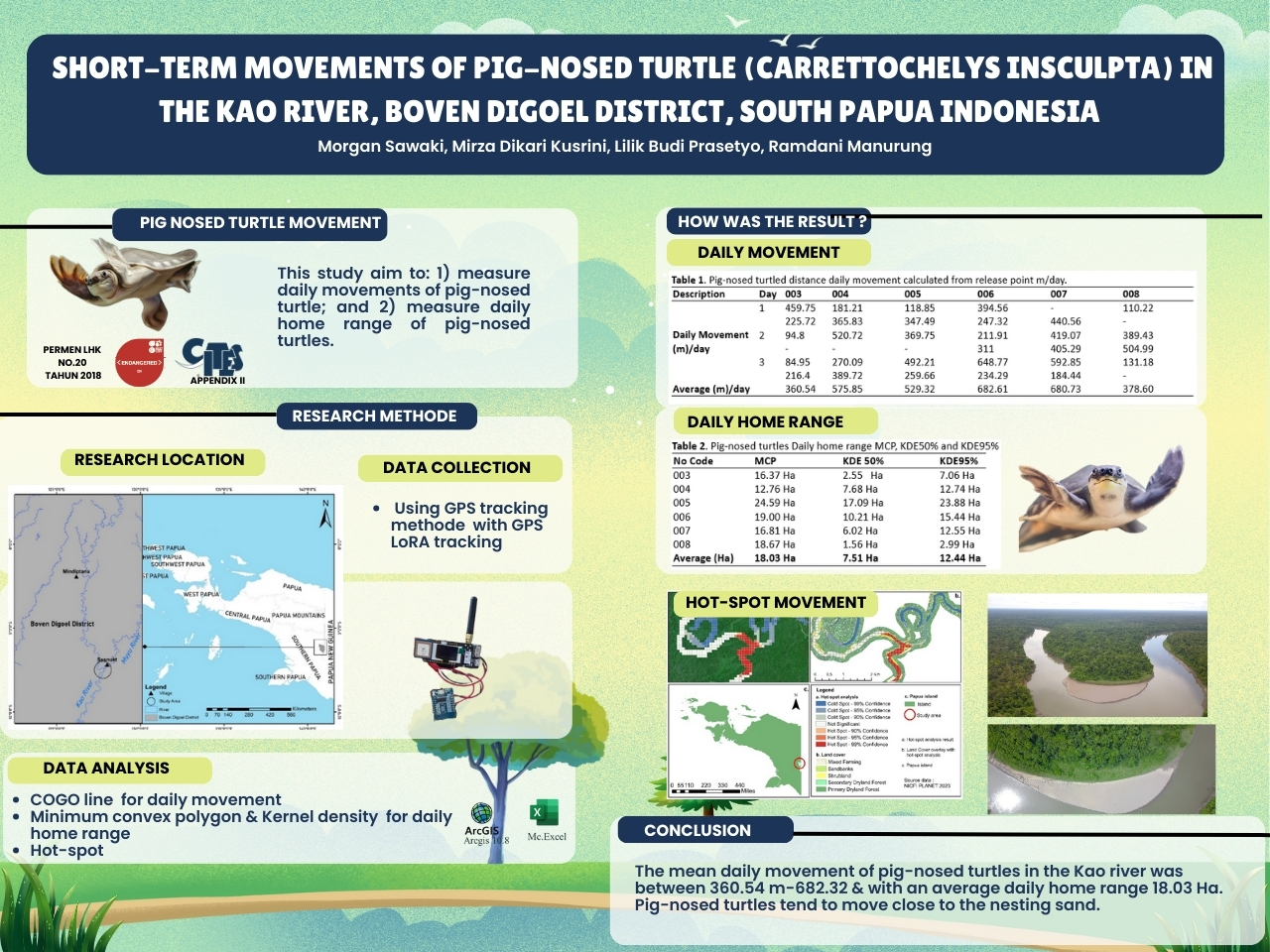
Understanding animal movement is essential for assessing species' ecological needs and informing effective conservation strategies. This study investigates the short-term daily movement and home range of the Endangered (EN) pig-nosed turtle (Carettochelys insculpta) in the Kao River, Boven Digoel District, South Papua, Indonesia. Native to Papua New Guinea, Northern Australia, and Southern Papua, this freshwater turtle faces heavy egg harvesting pressure. Using low-cost GPS tracking devices, we monitored six adult individuals (one male and five females) over a three-day period during November–December 2023. The results indicated that the daily movements of C. insculpta ranged from 84.95 to 648.77 m. Average home range estimates were 18.03 ha (minimum convex polygon), 7.51 ha (50% kernel density), and 12.44 ha (95% kernel density). The movement overlaps among the four turtles totaled 30.64 ha, with an average overlap of 6.12 ha. The hotspot analysis identified 76.16 ha as key movement areas, revealing that the pig-nosed turtles tend to stay near sandbanks, primary dryland forest, secondary dryland forest, and shrublands. Our study
provides important baseline ecological data that can be used to inform future conservation and recovery programs. Elaboration between stakeholders and the local community can be carried out to protect the species.
Full text article
References
Maxwell, S.M.; Hazen, E.L.; Bograd, S.J.; Halpern, B.S.; Breed, G.A.; Nickel, B.; Teutschel, N.M.; Crowder, L.B.; Benson, S.; Dutton, P.H.; et al. Cumulative human impacts on marine predators. Nat. Commun. 2013, 4, 2688, doi:10.1038/ncomms3688. DOI: https://doi.org/10.1038/ncomms3688
Allen, A.M.; Singh, N.J. Linking Movement Ecology with Wildlife Management and Conservation. Front. Ecol. Evol. 2016, 3. DOI: https://doi.org/10.3389/fevo.2015.00155
Nathan, R.; Getz, W.; Revilla, E.; Holyoak, M.; Kadmon, R.; Saltz, D.; Smouse, P. A movement ecology paradigm for unifying organismal movement research. Proc. Natl. Acad. Sci. U. S. A. 2009, 105, 19052–19059, doi:10.1073/pnas.0800375105. DOI: https://doi.org/10.1073/pnas.0800375105
Kays, R. KENWARD, R. 2001. A manual for wildlife radio tagging, 2nd edition. New York: Academic Press. 350 pp. ISBN:0 124 04242 2 and MILLLSPAUGH, J. and MARZLUFF, J. 2001. Radio tracking and animal populations, New York: Harcourt Publishers. 400 pp. ISBN: 0 124 9. Anim. Conserv. 2002, 5, 259–260, doi:10.1017/S1367943002212317. DOI: https://doi.org/10.1017/S1367943002212317
Gibbons, J.W. Reproductive Potential, Activity, and Cycles in the Painted Turtle, Chrysemys Picta. Ecology 1968, 49, 399–409, doi:https://doi.org/10.2307/1934106. DOI: https://doi.org/10.2307/1934106
Nursal, W.I. Aplikasi GIS untuk distribusi sebaran satwa liar dan kesesuaian habitat: studi kasus owa jawa, Gunung Salak, Jawa barat, IPB University, 2007.
Slavenko, A.; Itescu, Y.; Ihlow, F.; Meiri, S. Home Is Where the Shell Is: Predicting Turtle Home Range Sizes. J. Anim. Ecol. 2016, 85, 106–114, doi:10.1111/1365-2656.12446. DOI: https://doi.org/10.1111/1365-2656.12446
Rowe, J.; Dalgarn, S.F. Home range size and daily movements of Midland Painted Turtles (Chrysemys picta marginata) in relation to body size, sex, and weather patterns. Herpetol. Conserv. Biol. 2010, 5, 461–473.
Stanford, C.B.; Iverson, J.B.; Rhodin, A.G.J.; Paul van Dijk, P.; Mittermeier, R.A.; Kuchling, G.; Berry, K.H.; Bertolero, A.; Bjorndal, K.A.; Blanck, T.E.G.; et al. Turtles and Tortoises Are in Trouble. Curr. Biol. 2020, 30, R721–R735, doi:https://doi.org/10.1016/j.cub.2020.04.088. DOI: https://doi.org/10.1016/j.cub.2020.04.088
Rhodin, A.; Iverson, J.; Bour, R.; Fritz, U.; Georges, A.; Shaffer, H.; Dijk, P.P. TURTLES OF THE WORLD Annotated Checklist and Atlas of Taxonomy, Synonymy, Distribution, and Conservation Status (8th Ed.); 2017; ISBN 978-1-5323-5026-9.
Lovich, J.E.; Ennen, J.R.; Agha, M.; Gibbons, J.W. Where Have All the Turtles Gone, and Why Does It Matter? Bioscience 2018, 68, 771–781, doi:10.1093/biosci/biy095. DOI: https://doi.org/10.1093/biosci/biy095
Eisemberg, C.; Dijk, P.P.; Georges, A.; Amepou, Y. Carettochelys insculpta. The IUCN Red List of Threatened Species. In; 2018; hal. e.T3898A2884984.
Doody, J.S.; Young, J.E.; Georges, A. Sex differences in activity and movements in the pig-nosed turtle, Carettochelys insculpta, in the wet-dry tropics of Australia. Copeia 2002, 93–103, doi:10.1643/0045-8511(2002)002[0093:SDIAAM]2.0.CO;2. DOI: https://doi.org/10.1643/0045-8511(2002)002[0093:SDIAAM]2.0.CO;2
Georges, A.; Doody, S.; Eisemberg, C.; Alacs, E. Carettochelys insculpta Ramsay 1886 – Pig-Nosed Turtle, Fly River Turtle. In Conservation Biology of Freshwater Turtles and Tortoises; 2008; hal. 009.1-009.17. DOI: https://doi.org/10.3854/crm.5.009.insculpta.v1.2008
Burgess, E.A.; Lilley, R. Assessing the trade in pig-nosed turtles Carettochelys insculpta in Papua, Indonesia; 2014;
Kusrini, M.; Manurung, R.; Setiawan, R.; Kim, N.; Triantoro, R. Local harvest of pig-nosed turtle (Carettochelys insculpta) in the Kao River, Boven Digoel District, South Papua, Indonesia. Biodiversitas J. Biol. Divers. 2024, 25, 522–532, doi:10.13057/biodiv/d250211. DOI: https://doi.org/10.13057/biodiv/d250211
Department of Transportation of Boven Digoel, D. Transportasi Tersedia pada: https://opd.bovendigoelkab.go.id/uploads/file/perhubungan-2016.pdf.
Eisemberg, C.; Rose, M.; Yaru, B.; Georges, A. Spatial and temporal patterns of harvesting of the Vulnerable pig-nosed turtle Carettochelys insculpta in the Kikori region, Papua New Guinea. Oryx 2014, 49, 1–10, doi:10.1017/S0030605313001646. DOI: https://doi.org/10.1017/S0030605313001646
Sawaki, M.W.L.; Kusrini, M.D.; Prastyo, L.B. A Low Cost device tracking for freshwater turtle. Unpubl. Manuscr. 2024.
Heaphy, L.J. The ecology of the pig nosed turtle, Carettochelys insculpta, in Northern Australia, University New South Wales, 1990.
Davies, C.L. Thermoregulation, activity and energetics of the pig-nosed turtle (Carettochelys insculpta) in the Daly River, Northern Territory, University Of Canberra, 2005.
Fachín-Terán, A.; Vogt, R.C.; Thorbjarnarson, J.B. Seasonal Movements of Podocnemis sextuberculata (Testudines: Podocnemididae) in the Mamirauá Sustainable Development Reserve, Amazonas, Brazil. Chelonian Conserv. Biol. 2006, 5, 18–24, doi:10.2744/1071-8443(2006)5[18:SMOPST]2.0.CO;2. DOI: https://doi.org/10.2744/1071-8443(2006)5[18:SMOPST]2.0.CO;2
Chen, T.-H.; Lue, K.-Y. Home ranges and movements of the Chinese stripe-necked turtle (Ocadia sinensis) in the Keelung River, northern Taiwan. Amphibia-Reptilia 2008, 29, 383–392, doi:10.1163/156853808785112011. DOI: https://doi.org/10.1163/156853808785112011
Demetrio, C.M.; Willey, L.L.; Jones, M.T.; Danaher, M.; Franklin, J. Home Range and Habitat Use of Florida Box Turtles (Terrapene bauri) in the Ten Thousand Islands, Florida. J. Herpetol. 2022, 56, 376–385, doi:10.1670/20-071. DOI: https://doi.org/10.1670/20-071
Galois, P.; Léveillé, M.; Bouthillier, L.; Daigle, C.; Parren, S. Movement Patterns, Activity, and Home Range of the Eastern Spiny Softshell Turtle (Apalone spinifera) in Northern Lake Champlain, Qubec, Vermont. J. Herpetol. 2002, 36, 402–411, doi:10.1670/0022-1511(2002)036[0402:MPAAHR]2.0.CO;2. DOI: https://doi.org/10.1670/0022-1511(2002)036[0402:MPAAHR]2.0.CO;2
Schubauer-Berigan, J.; Gibbons, J.; Spotila, J. Home range and movement patterns by Trachemys scripta inhabiting Par Pond. In; 1990.
Tucker, A.; Limpus, C.; Priest, T.E.; Cay, J.; Glen, C.; Guarino, E. Home ranges of Fitzroy River turtles (Rheodytes leukops) overlap riffle zones: Potential concerns related to River regulation. Biol. Conserv. 2001, 171–181, doi:10.1016/S0006-3207(01)00097-0. DOI: https://doi.org/10.1016/S0006-3207(01)00097-0
Bulté, G.; Gravel, M.-A.; Blouin-Demers, G. Intersexual niche divergence in northern map turtles (Graptemys geographica): The roles of diet and habitat. Can. J. Zool. 2008, 86, 1235–1243, doi:10.1139/Z08-107. DOI: https://doi.org/10.1139/Z08-107
Cardille, J.; Ouellette, M. The Complex Linear Home Range Estimator: Representing the Home Range of River Turtles Moving in Multiple Channels. Chelonian Conserv. Biol. 2011, 10, 259–265, doi:10.2744/CCB-0847.1. DOI: https://doi.org/10.2744/CCB-0847.1
Ross, J.P.; Bluett, R.D.; Dreslik, M.J. Movement and Home Range of the Smooth Softshell Turtle (Apalone mutica): Spatial Ecology of a River Specialist. Diversity 2019, 11. DOI: https://doi.org/10.3390/d11080124
Ghaffari, H.; Ihlow, F.; Plummer, M.; Karami, M.; Khorasani, N.; Safaei-Mahroo, B.; Rödder, D. Home Range and Habitat Selection of the Endangered Euphrates Softshell Turtle Rafetus euphraticus in a Fragmented Habitat in Southwestern Iran. Chelonian Conserv. Biol. 2014, 13, 202–215, doi:10.2744/CCB-1071.1. DOI: https://doi.org/10.2744/CCB-1071.1
Smith, L.M.; Cherry, R.P. Movement, Seasonal Activity, and Home Range of an Isolated Population of Glyptemys muhlenbergii, Bog Turtle, in the Southern Appalachians. Southeast. Nat. 2016, 15, 207–219, doi:10.1656/058.015.0202. DOI: https://doi.org/10.1656/058.015.0202
Doody, J.; Georges, A.; Young Kirby, J. Twice every second year: Reproduction in the pig-nosed turtle, Carettochelys insculpta, in the wet-dry tropics of Australia. J. Zool. 2003, 259, doi:10.1017/S0952836902003217. DOI: https://doi.org/10.1017/S0952836902003217
Authors
Authors who publish with this journal agree to the following terms:
- Authors retain copyright and grant the journal right of first publication with the work simultaneously licensed under a Creative Commons Attribution License that allows others to share the work with an acknowledgement of the work's authorship and initial publication in this journal.
- Authors are able to enter into separate, additional contractual arrangements for the non-exclusive distribution of the journal's published version of the work (e.g., post it to an institutional repository or publish it in a book), with an acknowledgement of its initial publication in this journal.
- Authors are permitted and encouraged to post their work online (e.g., in institutional repositories or on their website) prior to and during the submission process, as it can lead to productive exchanges, as well as earlier and greater citation of published work (See The Effect of Open Access).
Article Details
How to Cite



