
Effect of Irrigating Cooler Water (ICWr) on The Canopy Temperature of Japonica Rice Cultivars Himenorin and Nikomaru
Article Sidebar
-
Canopy temperature, Canopy temperature depression, Himenorin, Irrigating cooler water, Nikomaru
Abstract
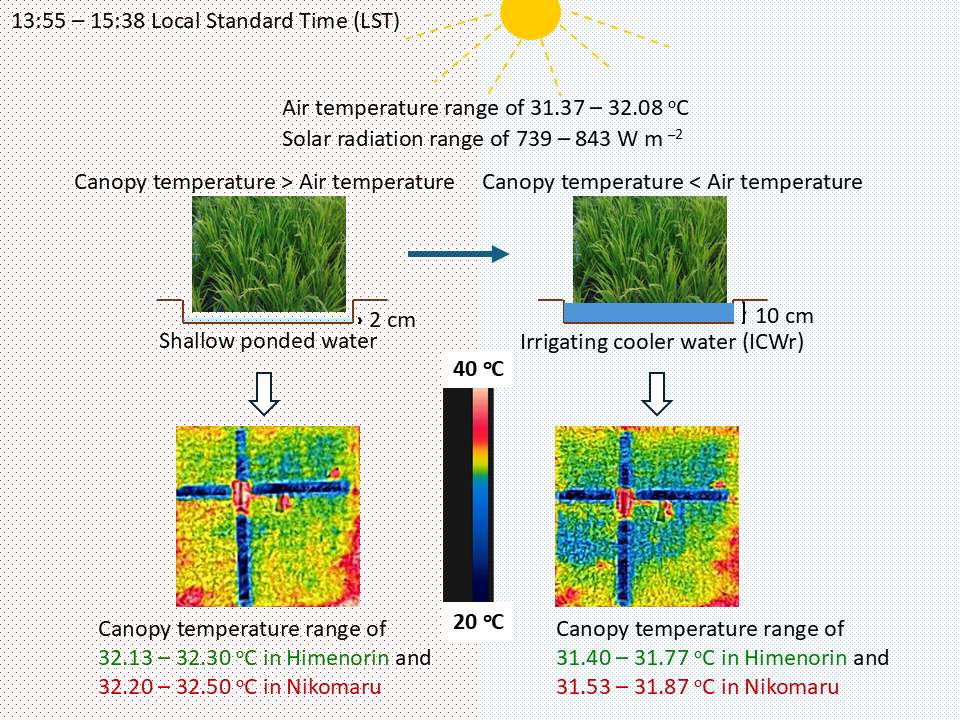
The canopy temperature of rice is a critical concern due to rising air temperatures and the increasing risk of heat damage. In this study, we investigated the canopy temperature difference (CTd) and canopy temperature depression (CTD) in the Japonica rice cultivars ‘Himenorin’ (HR) and ‘Nikomaru’ (NM). Additionally, we examined the effect of irrigating cooler water (ICWr) on canopy temperature, particularly its impact on CTD reduction, compared to a control plot. The results showed that CTd in HR was lower than in NM. Furthermore, CTD reached 2.23 °C in HR and 2.35 °C in NM under shallower ponding conditions. ICWr effectively reduced the canopy temperature in both cultivars and decreased CTD to a negative value. These findings highlight that ICWr can mitigate canopy temperature increases under more intense solar radiation and high air temperatures. Therefore, implementing ICWr in rice fields may serve as a potential countermeasure to reduce heat damage in rice by lowering canopy temperature. Further research is necessary to elucidate the underlying mechanisms and enhance strategies for mitigating heat exposure, ensuring rice resilience and sustainability in a changing climate.
Full text article
References
Portner, H.O.; Roberts, D.; Tignor, M.; Poloczanska, E.S.; Mintenbeck, K.; Alegria, A.; Craig, M.; Langsdorf, S.; Lozchke, S.; Moller, V.; Okem, A.; Rama, B. Climate Change 2022: Impacts, Adaptaion and Vulnerability. Cambridge University Press: UK and New York, 2022; 3056 pp., doi:10.1017/9781009325844. DOI: https://doi.org/10.1017/9781009325844
Kobata, T.; Uemuki, N.; Inamura, T.; Kagata, H. Shortage of Assimilate Supply to Grain Increases the Proportion of Milky White Rice Kernels under High Temperatures. Jpn. J. Crop Sci. 2004, 73, 315-322, doi: 10.1626/jcs.73.315. (in Japanese with English abstract) DOI: https://doi.org/10.1626/jcs.73.315
Tsukaguchi, T.; Iida, Y. Effects of Assimilate Supply and High Temperature during Grain-Filling Period on the Occurrence of Various Types of Chalky Kernels in Rice Plants (Oryza sativa L.). Plant Prod. Sci. 2008, 11, 203-210, doi:10.1626/pps.11.203. DOI: https://doi.org/10.1626/pps.11.203
Kobata, T.; Miya, N.; Anh, N.T. High Risk of the Formation of Milky White Rice Kernels in Cultivars with Higher Potential Grain Growth Rate Under Elevated Temperatures. Plant Prod. Sci. 2011, 14, 359-364, doi: 10.1626/pps.14.359 DOI: https://doi.org/10.1626/pps.14.359
Tanaka, A.; Toriyama, K.; Kobayashi, K. Less yield reduction induced by high temperature in a paddy field under organic fertilizer management in Tochigi prefecture. J. Agric. Meteorol. 2011, 67, 249-258, doi: 10.2480/agrmet.67.4.7. DOI: https://doi.org/10.2480/agrmet.67.4.7
She, K.C.; Kusano, H.; Yaeshima, M.; Sasaki, T.; Satoh, H.; Shimada, H. Reduced rice grain production under high temperature stress closely correlates with ATP shortage during seed development. Plant Biotechnology 2010, 27, 67-73, doi:10.5511/plantbiotechnology.27.67. DOI: https://doi.org/10.5511/plantbiotechnology.27.67
Pasuquin, E.M.; Eberbach, P.L.; Hasegawa, T.; Lafarge, T.; Harnpichitvitaya, D.; Wade, L.J. Response to elevated daytime air and canopy temperature during panicle development in four rice genotypes under paddy conditions in large field chambers. Crop and Environment 2023, 2, 147-156, doi: 10.1016/j.crope.2023.04.004. DOI: https://doi.org/10.1016/j.crope.2023.04.004
Yan, C.; Chen, H.; Fan, T.; Huang, Y.; Yu, S.; Chen, S.; Hong, X. Rice flag leaf physiology, organ and canopy temperature in response to water stress. Plant Prod. Sci. 2012, 15, 92-99, doi:10.1626/pps.15.92. DOI: https://doi.org/10.1626/pps.15.92
Fukai, S.; Mitchell, J. Role of canopy temperature depression in rice. Crop and Environment 2022, 1, 198-213, doi: 10.1016/j.crope.2022.09.001. DOI: https://doi.org/10.1016/j.crope.2022.09.001
Kondo, R.; Tanaka, Y.; Katayama, H.; Homma, K.; Shiraiwa, T. Continuous estimation of rice (Oryza sativa L.) canopy transpiration realized by modifying the heat balance model. Biosystems Engineering 2021, 204, 294-303, doi: 10.1016/j.biosystemseng.2021.01.016 DOI: https://doi.org/10.1016/j.biosystemseng.2021.01.016
Matsue, Y.; Takasaki, K.; Abe, J. Water management for improvement of rice yield, appearance quality and palatability with high temperature during ripening period. Rice Science 2021, 28, 409-416, doi:10.1016/j.rsci.2021.05.011. DOI: https://doi.org/10.1016/j.rsci.2021.05.011
Shi, W.; Zhang, X.; Yang, J.; Impa, S.M.; Wang, D.; Lai, Y.; Yang, Z.; Xu, H.; Wu, J.; Zhang, J.; Jagadish, S.V.K. Irrigating cooler water does not reverse high temperature impact on grain yield and quality in hybrid rice. The Crop Journal 2023, 11, 904-913, doi: 10.1016/j.cj.2022.09.006. DOI: https://doi.org/10.1016/j.cj.2022.09.006
Wada, Y.; Oozeki, F.; Kobayahsi, T.; Kumekawa, H. Effects of cool water irrigation on grain quality of rice by high air temperatures during the ripening period. Jpn. J. Crop. Sci. 2013, 82, 360-368, doi:10.1626/jcs.82.360. DOI: https://doi.org/10.1626/jcs.82.360
Oue, H. Comparisons of the stomatal conductance and electron transport rate of three Japanese rice cultivars including Himenorin in Ehime Prefecture. Journal of Agricultural Meteorology 2023, 79, 77-84, doi:10.2480/agrmet.D-22-00025. DOI: https://doi.org/10.2480/agrmet.D-22-00025
Yoshimoto, M.; Fukuoka, M.; Tsujimoto, Y.; Matsui, T.; Kobayashi, K.; Saito, K.; et al. Monitoring canopy micrometeorology in diverse climate to improve the prediction of heat induced spikelet sterility in rice under climate change. Agricultural and Forest Meteorology 2022, 316, 108860, doi:10.1016/j.agrformet.2022.108860. DOI: https://doi.org/10.1016/j.agrformet.2022.108860
Shimoda, S. Effects of high temperature and early drainage on leaf CO2 assimilation and grain yield in the rice cultivar Hinohikari. Journal of Agricultural Meteorology 2011, 67, 259-267, doi: 10.2480/agrmet.67.4.2. DOI: https://doi.org/10.2480/agrmet.67.4.2
Zhang, W.Z.; Han, Y.D.; Du, H.J. Relationship Between Canopy Temperature at Flowering Stage and Soil Water Content, Yield Components in Rice. Rice Science 2007, 14, 67 – 70, doi:10.1016/S1672-6308(07)60010-9 DOI: https://doi.org/10.1016/S1672-6308(07)60010-9
Karwa, S.; Bahuguna, R.N.; Chaturvedi, A.K.; Maurya, S.; Arya, S.S.; Chinnusamy, V.; Pal, M. Phenotyping and characterization of heat stress tolerance at reproductive stage in rice (Oryza sativa L.). Acta Physiologiae Plantarum 2020, 42:29, doi:10.1007/s11738-0020-3016-5. DOI: https://doi.org/10.1007/s11738-020-3016-5
Fukuda, A.; Kondo, K.; Ikka, T.; Takai, T.; Tanabata, T.; Yamamoto, T. A novel QTL associated with rice canopy temperature difference affects stomatal conductance and leaf photosynthesis. Breeding Science 2018, 68, 305 – 315, doi:10.1270/jsbbs.17129. DOI: https://doi.org/10.1270/jsbbs.17129
Wakamatsu, K.; Sasaki, O.; Euzono, I.; Tanaka, A. Effects of high temperature during the ripening period in the grain quality of rice in warm regions of Japan. Jpn. J. Crop Sci. 2007, 76, 71 – 78, doi:10.1626/jcs.76.71. DOI: https://doi.org/10.1626/jcs.76.71
Ohsumi, A.; Kanemura, T.; Homma, K.; Horie, T.; Shiraiwa, T.; Genotype variation of stomatal conductance in relation to stomatal density and length in rice (Oryza sativa L.). Plant Prod. Sci. 2007, 10, 322 – 328, doi:10.1626/pps.10.322 DOI: https://doi.org/10.1626/pps.10.322
Chen, L.; Deng, X.; Duan, H.; Tan, X.; Xie, X.; Pan, X.; Guo, L.; Gao, H.; Wei, H.; Zhang, H.; Luo, T.; Chen, X.; Zeng, Y. Water management can alleviate the deterioration of rice quality caused by high canopy humidity. Agricultural Water Management 2023, 289, 108567, doi:10.1016/j.agwat.2023.108567. DOI: https://doi.org/10.1016/j.agwat.2023.108567
Shi, W.; Yin, X.; Struik, P.C.; Solis, C.; Xie, F.; Schmidt, R.C.; Huang, M.; Zou, Y.; Ye, C.; Jagadish, S.V.K. High day- and night-time temperatures affect grain growth dynamics in contrasting rice genotypes. Journal of Experimental Botany 2017, 68, 5233 – 5245, doi:10.1093/jxb/erx344. DOI: https://doi.org/10.1093/jxb/erx344
Tokyo Climate Center (TCC), Japan Meteorological Agency (JMA). Climate characteristics and factors behind heavy rainfall during the Baiu season in 2023 and extremely high temperatures from mid-July onward. Japan Meteorological Agency 2023, https://www.data.jma.go.jp/tcc/data/news/press_20230928.pdf.
Yoshida, S. Fundamentals of Rice Crop Science; International Research Institute: Los Banos, 1981.
Yuliawan, T.; Ichwan N.; Ukpoju, A.; Irsyad, F.; Oue, H. Comparisons of growth, yield, and meteorological properties of rice canopy under double-row (jajar legowo and jejer manten) and tile transplanting systems. Journal of Natural Resources and Environmental Management 2024, 14(2), 325 – 340, doi:10.29244/jpsl.14.2.325. DOI: https://doi.org/10.29244/jpsl.14.2.325
Wang, Y.; Oue, H.; Limin, S.G.; Laban, S. Effects of water ponding on decreasing leaf and panicle temperature in rice paddy fields. Jurnal Teknologi 2015, 76(15), 131 – 137, doi:10.11113/jt.v76.5965 DOI: https://doi.org/10.11113/jt.v76.5965
Morita, S.; Shiratsuchi, H.; Takahashi, J.; Fujita, L. Effect of high temperature on grain ripening in rice plants. Japanese Journal of Crop Science 2004, 73, 77-83, doi:10.1626/jcs.73.77 DOI: https://doi.org/10.1626/jcs.73.77
Authors
Authors who publish with this journal agree to the following terms:
- Authors retain copyright and grant the journal right of first publication with the work simultaneously licensed under a Creative Commons Attribution License that allows others to share the work with an acknowledgement of the work's authorship and initial publication in this journal.
- Authors are able to enter into separate, additional contractual arrangements for the non-exclusive distribution of the journal's published version of the work (e.g., post it to an institutional repository or publish it in a book), with an acknowledgement of its initial publication in this journal.
- Authors are permitted and encouraged to post their work online (e.g., in institutional repositories or on their website) prior to and during the submission process, as it can lead to productive exchanges, as well as earlier and greater citation of published work (See The Effect of Open Access).
Article Details
How to Cite



