
Carbon Footprint of Elephant Mammal Management in Taman Margasatwa Ragunan Using Life Cycle Assessment Approach
Article Sidebar
-
Carbon footprint, Elephant, Life cycle assessment
Abstract
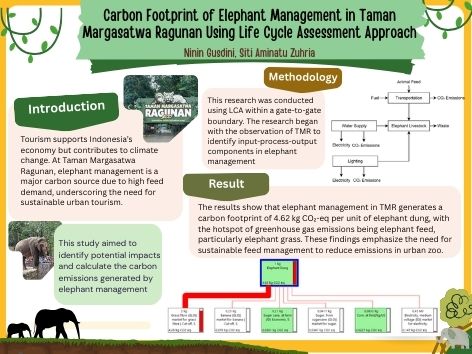
Tourism is the second largest contributor to Indonesia's foreign exchange. In addition, tourism can be a leverage factor for other developments, especially in the socio-economic field. nHowever, this development can have an impact on environmental quality such as climate chage. Jakarta as an urban area has many tourism potentials, one of which is Taman Margasatwa Ragunan (TMR). The development of urban tourism has become a new trend in the community because the distance traveled is relatively closer and the cost is relatively cheaper. In its development, urban tourism needs to be controlled and well designed in order to be sustainable. This study aims to identify the impacts that may arise and calculate the carbon emissions generated from elephant management. Elephants are taken as the object of study because among the existing animals, elephants are the animals with the most food consumption and produce the most carbon emissions. The method used to calculate environmental impacts is life cycle assessment (LCA). The scope taken in this study is gate to gate, so that the impacts taken into account are those that occur in the process of raising elephants. The research began with observation of Ragunan Wildlife Park to identify input-process-output components in elephant management. The results showed that the carbon footprint value of elephant mammal management in TMR was 4.62 kg CO2eq/elephant. The hotspot GHG emission-contributing sector is elephant feed in the form of elephant grass
Full text article
References
2. Stephen, P., & Miichael, D. (2023). Progress in Tourism Management: Is Urban Tourism a Paradoxical Research domain? Progress since 2011 and Prospects for Future. Tourism Management, 9.
3. Gopala, O; Hadian, Sunarto, A; Sitompil, A; Williams, P ; Leimgruber, P; Chambliss and S. E. d. Gunayardi. Elephas maximus ssp. Sumatranus, Sumatra Elephant. 2022. [Online]. Available: https://dx.doi.org/10.2305/IUCN.UK.2011- 2.RLTS.T199856A9129626.en. [Diakses pada 26 Februari 2022].
4. Berliani, K. S; Hartini and Y. Andriani, “Daily Activity of Elephant Allomothers (Elephas maximus sumatranus) in Tangkahan Conservation Response Unit (CRU) Area, Langkat, North Sumatera”, in IOP Conference Series: Earth and Environmental Science, 2019, pp. 1—7.
5. Yudarini N. D; Soma I.G and Widyastuti S. (2013). Tingkah Laku Harian Gajah Sumatera (Elephas maximus sumatranus) di Bali Safari and Marine Park, Gianyar”, Indonesia Medicus Veterinus, vol. 2, (4), pp. 461—468.
6. Handiyanti, R.P. (2018).Perilaku Harian Individu dan Perilaku Tourism and Sosial Populasi Gajah Sumatra (Elephas maximus sumatranus) di Taman Margasatwa Ragunan, Jakarta”, S.Si thesis, Dept. Biologi, Universitas Indonesia, Depok, Indonesia, 2018.
7. Kruczek, Z. (2018). The Influence of Excessive Tourist Attendance on The Process of Gentrification of Historic Cities on The Example of Krow. Turystyka Kulturowa, 3.
8. Sohil, A & Kichloo, M.A. (2023). Sustainable Solutions to Animal Waste: Climate Change Mitigation and Bioproduct Harvest. In: Arshad, M. (eds) Climate Changes Mitigation and Sustainable Bioenergy Harvest Through Animal Waste. Springer, Cham. https://doi.org/10.1007/978-3-031-26224-1_12
9. Widyastuti, F. R. 2013. Upaya pengelolaan lingkungan usaha peternakan sapi di kawasan usahatani terpadu Bangka Botanical Garden Pangkalpinang. [Thesis]. Pasca Sarjana. Universitas Diponegoro
10. Acero, A., & Rodriguez, C. &. (2014). LCIA Methods in Life Cycle Assessment and Their Impact Categories. Greendelta .
11. Nurunnissa, S., & Aziz, R. (2020). Kajian dampak lingkungan sistem pengelolaan sampah. Jurnal Teknologi dan Inovasi Industri,(01:02) , 6-11.
12. Nofriya ; Sutiani, B. M., & Benno, R. (2022). The application of Life Cycle Assessment to achieve sustainable tourism: A literature review. Journal of Environmental & Sustainability (06;02).
13. Sukumar R. The Living Elephants: Evolutionary Ecology, Behavior, and Conservation, New York: Oxford University Press, 2003.
14. Joos, F; Roth, R; Fuglestvedt, J. S; Peters, G. P; Enting, I. G; Von Bloh, W; Brovkin, V; Burke, E. J; Eby, M; Edwards, N. R; Friedrich, T; Frölicher, T. L; Halloran, P. R; Holden, P. B; Jones, C;., Kleinen, T; Mackenzie, F. T. ;, Matsumoto, K; Meinshausen, M; Weaver, A. J. (2013). Carbon dioxide and climate impulse response functions for the computation of greenhouse gas metrics: A multi-model analysis. Atmospheric Chemistry and Physics, 13(5), 2793–2825. https://doi.org/10.5194/acp-13-2793-2013
15. Forster, P; Hegerl, G; Knutti, R; Ramaswamy, V;., Solomon, S;., omas Stocker, T. F; Stott, P;., Zwiers, F; Schwartz, S. E; Charlson, R. J; Rodhe, H. (2007). 3. Meehl, G. A. et al. in Climate Change. Nat. Rep. Clim. Change, 1(2), 63–64. www.nature.com/reports/climatechange
Authors
Copyright (c) 2025 Ninin Gusdini, Siti Aminatu Zuhria

This work is licensed under a Creative Commons Attribution 4.0 International License.
Authors who publish with this journal agree to the following terms:
- Authors retain copyright and grant the journal right of first publication with the work simultaneously licensed under a Creative Commons Attribution License that allows others to share the work with an acknowledgement of the work's authorship and initial publication in this journal.
- Authors are able to enter into separate, additional contractual arrangements for the non-exclusive distribution of the journal's published version of the work (e.g., post it to an institutional repository or publish it in a book), with an acknowledgement of its initial publication in this journal.
- Authors are permitted and encouraged to post their work online (e.g., in institutional repositories or on their website) prior to and during the submission process, as it can lead to productive exchanges, as well as earlier and greater citation of published work (See The Effect of Open Access).
Article Details
How to Cite



