
Evaluation of Visitor Loyalty to Technology-Based Attractions for Sustainable Tourism at Taman Safari Indonesia after COVID-19
Article Sidebar
-
Taman Safari Indonesia, Sustainable, SEM-PLS, Satisfaction, Loyalty
Abstract
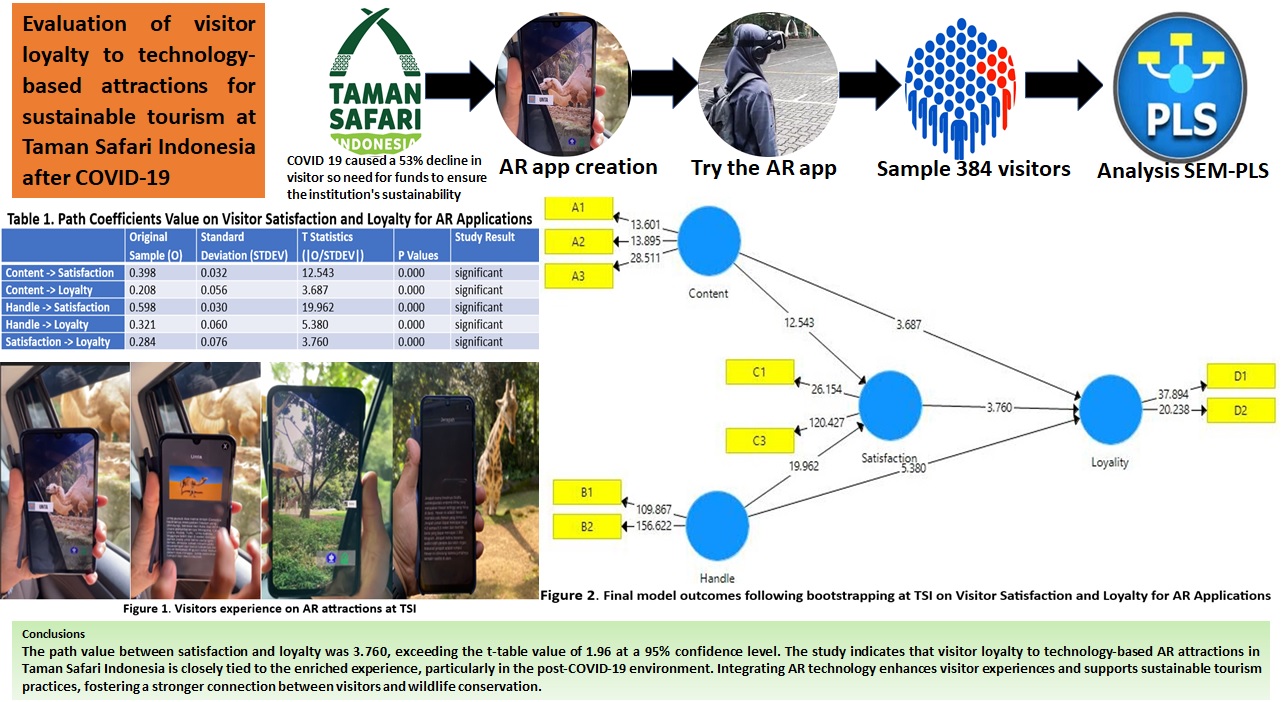
Taman Safari Indonesia (TSI) is an organization dedicated to ex-situ conservation. The pandemic caused a 53% decline in visitor visits to TSI in 2020 compared to 2019, creating an urgent need for funds to ensure the institution's sustainability. In response, various technology-based visitor attractions have been developed, focusing on Augmented Reality (AR) applications to enhance both the quantity and quality of visitor experiences. This study examines how visitors' experiences with technology-driven attractions influence their satisfaction and loyalty to TSI. The SEM-PSL method was used to analyze data using structural equation modeling. After using the AR features, they completed a questionnaire based on their impressions of AR-based visitors' attractions. The results showed that the relationship between satisfaction and loyalty was significant, with a path coefficient of 3.760, greater than the t-table value of 1.96 at a 95% confidence level, indicating statistical significance. The findings suggest that higher satisfaction levels lead to greater visitor loyalty, with satisfied visitors more likely to return to TSI, especially with the enhanced AR experience. Visitors' interactions with AR features improved their overall experience and strengthened their emotional connection to the TSI, suggesting the potential for sustained engagement. These results imply that integrating advanced technologies such as AR can play a key role in fostering visitor loyalty. Future tourism strategies should integrate immersive AR experiences with ecological education and conservation efforts to promote environmental sustainability.
Full text article
References
D. T. Anggarini, “Upaya Pemulihan Industri Pariwisata Dalam Situasi Pandemi Covid -19,” J. Pariwisata, vol. 8, no. 1, pp. 22–31, 2021, doi: 10.31294/par.v8i1.9809. DOI: https://doi.org/10.31294/par.v8i1.9809
M. E. Atmojo and H. D. Fridayani, “An Assessment of Covid-19 Pandemic Impact on Indonesian Tourism Sector,” J. Gov. Public Policy, vol. 8, no. 1, pp. 1–9, 2021, doi: 10.18196/jgpp.811338. DOI: https://doi.org/10.18196/jgpp.811338
U. F. Bascha, D. Y. Reindrawati, A. M. Witaningrum, and D. S. Sumardiko, “Dampak Pandemi COVID-19 Terhadap Minat Masyarakat dalam Berwisata dan Sosialisasi Penerapan Protokol New Normal Saat Berwisata,” J. Abdidas, vol. 1, no. 6, pp. 560–570, 2020, doi: 10.31004/abdidas.v1i6.129. DOI: https://doi.org/10.31004/abdidas.v1i6.129
S. Gössling, D. Scott, and C. M. Hall, “Pandemics, tourism and global change: a rapid assessment of COVID-19,” J. Sustain. Tour., vol. 29, no. 1, pp. 1–20, 2020, doi: 10.1080/09669582.2020.1758708. DOI: https://doi.org/10.1080/09669582.2020.1758708
[UNWTO] United Nations World Tourism Organization, “Growth in international tourist arrivals continues to outpace the economy,” vol. 18, no. 1, pp. 1–6, 2020.
Y. Mao, J. He, A. M. Morrison, and J. Andres Coca-Stefaniak, “Effects of tourism CSR on employee psychological capital in the COVID-19 crisis: from the perspective of conservation of resources theory,” Curr. Issues Tour., vol. 24, no. 19, pp. 2716–2734, 2021, doi: 10.1080/13683500.2020.1770706. DOI: https://doi.org/10.1080/13683500.2020.1770706
S. M. Sánchez-Cañizares, L. J. Cabeza-Ramírez, G. Muñoz-Fernández, and F. J. Fuentes-García, “Impact of the perceived risk from Covid-19 on intention to travel,” Curr. Issues Tour., vol. 24, no. 7, pp. 970–984, 2021, doi: 10.1080/13683500.2020.1829571. DOI: https://doi.org/10.1080/13683500.2020.1829571
Hoque A, Farzana Afrin Shikha, Mohammad Waliul Hasanat, Ishtiaque Arif, Abu Bakar Abdul Hamid, “The effect of coronavirus sars-cov-2 in the tourism industry in Africa,” Asian J. Multidiscip. Stud., vol. 3, no. 1, 2020, doi: 10.14505/jemt.v11.8(48).06. DOI: https://doi.org/10.31580/jpvai.v3i4.1557
M. Škare, D. R. Soriano, and M. Porada-Rochoń, “Impact of COVID-19 on the travel and tourism industry,” Technol. Forecast. Soc. Change, vol. 163, no. April 2020, 2021, doi: 10.1016/j.techfore.2020.120469. DOI: https://doi.org/10.1016/j.techfore.2020.120469
Saway WV, Alvianna S,Estikowati,Lasarudin A,Hidayatullah S, “Dampak Atraksi, Amenitas Dan Aksesibilitas Pantai Pasir Putih Kabupaten Manokwari Terhadap Kepuasaan Wisatawan Berkunjung,” Pariwisata Budaya J. Ilm. Agama Dan Budaya, vol. 6, no. 1, p. 1, 2021, doi: 10.25078/pba.v6i1.1937. DOI: https://doi.org/10.25078/pba.v6i1.1937
C. D. Kounavis, A. E. Kasimati, and E. D. Zamani, “Enhancing the tourism experience through mobile augmented reality: Challenges and prospects,” Int. J. Eng. Bus. Manag., vol. 4, no. 1, pp. 1–6, 2012, doi: 10.5772/51644. DOI: https://doi.org/10.5772/51644
Nanni A and Ulqinaku A, “Mortality threats and technology effects on tourism,” Ann. Tour. Res., vol. 86, no. April, 2021, doi: 10.1016/j.annals.2020.102942. DOI: https://doi.org/10.1016/j.annals.2020.102942
G. B. Copra K, “Location-based mobile augmented reality application for tourism,” 2020 IEEE Graph. Multimedia, GAME 2020, vol. XII, no. Iv, pp. 37–42, 2020, doi: 10.1109/GAME50158.2020.9315096. DOI: https://doi.org/10.1109/GAME50158.2020.9315096
A. Keckes and I. Tomicic, “Augmented Reality in Tourism - Research and Applications Overview,” Interdiscip. Descr. Complex Syst., vol. 15, no. 1, pp. 157–167, 2017, doi: 10.7906/indecs.15.2.5. DOI: https://doi.org/10.7906/indecs.15.2.5
D. I. D. Han, M. C. Tom Dieck, and T. Jung, “Augmented Reality Smart Glasses (ARSG) visitor adoption in cultural tourism,” Leis. Stud., vol. 38, no. 5, pp. 618–633, 2019, doi: 10.1080/02614367.2019.1604790. DOI: https://doi.org/10.1080/02614367.2019.1604790
S. Park and B. Stangl, “Augmented reality experiences and sensation seeking,” Tour. Manag., vol. 77, no. October 2019, p. 104023, 2020, doi: 10.1016/j.tourman.2019.104023. DOI: https://doi.org/10.1016/j.tourman.2019.104023
N. K. Arismayanti, M. Budiarsa, I. M. Bakta, and I. G. Pitana, “the Satisfaction Index of Tourists Experience Quality: a Case Study in Bali Tourism Destination,” Russ. J. Agric. Socio-Economic Sci., vol. 105, no. 9, pp. 67–77, 2020, doi: 10.18551/rjoas.2020-09.08. DOI: https://doi.org/10.18551/rjoas.2020-09.08
Sugiyono, Metode Penelitian Kuantitatif, Kualitatif, dan R&D. Bandung : Alfabeta, CV, 2017.
J. F. Hair, M. Sarstedt, C. M. Ringle, and J. A. Mena, “An assessment of the use of partial least squares structural equation modeling in marketing research,” J. Acad. Mark. Sci., vol. 40, no. 3, pp. 414–433, 2012, doi: 10.1007/s11747-011-0261-6. DOI: https://doi.org/10.1007/s11747-011-0261-6
O. Al Badi and F. Khan, “Examining Challenging Factors of Tourism Entrepreneurship in Oman using PLS-SEM,” Int. J. Res. Entrep. Bus. Stud., vol. 1, no. 1, pp. 48–64, 2020, doi: 10.47259/ijrebs.115.
J. F. Hair, G. T. M. Hult, C. M. Ringle, M. Sarstedt, N. P. Danks, and S. Ray, An Introduction to Structural Equation Modeling. 2021. doi: 10.1007/978-3-030-80519-7_1. DOI: https://doi.org/10.1007/978-3-030-80519-7_1
H. T. T. Saurik, D. D. Purwanto, and J. I. Hadikusuma, “Teknologi Virtual Reality untuk Media Informasi Kampus,” J. Teknol. Inf. dan Ilmu Komput., vol. 6, no. 1, pp. 71–76, 2019, doi: 10.25126/jtiik.2019611238. DOI: https://doi.org/10.25126/jtiik.2019611238
D. P. Sundoro and Setya Chendra Wibawa, “Pengembangan Media Pembelajaran Video Interaktif Berbasis Virtual Reality (VR) Pada Mata Pelajaran Komposisi Foto Digital Di SMK Kartika 2 Surabaya,” J. IT-EDU, vol. 04, no. 1, pp. 218–224, 2019, [Online]. Available: https://ejournal.unesa.ac.id/index.php/it-edu/article/view/29996%0Ahttps://ejournal.unesa.ac.id/index.php/it-edu/article/download/29996/27498
G. Kharismajati, R. Umar, and S. Sunardi, “Inovasi Promosi Obyek Wisata Purbalingga Menggunakan Teknologi Virtual Reality 360 Panorama Berbasis Android,” JIKO (Jurnal Inform. dan Komputer), vol. 3, no. 2, pp. 62–68, 2020, doi: 10.33387/jiko.v3i2.1756. DOI: https://doi.org/10.33387/jiko.v3i2.1756
S. Sungkono, V. Apiati, and S. Santika, “Media Pembelajaran Berbasis Teknologi Augmented Reality,” Mosharafa J. Pendidik. Mat., vol. 11, no. 3, pp. 459–470, 2022, doi: 10.31980/mosharafa.v11i3.1534. DOI: https://doi.org/10.31980/mosharafa.v11i3.1534
Lauw V, I Nyoman Sudiarta, Sagita PAW, “Analisis Preferensi Wisatawan Staycation Ke Daya Tarik Wisata Di Badung, Bali,” J. IPTA (Industri Perjalanan Wisata), vol. 10, no. 1, pp. 106–113, 2022. DOI: https://doi.org/10.24843/IPTA.2022.v10.i01.p12
A. Khusaeni, Khusaini K dan Widiarti, “Dampak Usia, Struktur Keluarga, dan Tingkat Pendidikan Terhadap Perilaku Konsumen (Pengunjung) Destinasi Wisata di Kabupaten Tangerang,” J. Inov. Pendidik. Ekon., vol. 11, no. 2, pp. 175–186, 2021. DOI: https://doi.org/10.24036/011129570
C. Bernini and M. F. Cracolici, “Demographic change, tourism expenditure and life cycle behaviour,” Tour. Manag., vol. 47, pp. 191–205, 2015, doi: 10.1016/j.tourman.2014.09.016. DOI: https://doi.org/10.1016/j.tourman.2014.09.016
S. Tomić, K. Leković, and J. Tadić, “Consumer behaviour: the influence of age and family structure on the choice of activities in a tourist destination,” Econ. Res. Istraz. , vol. 32, no. 1, pp. 755–771, 2019, doi: 10.1080/1331677X.2019.1579663. DOI: https://doi.org/10.1080/1331677X.2019.1579663
R. Hudiono, “Pengaruh Jenis Kelamin dan Usia Terhadap Kecenderungan Berwisata Selama Pandemi COVID-19,” J. Manaj. Perhotelan dan Pariwisata, vol. 5, no. 2, pp. 123–128, 2022, doi: 10.23887/jmpp.v5i2.50060. DOI: https://doi.org/10.23887/jmpp.v5i2.50060
Masluhah and Ratnawati, “Pengaruh Pendidikan Alam Bebas Terhadap Kesadaran Kelestarian Lingkungan,” J. Edueksos, vol. 8, no. 2, pp. 1–13, 2019. DOI: https://doi.org/10.24235/edueksos.v8i2.5203
Yulia Amanda Putri and P. Silitonga, “Meningkatkan Kualitas Produk Dan Persepsi Harga Terhadap Loyalitas Pelanggan Melalui Kepuasan Pelanggan Di Mcdonald’s Kelapa Dua Depok,” J. Ilm. Multi Disiplin Indones., vol. 1, no. 9, pp. 1278–1285, 2022. DOI: https://doi.org/10.70429/jpema.v1i01.59
A. B. OA and K. FR, “Examining Challenging Factors of Tourism Entrepreneurship in Oman using PLS-SEM,” Int. J. Res. Entrep. Bus. Stud., vol. 1, no. 1, pp. 48–64, 2020, doi: 10.47259/ijrebs.115. DOI: https://doi.org/10.47259/ijrebs.115
Sulistiowati R, Yulianto Y, Bakri S, Mukhlis M, Saputra DA, “Analysis of Factors Influencing Re-Visit Intentions and Recommending Post-Pandemic Marine Tourism Destinations in Lampung Province,” J. Environ. Manag. Tour., vol. 14, no. 6, p. 2799, 2023, doi: 10.14505/jemt.v14.6(70).26. DOI: https://doi.org/10.14505/jemt.v14.6(70).26
Authors
Authors who publish with this journal agree to the following terms:
- Authors retain copyright and grant the journal right of first publication with the work simultaneously licensed under a Creative Commons Attribution License that allows others to share the work with an acknowledgement of the work's authorship and initial publication in this journal.
- Authors are able to enter into separate, additional contractual arrangements for the non-exclusive distribution of the journal's published version of the work (e.g., post it to an institutional repository or publish it in a book), with an acknowledgement of its initial publication in this journal.
- Authors are permitted and encouraged to post their work online (e.g., in institutional repositories or on their website) prior to and during the submission process, as it can lead to productive exchanges, as well as earlier and greater citation of published work (See The Effect of Open Access).
Article Details
How to Cite



