Optimizing Waste Management for Circular Economy and Low-Carbon Development: A Case Study of Depok City, Indonesia
Article Sidebar
-
waste management, investment needs, greenhouse gas
Abstract
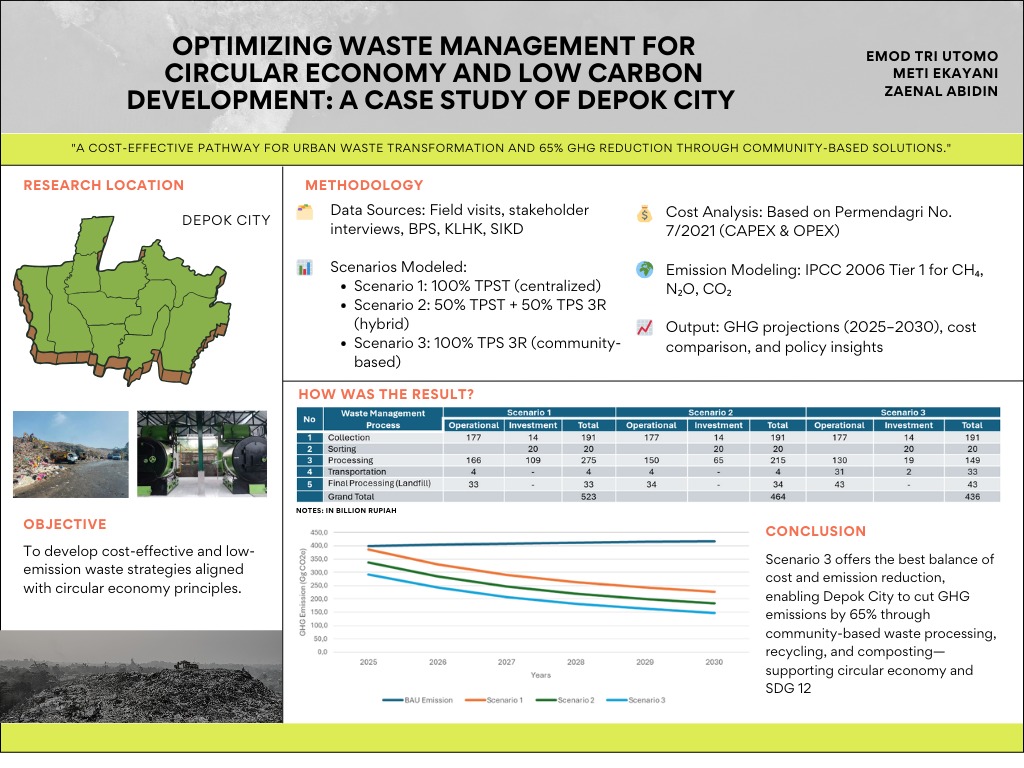
In Depok, Indonesia, rapid urbanization and economic growth have significantly increased waste production, exposing inefficiencies in existing management systems that contribute to environmental, health, and socio-economic problems, including pollution and rising greenhouse gas (GHG) emissions. This study evaluates the investment and operational requirements for optimal waste management, estimates potential GHG reductions compared to a Business as Usual (BAU) baseline in 2030, and examines policy implications that support a circular economy and low-carbon development. A mixed-method approach was employed by integrating field surveys, stakeholder interviews, and secondary data from local government and environmental agencies. Emissions were calculated for 2025 to 2030 using Intergovernmental Panel on Climate Change (IPCC) 2006 Tier 1 methods, while descriptive analysis was applied to interpret institutional and policy readiness. The results demonstrate that an optimized scenario, which emphasizes decentralized composting, recycling infrastructure, and improved governance, could achieve a 65% reduction in GHG emissions by 2030 relative to the BAU baseline. Beyond quantifying emissions, the novelty of this study lies in integrating financial, environmental, and governance dimensions within a city-level framework, which remains underexplored in Indonesian and Southeast Asian waste management research. Strategic recommendations include upgrading community-based facilities, implementing fair waste tariffs consistent with the polluter pays principle, and fostering greater citizen participation. By linking emission mitigation with financial feasibility and institutional mechanisms, this study highlights how secondary cities such as Depok can serve as models for advancing circular economy and low-carbon urban transitions in Indonesia.
Full text article
References
2. Chen, D.M.C.; Bodirsky, B.L.; Krueger, T.; Mishra, A.; Popp, A. The World’s Growing Municipal Solid Waste: Trends and Impacts. Environmental Research Letters 2020, 15, doi:10.1088/1748-9326/ab8659.
3. Alawiyah, T.; Hadinata, F.; Saputra, D. Comparing Greenhouse Gas Emissions from Municipal Solid Waste Management Scenarios: A Case of Palembang, Indonesia. 8, 42–47, doi:10.22135/sje.2023.8.1,42-47.
4. Budihardjo, M.A.; Humaira, N.G.; Ramadan, B.S.; Wahyuningrum, I.F.S.; Huboyo, H.S. Strategies to Reduce Greenhouse Gas Emissions from Municipal Solid Waste Management in Indonesia: The Case of Semarang City. Alexandria Engineering Journal 2023, 69, 771–783, doi:10.1016/j.aej.2023.02.029.
5. Arisman and Famah, Y.A. Waste Management in Indonesia: Strategies and Implementaon of Sustainable Development Goals (SDGs) and Circular Economy. In Circular Economy Adoption : Catalysing Decarbonisation Through Policy Instruments; Ghosh Sadhan Kumar and Ghosh, S.K., Ed.; Springer Nature Singapore: Singapore, 2023; pp. 131–157 ISBN 978-981-99-4803-1.
6. Tahir, M.; Hussain, T.; Behaylu, A. Scenario of Present and Future of Solid Waste Generaon in India: A Case Study of Delhi Mega City. 2015, 5.
7. Kristanto, G.A.; Koven, W. Esmang Greenhouse Gas Emissions from Municipal Solid Waste Management in Depok, Indonesia. City and Environment Interactions 2019, 4, doi:10.1016/j.cacint.2020.100027.
8. Miahadi, M.F.; Rachman, I.; Matsumoto, T. Opmizing Indonesian Municipal Solid Waste Collecon Scenarios: Integraon of Mul-Objecve Search Simulaon and Social Cost–Benefit Analysis. J Mater Cycles Waste Manag 2024, 26, 1569–1587, doi:10.1007/s10163-024-01910-0.
htps://doi.org/10.29244/jpsl.20.1.1-10 JPSL, Vol(No) | 11
9. Mustafa, A.B.; Dong, H.; Zhang, C.; Fujii, M. Life Cycle Environmental Benefit and Waste-to-Energy Potenal of Municipal Solid Waste Management Scenarios in Indonesia. J Mater Cycles Waste Manag 2022, 24, 1859–1877, doi:10.1007/s10163-022-01441-6.
10. Intergovernmental Panel on Climate Change (IPCC) Climate Change 2021 – The Physical Science Basis; Cambridge University Press, 2023; ISBN 9781009157896.
11. Zhang, X.; Liu, C.; Chen, Y.; Zheng, G.; Chen, Y. Source Separaon, Transportaon, Pretreatment, and Valorizaon of Municipal Solid Waste: A Crical Review. Environ Dev Sustain 2022, 24, 11471–11513, doi:10.1007/s10668-021-01932-w.
12. Orlov, A.; Klyuchnikova, E.; Korppoo, A. Economic and Environmental Benefits from Municipal Solid Waste Recycling in the Murmansk Region. Sustainability (Switzerland) 2021, 13, doi:10.3390/su131910927.
13. Fei, X.; Fang, M.; Wang, Y. Climate Change Affects Land-Disposed Waste. Nat Clim Chang 2021, 11, 1004–1005, doi:10.1038/s41558-021-01220-5.
14. Talballa, H.M.; Gichuru, J. Toward the Circular Qatari Zero-Waste Management Sector. In Gulf Studies; Springer, 2023; Vol. 9, pp. 305–327.
15. Gopinath, K.P.; Vo, D.-V.N.; Gnana Prakash, D.; Adithya Joseph, A.; Viswanathan, S.; Arun, J. Environmental Applicaons of Carbon-Based Materials: A Review. Environ Chem Lett 2021, 19, 557–582, doi:10.1007/s10311-020-01084-9.
16. Gunarathne, V.; Ashiq, A.; Ramanayaka, S.; Wijekoon, P.; Vithanage, M. Biochar from Municipal Solid Waste for Resource Recovery and Polluon Remediaon. Environ Chem Lett 2019, 17, 1225–1235, doi:10.1007/s10311-019-00866-0.
17. Ferronato, N.; Torreta, V. Waste Mismanagement in Developing Countries: A Review of Global Issues. Int J Environ Res Public Health 2019, 16.
18. Zhang, X.; Liu, B.; Zhang, N. Forecasng the Migaon Potenal of Greenhouse Gas Emissions in Shenzhen through Municipal Solid Waste Treatment: A Combined Weight Forecasng Model. Atmosphere (Basel) 2024, 15, doi:10.3390/atmos15040507.
19. Ding, Y.; Zhao, J.; Liu, J.W.; Zhou, J.; Cheng, L.; Zhao, J.; Shao, Z.; Iris, Ç.; Pan, B.; Li, X.; et al. A Review of China’s Municipal Solid Waste (MSW) and Comparison with Internaonal Regions: Management and Technologies in Treatment and Resource Ulizaon. J Clean Prod 2021, 293.
20. Zhang, J.; Qin, Q.; Li, G.; Tseng, C.-H. Sustainable Municipal Waste Management Strategies through Life Cycle Assessment Method: A Review. J Environ Manage 2021, 287, 112238, doi:htps://doi.org/10.1016/j.jenvman.2021.112238.
21. Leifeld, J. Carbon Farming: Climate Change Migaon via Non-Permanent Carbon Sinks. J Environ Manage 2023, 339, doi:10.1016/j.jenvman.2023.117893.
22. Domínguez, M.; Paradelo Núñez, R.; Piñeiro, J.; Barral, M.T. Physicochemical and Biochemical Properes of an Acid Soil under Potato Culture Amended with Municipal Solid Waste Compost. International Journal of Recycling of Organic Waste in Agriculture 2019, 8, 171–178, doi:10.1007/s40093-019-0246-x.
This journal is © Author et al. 20xx JPSL, Vol(No)| 12
23. Hajam, Y.A.; Kumar, R.; Kumar, A. Environmental Waste Management Strategies and Vermi Transformaon for Sustainable Development. Environmental Challenges 2023, 13, 100747, doi:htps://doi.org/10.1016/j.envc.2023.100747.
24. Michel Devadoss, P.S.; Pariatamby, A.; Bha, M.S.; Chenayah, S.; Shahul Hamid, F. Strategies for Reducing Greenhouse Gas Emissions from Municipal Solid Waste Management in Pakistan. Waste Management & Research 2021, 39, 914–927, doi:10.1177/0734242X20983927.
25. Yasmeen, R.; Sarfraz, M.; Shah, W.U.H.; Ivascu, L.; Cifuentes-Faura, J. The Impact of Public Awareness, Infrastructure, and Technological Development with Economic Growth on Solid Waste Management of European Countries: Does Governance Quality Maters. Environmental Science and Pollution Research 2023, 30, 113442–113456, doi:10.1007/s11356-023-30356-4.
26. Ella, D.M.-L.; Lim, D.M.; Lu, B.; Cabauatan, R.R. The Impact of Solid Waste Management to the Economic Growth in Selected OECD Countries and Philippines. Journal of Economics, Finance and Accounting Studies 2022.
27. Hoang, N.H.; Ishigaki, T.; Kubota, R.; Tong, T.K.; Nguyen, T.T.; Nguyen, H.G.; Yamada, M.; Kawamoto, K. Financial and Economic Evaluaon of Construcon and Demolion Waste Recycling in Hanoi, Vietnam. Waste Management 2021, 131, 294–304, doi:htps://doi.org/10.1016/j.wasman.2021.06.014.
28. Peng, Z.; Lu, W.; Webster, C. If Invisible Carbon Waste Can Be Traded, Why Not Visible Construcon Waste? Establishing the Construcon Waste Trading ‘Missing Market.’ Resour Conserv Recycl 2022, 187, 106607, doi:htps://doi.org/10.1016/j.resconrec.2022.106607.
29. Foggia, G. Di; Beccarello, M. Designing Waste Management Systems to Meet Circular Economy Goals: The Italian Case. Political Economy - Development: Public Service Delivery eJournal 2021.
30. Hammed, T.B.; Sridhar, M.K.C. Green Technology Approaches to Solid Waste Management in the Developing Economies. In African Handbook of Climate Change Adaptation; Oguge, N., Ayal, D., Adeleke, L., da Silva, I., Eds.; Springer Internaonal Publishing: Cham, 2021; pp. 1293–1312 ISBN 978-3-030-45106-6.
31. Nurpagi, E.M.; Ekayani, M.; Ismail, A. Waste Generaon Potenal and Household’s Willingness to Pay for the Management of Community 3R Waste Treatment Facility (TPS 3R) in Babakan Village, Bogor Regency. Jurnal Pengelolaan Sumberdaya Alam dan Lingkungan 2022, 12, 599–608, doi:10.29244/jpsl.12.4.599-608.
32. Yulia, K.; Arifin, H.S.; Ekayani, M. Tourist’s Willingness to Pay toward Waste Management in Gunung Salak Endah Tourism Area, Bogor District. Jurnal Pengelolaan Sumberdaya Alam dan Lingkungan 2022, 12, 123–133, doi:10.29244/jpsl.12.1.123-133.
Authors
Copyright (c) 2025 Emod Tri Utomo, Meti Ekayani, Zaenal Abidin

This work is licensed under a Creative Commons Attribution 4.0 International License.
Authors who publish with this journal agree to the following terms:
- Authors retain copyright and grant the journal right of first publication with the work simultaneously licensed under a Creative Commons Attribution License that allows others to share the work with an acknowledgement of the work's authorship and initial publication in this journal.
- Authors are able to enter into separate, additional contractual arrangements for the non-exclusive distribution of the journal's published version of the work (e.g., post it to an institutional repository or publish it in a book), with an acknowledgement of its initial publication in this journal.
- Authors are permitted and encouraged to post their work online (e.g., in institutional repositories or on their website) prior to and during the submission process, as it can lead to productive exchanges, as well as earlier and greater citation of published work (See The Effect of Open Access).
Article Details
How to Cite



