
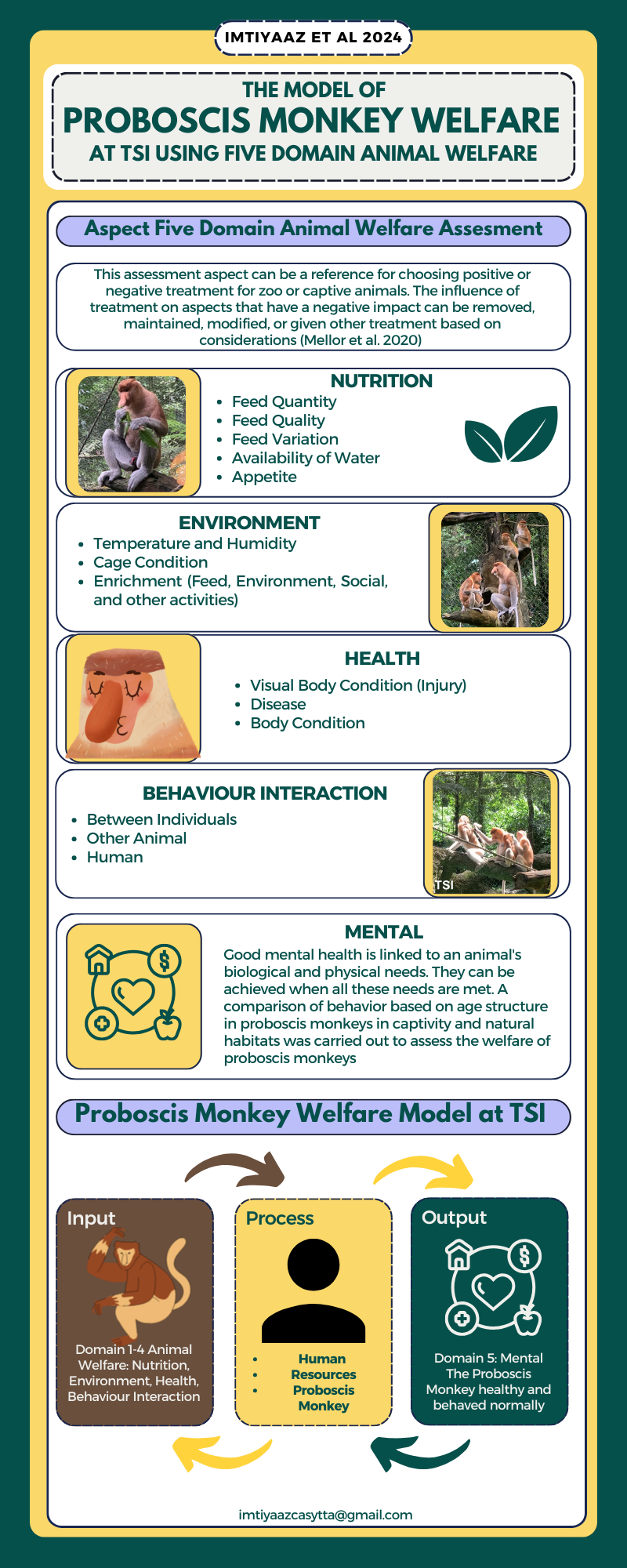
The model of Proboscis Monkey welfare in Indonesian Safari Park (Taman Safari Indonesia) using Five Domain Animal Welfare
Article Sidebar
-
Primate welfare, Nasalis larvatus,, animal welfare, ex-situ conservation, zoo management
Abstract
The proboscis monkey (Nasalis larvatus) is endemic to Borneo and is currently categorized as Endangered on the IUCN Red List. Not all proboscis monkeys can be conserved effectively in natural habitats. Zoos are ex-situ conservation, which aims to support conservation and ensure the welfare of animals. This research uses the Five Domain method to examine the welfare of proboscis monkeys at Taman Safari Indonesia (TSI) Bogor. The research was carried out from October 2022 to March 2023. The proboscis monkeys at TSI consumed feed ravenously, as indicated by the high percentage of ingestive behavior, 34.24%. Based on the MCU (medical check-up) results through interviews with veterinarians, the proboscis monkeys at TSI are in good health. No abnormal behavior was found in proboscis monkeys at TSI. Natural behavior and high use of environmental enrichment can be indicators of good welfare. Overall, proboscis monkeys at TSI show good welfare and management. The proboscis monkey welfare model can support ex-situ link in situ synergy as a sustainable conservation strategy. The condition of proboscis monkeys at TSI is in the welfare category based on behavioral observations and comprehensive studies.
Full text article
References
[2] Desnindriani P. Penelusuran Terancam Punahnya Satwa Bekantan di Kalimatan Selatan dalam Penyutradaraan Film Dokumenter Investigasi “Nasalis larvatus.” 2020; 1–20. https://cites.org/eng/node/23224
[3] Alikodra HS. Bekantan Perjuangan Melawan Kepunahan. 2015; Bogor (ID): Penerbit Fakultas Kehutanan IPB.
[4] Bismark M. Biologi konservasi Bekantan (Nasalis larvatus). 2009; (Issue 5).
[5] Albert JW. The history of the management proboscis monkey Nasalis larvatus at the Dallas Zoo. In Proceedings of the American Zoo and Aquarium Association. 1983; Wheeling, WV: AZA 276:283.
[6] Manansang J, Traylor-Holzer K, Leus DRK. Indonesian Proboscis Monkey Population and Habitat Viability Assessment. 2005; January 2005.
[7] Mellor DJ, Beausoleil NJ, Littlewood KE, McLean AN, McGreevy PD, Jones B, Wilkins C. The 2020 five domains model: Including human–animal interactions in assessments of animal welfare. Animals. 2020; 10(10): 1–24. doi.org/10.3390/ani10101870.
[8] Mellor DJ, Beausoleil NJ. Extending the ‘Five Domains’ model for animal welfare assessment to incorporate positive welfare states. Animal Welfare. 2015; 24: 241-253. doi: 10.7120/09627286.24.3.241.
[9] Mellor DJ. Operational details of the five domains model and its key applications to the assessment and management of animal welfare. Animals. 2017; 7(8). doi.org/10.3390/ani7080060
[10] Altman J. Observational study of behavior: Sampling methods. Behaviour. 1974; 49(3): 227-67. doi: 10.1163/156853974x00534.
[11] Yeager CP. Feeding ecology of the proboscis monkey (Nasalis larvatus). Int. J. of Primatology. 1989; 10(6): 497-529.
[12] Alikodra HS. Pengelolaan Satwa Liar. 1990; Bogor (ID): Pusat Antar Universitas Institut Pertanian Bogor.
[13] Odum EP. Fundamentals of Ecology. Third Edition, W.B. Saunders Co., Philadelphia. 1971; 1-574.
[14] Sari DRK. Studi Perilaku Makan Drop In Orang Utan Kalimantan (Pongo Pygmaeus, Linnaeus 1760) di Pusat Primata Schmutzer. 2006; Taman Margasatwa Ragunan. Jakarta.
[15] Bloomsmith MA, Linda YB, Steven JS. Guidelines to Developing and Managing an Environmental Enrichment Program for Nonhuman Primates. Labor Anim Sci. 1991; 41(4): 372-77.
[16] Bismark M. Perilaku bekantan (Nasalis larvatus Wurmb) dalam memanfaatkan lingkungan Hutan Bakau Taman Nasional Kutai, Kalimantan Timur [tesis]. 1986; Bogor: Institut Pertanian Bogor, Fakultas Pascasarjana.
[17] Yeager CP, Blondal TK. Conservation status of the proboscis monkey (Nasalis larvatus) at Tanjung Puting National Park, Kalimantan Tengah, Indonesia. Forest Biology and Conservation in Borneo. 1990; 2:220–228.
[18] Matsuda I, Murai T, Clauss M, Yamada T, Tuuga A, Bernard H, Higashi S. Regurgitation and remastication in the foregut-fermenting proboscis monkey (Nasalis larvatus). Biology Letters. 2011; 7: 786–789.
[19] Bismark M. Strategi dan tingkah-laku makan bekantan (Nasalis larvatus) di hutan bakau, Taman Nasional Kutai, Kalimantan Timur. Buletin Penelitian Hutan . 1987; (492): 1-10.
[20] Hollihn U. Remarks on breeding maintenance of Colobus monkey, proboscis monkey, and douc langur in zoos. Husbandry. 1973; 185-187
[21] Caro TM. Sex differences in the termination of social play in cats. Anim Behav. 1981; 29:271–279.
[22] Chalmers NR, Locke-Haydon J. Temporal patterns of play bouts in captive common marmosets (Callithrix jacchus). Anim Behav. 1981; 29:1229–1238
[23] Boissy A, Manteuffel G, Jensen MB, Moe RO, Spruijt B, et al. Assessment of positive emotions in animals to improve their welfare. Physiology & Behavior. 2007; 92: 375-397.
[24] Supriatna J, Wahyono EH. Panduan Lapangan Primata Indonesia. 2000; Jakarta (ID): Yayasan Pustaka Obor Indonesia
[25] Soerianegara I, Sastradipradja D, Alikodra HS, Bismark M. Studi Habitat, Sumber Pakan, dan Perilaku Bekantan (Nasalis larvatus) sebagai Parameter Ekologi dalam Mengkaji Sistem Pengelolaan Habitat Hutan Mangrove di Taman Nasional Kutai. 1994; Bogor: Laporan Akhir Pusat Penelitian Lingkungan Hidup, IPB.
[26] Soendjoto MA. Adaptasi Bekantan (Nasalis larvatus Wurmb) terhadap Hutan Karet: Studi Kasus di Kabupaten Tabalong, Kalimantan Selatan. 2005; [Disertasi]. Bogor: Program Pascasarjana IPB.
[27] Matsuda I, Bernard H, Tuuga A et al. Fecal nutrients suggest diets of higher fiber levels in free-ranging than in captive proboscis monkeys (Nasalis larvatus). Front Vet Sci. 2018; 4:246. https://doi. org/10. 3389/ fvets. 2017. 00246
[28] Hoshino S, Selno S, Azumano A, Tuuga A, Nathan SKSS, Saldivar DAR, Goossens, Lynn MS, Matsuda I, Yayota M. Modifying the diets of captive proboscis monkey in a temperate zoo to reduce weight loss and renal disease. Primates. 2022; https://doi.org/10.1007/s10329-022-01031-y
[29] Yeager CP, Silver SC, Dierenfeld ES. Mineral and phytochemical influences on foliage selection by the proboscis monkey (Nasalis larvatus). Am J Primatol. 1997; 41:117–128.
[30] Aryantini D. Aktivitas antioksidan dan kandungan tanin total ekstrak etanol daun kupu-kupu (Bauhinia purpurea L.). Jurnal Farmagazine. 2021; 8(1): 53-60.
[31] Alikodra HS, Mustari AH. Study on ecology and conservation of proboscis monkey (Nasalis larvatus Wurmb) at Mahakam River Delta, East Kalimantan: Behaviour and habitat function. Annual Report of Pusrehut 1994; Vol. 5 Desember.
[32] Atmoko T, Ma'ruf A, Rinaldi SE, Sitepu BS. Penyebaran bekantan (Nasalis larvatus Wurmb.) di Teluk Balikpapan, Kalimantan Timur. In Nur Sumedi et al., eds. Prosiding Seminar Hasil-Hasil Penelitian BPTKSDA. Bogor: Pusat Penelitian dan Pengembangan Konservasi dan Rehabilitasi. 2011; pp. 71–83
[33] Zainudin, Rezeki A. Aktivitas makan dan jenis pakan bekanta (Nasalis larvatus) di Pulau Bakut Kabupaten Barito Kuala. Prosiding Seminar Nasional Lahan Basah. 2016; 1: 99-104.
[34] Leinmüller E, Steingass H, Menke K. Tannins in ruminant feedstuffs. Animal Research Development. 1991; 33: 9-62.
[35] Hosey GR. How does the zoo environment affect the behaviour of captive primates? Applied Animal Behaviour Science. 2005; 90(2): 107–129. https://doi.org/10.1016/j.applanim.2004.08.015
[36] Altman J. Animal activity and visitor learning at the zoo. Anthrozoös. 1998; 11: 12–21. doi: 10.2752/089279398787000869.
[37] Melfi VA, McCormick W, Gibbs A. A preliminary assessment of how zoo visitors evaluate animal welfare according to enclosure style and the expression of behavior. Anthrozoös. 2004; 17: 98–108. doi:10.2752/089279304786991792
[38] Husband S, Mayo LK, Sodaro C. Environmental pengayaan lingkungan. Diperbarui oleh FogartyD. 2008; http://www.brookfieldzoo.org/czs/Animal- Care/Animal.
[39] Caro TM. Short-term costs and correlates of play in cheetahs. Anim Behav. 1995; 49: 333–345.
[40] Hall SL, Bradshaw JWS, Robinson IH. Object of play in adult domestic cats: the roles of habituation and disinhibition. Appl Anim Behav Sci. 2002; 79:263–271
[41] Nunes S, Muecke E, Lancaster LT, Miller NA, Mueller MA, Muelhaus J, Castro L. Functions and consequences of play behaviour in juvenile belding’s ground squirrels. Anim Behav. 2004; 68:27–37.
[42] Matsuda I, Tuuga A, Akiyama Y, Higashi S. Selection of river crossing location and sleeping site by proboscis monkeys (Nasalis larvatus) in Sabah, Malaysia. Am J Primatol. 2008; 70: 1097–1101.
[43] Feilen KL, Marshall AJ. Sleeping site selection by proboscis monkeys (Nasalis larvatus) in West Kalimantan, Indonesia. Am J Primatol. 2014; 76(12), 1127–1139. https://doi.org/10.1002/ajp.22298362–373.https://doi.org/10.1002/zoo.20404.
[44] Bernard H, Matsuda I, Hanya G, Ahmad AH. Characteristics of night sleeping trees of proboscis monkeys (Nasalis larvatus) in Sabah, Malaysia. Int J Primatol. 2011; 32: 259–267. https://doi.org/10.1007/s10764-010-9465-8.
[45] Latham N, Mason G. Frustration and perseveration in stereotypic captive animals: is a taste of enrichment worse than none at all?. Behav Brain Res. 2010; 211(1): 96-104. doi: 10.1016/j.bbr.2010.03.018.
[46] Bekoff M. Motor training and physical fitness: possible short and long-term influences on the development of individual differences in behaviour. Dev Psychobiol. 1988; 21: 601–612.
[47] Spinka M, Newberry RC, Bekoff M. Mammalian play: training for the unexpected. Q Rev Biol. 2001; 76:141–168.
[48] Sajuthi D. Satwa Primata Sebagai Hewan Laboratorium. 1984; Bogor (ID): Institut Pertanian Bogor.
[49] Klaus A, Strube C, Roper KM, Radespiel U, Schaarschmidt F, Nathan S, Goossens B, Zimmermann E. Fecal parasite risk in the endangered proboscis monkey is higher in an anthropogenically manage forest environment compared to a riparian rain forest in Sabah, Borneo. 2018.
[50] Hashido SN, Tsuchida S, Azumano A, Goossens B, Saldivar, D.A.R.; Stark, D.J, Tuuga A, Ushida K, Matsuda I. Isolation of Bacteria from Freeze-Dried Samples and the Functional Characterization of Species-Specific Lactic Acid Bacteria with a Comparison of Wild and Captive Proboscis Monkeys. Microorganisms. 2023; 11: 1458.https://doi.org/10.3390/microorganisms11061458
[51] Bennett EL, Sebastian AC. Social organization and ecology of proboscis monkeys (Nasalis larvatus) in mixed coastal forest in Sarawak. Int J Primatol. 1988; 9: 233–55. doi:10.1007/BF02737402
[52] Boonratana R. Social organization of proboscis monkeys (Nasalis larvatus) in the lower Kinabatangan, Sabah, Malaysia. Malay Nat. 2002; J 56:57–75.
[53] Yeager CP. Proboscis monkey (Nasalis larvatus) social organization: intergroup patterns of association. American Journal of Primatology. 1991; 23:73–86.
[54] Fashing PJ. African colobine monkeys: patterns of between group interaction. In: Campbell CJ, Fuentes A, Mackinnon KC, Panger M, Bearder SK (eds) Primates in perspective. Oxford University Press, Oxford. 2007; pp 201–224.
[55] Kirkpatrick RC. The Asian colobines diversity among leaf eating monkeys. In: Campbell CJ, Fuentes A, Mackinnon KC, Panger M, Bearder SK (eds) Primates in perspective. Oxford University Press, Oxford. 2007; pp 186–200.
[56] Sha JC, Alagappasamy S, Chandran S, Cho KM, Guha B. Establishment of a captive all-male group of proboscis monkey (Nasalis larvatus) at the Singapore Zoo. Zoo Biol. 2012; 32(3): 281–90. doi:10.1002/zoo.21020
[57] Asa CS. Weighing the options for limiting surplus animals. ZooBiology. 2016; 35(3): 183–186. https://doi.org/10.1002/zoo.21293
[58] Ferrie GM, Becker KK, Wheaton CJ, Fontenot D, Bettinger T. Chemical and surgical interventions toal leviate intraspecific aggression in male collared lemurs (Eulemur collaris). Journal of Zoo and Wildlife Medicine. 2011; 42(2): 214–221.https://doi.org/10.1638/2009-0193.1
[59] Cowl VB. The effect of captive management on primate social behaviour and aggression. [Thesis]. 2019; University of Manchester Faculty of Science and Engineering.
[60] Struhsaker TT, Leland L. Socioecology of five sympatric monkey species in the Kibale Forest, Uganda. Di dalam : Rosenblett J, Hinde RA, Beer C, Busnel MC, editor. Advanced in the study of behavior. 1979; New York: Academic Pr.
[61] Alikodra HS. Dasar-Dasar Pembinaan Margasatwa. Laboratorium Satwa Liar. 1997; Bogor (ID): Jurusan KSH Fakultas Kehutanan IPB.
[62] Riggio G, Pirrone F, Lunghini E, Gazzano A, Mariti C. Zookepers Perception of Canid Welfare and Its Effect on Job Satisfaction, Worldwide. Animals. 2020; 10 (916).
[63] Hill SP, Broom DM. Measuring zoo animal welfare: theory and practice. Zoo Biol. 2009; 28(680): 531-544.
[64] Hosey GR, Melfi V, Pankhurst S. Zoo Animals: behavior management and welfare (2nd ed). 2013; Oxford (UK): Oxford University Pr.
[65] Nasuka. Teori Sistem Sebagai Salah Satu Alternatif Pendekatan Ilmu-Ilmu Agama Islam. Jakarta (ID). Prenada Media. 2005.
[66] Morgan KN, Tromborg CT. Sources of stress in captivity. Applied Animal Behaviour Science. 2007; 102: 262-302. https://doi.org/10.1016/j.applanim.2006.05.032
[67] Schapiro SJ, Lambeth SP, Jacobsen KR, Williams LE, Nehete BN, Nehete PN. Physiological and welfare consequences of transport, relocation, and climatization of chimpanzees (Pan troglodytes). Applied Animal Behaviour Science. 2011; 137: 183-193.
Authors
Copyright (c) 2025 Cassytta Dhiya Imtiyaaz, Hadi Sukadi Alikodra, Jansen Manansang, Yohana Trihastuti, Huda Shalahudi Darusman

This work is licensed under a Creative Commons Attribution 4.0 International License.
Authors who publish with this journal agree to the following terms:
- Authors retain copyright and grant the journal right of first publication with the work simultaneously licensed under a Creative Commons Attribution License that allows others to share the work with an acknowledgement of the work's authorship and initial publication in this journal.
- Authors are able to enter into separate, additional contractual arrangements for the non-exclusive distribution of the journal's published version of the work (e.g., post it to an institutional repository or publish it in a book), with an acknowledgement of its initial publication in this journal.
- Authors are permitted and encouraged to post their work online (e.g., in institutional repositories or on their website) prior to and during the submission process, as it can lead to productive exchanges, as well as earlier and greater citation of published work (See The Effect of Open Access).
Article Details
How to Cite



