
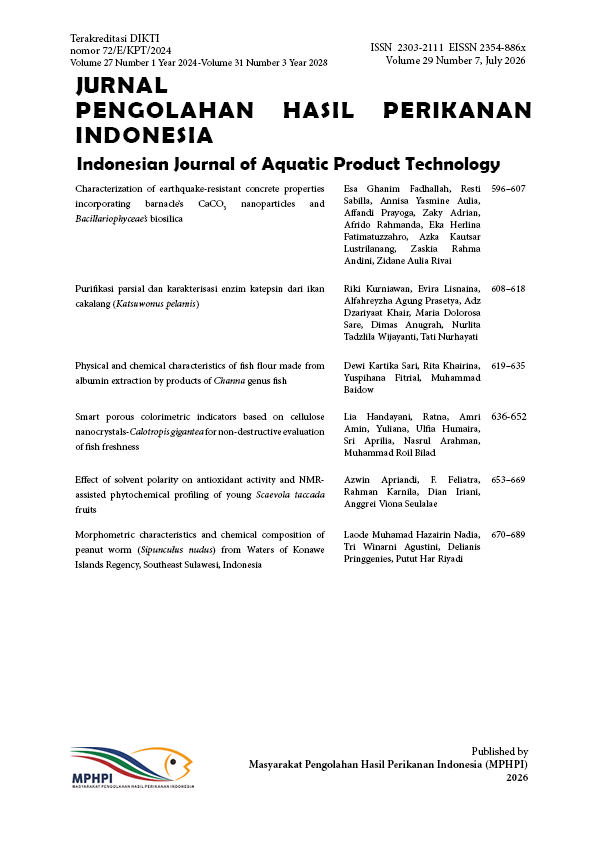
Effect of solvent polarity on antioxidant activity and NMR-assisted phytochemical profiling of young Scaevola taccada fruits Pengaruh polaritas pelarut terhadap aktivitas antioksidan dan karakterisasi fitokimia berbasis nmr pada buah muda <i>Scaevola taccada</i>
Article Sidebar
-
bioprospecting, coastal bioresources, DPPH, glycosylated metabolites, secondary metabolite
Abstract
The exploration of coastal plants as natural antioxidant sources has gained attention because of their adaptation to harsh environments and the presence of diverse bioactive metabolites in them. This study investigated the effect of solvent polarity on the extraction yield, antioxidant activity, and metabolite characteristics of young S. taccada fruits using an NMR-assisted phytochemical approach. Sequential extraction was performed using n-hexane, ethyl acetate, and ethanol. Antioxidant activity was evaluated using the DPPH radical scavenging assay, and metabolites were characterized using one-dimensional ¹H and ¹³C NMR spectroscopy. The extraction yield increased with solvent polarity, with ethanol providing the highest yield (1.17 ± 0.00%), followed by ethyl acetate (0.73 ± 0.00%) and n-hexane (0.23 ± 0.00%) extracts. The ethanol extract showed moderate activity (IC₅₀ = 113.99 ± 5.07 ppm), followed by ethyl acetate (181.01 ± 15.60 ppm), whereas n-hexane showed very weak activity (2,965.25 ± 1,966.56 ppm). DPPH inhibition increased with increasing concentrations, indicating a concentration-dependent response. NMR analysis of the ethanol extract revealed dominant carbohydrate-associated signals (δH 3.1-4.0 ppm; δC 64.17-73.68 ppm), along with aliphatic, unsaturated, and carbonyl signals, indicating a predominance of carbohydrate-associated and oxygenated metabolites; however, their contribution to antioxidant activity could not be directly established. Overall, solvent polarity significantly (p<0.05) influenced the extraction yield, antioxidant activity, and metabolite distribution of the extracts. Because assignments rely solely on one-dimensional NMR, metabolite identities and structure–activity relationships remain uncertain. Further studies using LC-MS/MS and two-dimensional NMR are required to confirm metabolite identities and clarify their contributions to the observed antioxidant activity.
Full text article
References
Apriandi, A., Anjar, R. Z., Fatmawati, K., Amrizal, N. S., & Putri, R. M. S. (2021). Aktivitas antioksidan dari air buah beruwas laut (Scaevola taccada). Jurnal Pengolahan Hasil Perikanan Indonesia, 24(3), 325–329. https://doi.org/10.17844/jphpi.v24i3.36874
Arunachalam, C. (2013). Study of anti-inflammatory activity of Scaevola taccada roxb leaf extracts. International Journal of Phytopharmacology, 4(4), 263-265.
Azmir, J., Zaidul, I. S. M., Rahman, M. M., Sharif, K. M., Mohamed, A., Sahena, F., Jahurul, M. H. A., Ghafoor, K., Norulaini, N. A. N., & Omar, A. K. M. (2013). Techniques for extraction of bioactive compounds from plant materials: A review. Journal of Food Engineering, 117(4), 426–436. https://doi.org/https://doi.org/10.1016/j.jfoodeng.2013.01.014
Azzahra, V. O., Mardiana, S., Suharyadi, S., Sianipar, R. J., & Ramadhan, D. S. (2025). Effect of solvent polarity on extraction yield, phytochemical composition, and antioxidant activity of Curcuma xanthorrhiza Roxb. and Moringa oleifera Lam. Biology, Medicine, & Natural Product Chemistry, 14(2), 1273–1284. https://doi.org/10.14421/biomedich.2025.142.1273-1284
Bitwell, C., Indra, S. Sen, Luke, C., & Kakoma, M. K. (2023). A review of modern and conventional extraction techniques and their applications for extracting phytochemicals from plants. Scientific African, 19, 1-19. https://doi.org/10.1016/j.sciaf.2023.e01585
Budiana, W., Novianti, H., Roni, A., Tinggi, S., & Bandung, F. (2019). Uji aktivitas antioksidan, penetapan kadar total flavonoid dan senyawa fenolik ekstrak daun dan batang subong-subong (Scaevola taccada L.). Jurnal Farmasi Galenika, 6(1), 22–32.
Chen, Z., Badman, R. P., Foley, L., Woods, R., & Hong, P. (2024). GlycoNMR: Dataset and benchmark of carbohydrate-specific NMR chemical shift for machine learning research. Journal of Data-centric Machine Learning Research, 1-23.
Ciupei, D., Colişar, A., Leopold, L., Stănilă, A., & Diaconeasa, Z. M. (2024). Polyphenols: from classification to therapeutic potential and bioavailability. Foods, 13(24), 1-36. https://doi.org/10.3390/foods13244131
Dai, J., & Mumper, R. J. (2010). Plant phenolics: Extraction, analysis and their antioxidant and anticancer properties. Molecules, 15(10), 7313–7352. https://doi.org/10.3390/molecules15107313
Dirar, A. I., Alsaadi, D. H. M., Wada, M., Mohamed, M. A., Watanabe, T., & Devkota, H. P. (2019). Effects of extraction solvents on total phenolic and flavonoid contents and biological activities of extracts from Sudanese medicinal plants. South African Journal of Botany, 120, 261–267. https://doi.org/https://doi.org/10.1016/j.sajb.2018.07.003
Do, Q. D., Angkawijaya, A. E., Tran-Nguyen, P. L., Huynh, L. H., Soetaredjo, F. E., Ismadji, S., & Ju, Y. H. (2014). Effect of extraction solvent on total phenol content, total flavonoid content, and antioxidant activity of Limnophila aromatica. Journal of Food and Drug Analysis, 22(3), 296–302. https://doi.org/https://doi.org/10.1016/j.jfda.2013.11.001
Dutta, A., Al-Younis, I., Manassra, R. I., Makharza, S. A., Al-Rimawi, F., Akkawi, M., Sawalha, K., Sioud, S., Sharfalddin, A. A., Jaremko, M., & Emwas, A. H. (2025). NMR and GC-MS based metabolic profiling, total phenolic content, antibacterial, antioxidant, anticancer and In-silico antiviral activity of Origanum ramonense plant. Scientific Reports, 15(1), 1-21. https://doi.org/10.1038/s41598-025-26621-w
El-Sayed, A. M., Abdel-Ghani, E. M., Tadros, S. H., & Soliman, F. M. (2020). Pharmacognostical and biological exploration of Scaevola taccada (Gaertn.) Roxb. grown in Egypt. Jordan Journal of Pharmaceutical Sciences, 13(4), 435-455.
Emu, S. A., Dulal, Md. A., Kali, T. Das, Chadni, M. S., Rasul, Md. G., Mondal, Md. N., Ahsan, Md. E., Khan, M., & Shah, A. K. M. A. (2023). Effects of extracting solvents on phytochemical, antioxidant, and antibacterial activity of some seaweeds from the Bay of Bengal offshore Island. Food and Humanity, 1, 1157–1166. https://doi.org/https://doi.org/10.1016/j.foohum.2023.09.005
Emura, N., Muranaka, T., Iwasaki, T., Honjo, M. N., Nagano, A. J., Isagi, Y., & Kudoh, H. (2022). Effects of fruit dimorphism on genetic structure and gene flow in the coastal shrub Scaevola taccada. Annals of Botany, 130(7), 1029–1040. https://doi.org/10.1093/aob/mcac138
Emwas, A. H., Roy, R., McKay, R. T., Tenori, L., Saccenti, E., Nagana Gowda, G. A., Raftery, D., Alahmari, F., Jaremko, L., Jaremko, M., & Wishart, D. S. (2019). NMR spectroscopy for metabolomics research. Metabolites, 9(7), 1-39. https://doi.org/10.3390/metabo9070123
Fatmawati, K., Apriandi, A., Amrizal, S. N., & Rezeki, Z. A. (2021, November 16). Antioxidant activity saripati beruwas laut fruit (Scaevola taccada) [Conference session]. Maritime Continent Fulcrum International Conference (MaCiFIC 2021), Tanjungpinang, Indonesia. E3S Web of Conferences, 324. https://doi.org/10.1051/e3sconf/202132401012
Gulcin, İ., & Alwasel, S. H. (2023). DPPH radical scavenging assay. Processes, 11(8), 1-20. https://doi.org/10.3390/pr11082248
Hasnat, H., Shompa, S. A., Islam, Md. M., Alam, S., Richi, F. T., Emon, N. U., Ashrafi, S., Ahmed, N. U., Chowdhury, Md. N. R., Fatema, N., Hossain, Md. S., Ghosh, A., & Ahmed, F. (2024). Flavonoids: A treasure house of prospective pharmacological potentials. Heliyon, 10(6), 1-28. https://doi.org/10.1016/j.heliyon.2024.e27533
Herwibawa. (2025). Fruit morphology and clustering analysis reveals diversity among commercial melons (Cucumis melo L.) in Indonesia. International Journal of Agriculture and Biosciences. 15(1), 115-124. https://doi.org/10.47278/journal.ijab/2025.137
Hilal, B., Khan, M. M., & Fariduddin, Q. (2024). Recent advancements in deciphering the therapeutic properties of plant secondary metabolites: phenolics, terpenes, and alkaloids. Plant Physiology and Biochemistry, 211, 108674. https://doi.org/https://doi.org/10.1016/j.plaphy.2024.108674
Jacob, A., Raju, S., Ramana, K. V., & Kumar, B. D. (2019). Pollination ecology of the coastal pantropical hermaphroditic shrub Scaevola taccada (Goodeniaceae). Phytologia Balcanica, 25(2), 191-202.
Jasna, T. J., Babu, K. S., Sreelakshmi, K., & Nanditha das, P. M. (2025). Pharmacological and ecological significance of Scaevola taccada: A comprehensive review. International Journal of Pharmacognosy and Clinical Research, 7(1), 46–49. https://doi.org/10.33545/2664763x.2025.v7.i1a.58
Joo, Y., Shin, E., Kim, H., Lee, M. K., & Kim, S. B. (2025). Molecular networking-guided annotation of flavonoid glycosides from quercus mongolica bee pollen. International Journal of Molecular Sciences, 26(16), 1-13. https://doi.org/10.3390/ijms26167930
Kim, H. K., Choi, Y. H., & Verpoorte, R. (2010). NMR-based metabolomic analysis of plants. Nature Protocols, 5(3), 536–549. https://doi.org/10.1038/nprot.2009.237
Ksouri, R., Megdiche, W., Debez, A., Falleh, H., Grignon, C., & Abdelly, C. (2007). Salinity effects on polyphenol content and antioxidant activities in leaves of the halophyte Cakile maritima. Plant Physiology and Biochemistry, 45(3), 244–249. https://doi.org/https://doi.org/10.1016/j.plaphy.2007.02.001
Liu, H., Xin, M., Liu, H., Luo, L., Chen, L., Sun, L., & Zhang, X. (2025). Structural verification of phenolic compounds in the aqueous extract of Chrysanthemum morifolium using LC-DAD-SPE-NMR method. Food Chemistry, 496, 146722. https://doi.org/https://doi.org/10.1016/j.foodchem.2025.146722
Ma, Y., Meng, A., Liu, P., Chen, Y., Yuan, A., Dai, Y., Ye, K., Yang, Y., Wang, Y., & Li, Z. (2022). Reflux extraction optimization and antioxidant activity of phenolic compounds from Pleioblastus amarus (Keng) shell. Molecules, 27(2), 1-19. https://doi.org/10.3390/molecules27020362
Mohammed, H. A., Emwas, A. H., & Khan, R. A. (2023). Salt-tolerant plants, halophytes, as renewable natural resources for cancer prevention and treatment: roles of phenolics and flavonoids in immunomodulation and suppression of oxidative stress towards cancer management. International Journal of Molecular Sciences, 24(6), 1-30. https://doi.org/10.3390/ijms24065171
Molyneux, P. (2004). The use of the stable free radical diphenylpicryl-hydrazyl (DPPH) for estimating antioxidant activity. J. Sci. Technol., 26(2), 211–219.
Mulyono, P., Yuzki, A. S., Sari, M. D., & Putri, N. R. E. (2022). Extraction of flavonoids from merremia mammosa using ethanol solvent in a fixed-bed column. ASEAN Journal of Chemical Engineering, 22(1), 105–112. https://doi.org/10.22146/ajche.70012
Nasution, Indriaty, & Marjanah. (2026). Phytochemical profile and antioxidant activity of phenolic and flavonoid compounds in methanol extracts of the fruit and leaves of Scaevola taccada (Geartn.) Roxb. Biology, Medicine, & Natural Product Chemistry, 15(1), 613–621. https://doi.org/10.14421/biomedich.2026.151.613-621
Nawaz, H., Shad, M. A., Rehman, N., Andaleeb, H., & Ullah, N. (2020). Effect of solvent polarity on extraction yield and antioxidant properties of phytochemicals from bean (Phaseolus vulgaris) seeds. Brazilian Journal of Pharmaceutical Sciences, 56, 1-9. https://doi.org/10.1590/s2175-97902019000417129
Nazir, S., Qasim, M., Gul, B., & Khan, M. A. (2018). Antioxidant properties and phenolic composition of coastal halophytes commonly used as medicine. International Journal of Biology and Biotechnology, 15(3), 66-71.
Prihantono, P., Syamsu, S. A., Smaradhania, N., Ahmad, M., Siagian, N. A., Lubis, K., & Umrah, A. S. (2020). Application of Scaevola taccada (Gaertn.) roxb. reduce pro-inflammatory cytokines interleukin-1β in sprague dawley mice suffering from mastitis. Macedonian Journal of Medical Sciences, 8(A), 423–427. https://doi.org/10.3889/oamjms.2020.4363
Qasim, M., Abideen, Z., Adnan, M. Y., Gulzar, S., Gul, B., Rasheed, M., & Khan, M. A. (2017). Antioxidant properties, phenolic composition, bioactive compounds and nutritive value of medicinal halophytes commonly used as herbal teas. South African Journal of Botany, 110, 240–250. https://doi.org/10.1016/j.sajb.2016.10.005
Shekhawat, M. S., Kannan, N., Manokari, M., & Priyadharshini, S. (2021). Regeneration of shoots via direct somatic embryogenesis from the leaf surface of Scaevola taccada (Gaertn.) roxb. – a climate resilient species of coastal areas. South African Journal of Botany, 140, 276–283. https://doi.org/https://doi.org/10.1016/j.sajb.2020.05.006
Silva, C. A. da, Soares, A. S., Silva, A. S., Pires, E. C. F., & Portella, A. C. F. (2018). Fully casualized design: a brief literary review. International Journal of Advanced Engineering Research and Science, 5(7), 100–108. https://doi.org/10.22161/ijaers.5.7.14
Singh, D., Thapa, S., Mahawar, H., Kumar, D., Geat, N., & Singh, S. K. (2022). Prospecting potential of endophytes for modulation of biosynthesis of therapeutic bioactive secondary metabolites and plant growth promotion of medicinal and aromatic plants. Antonie van Leeuwenhoek, 115(6), 699–730. https://doi.org/10.1007/s10482-022-01736-6
Swensen, S. M., Gomez, A. M., Piasecki-Masters, C., Chime, N., Wine, A. R., Rodriguez, N. C., Conklin, J., & Melcher, P. J. (2024). Minimal impacts of invasive Scaevola taccada on Scaevola plumieri via pollinator competition in Puerto Rico. Frontiers in Plant Science, 1-14. https://doi.org/10.3389/fpls.2024.1281797
Tripathi, S., Singh, S., Mishra, N., & Mishra, N. (2025). The impact of solvent polarity on the phenolic and antioxidant capacity of green coffee beans (Robusta species) extracts. Current Research in Nutrition and Food Science, 13(2), 926–936. https://doi.org/10.12944/CRNFSJ.13.2.27
Yadav, B., Jogawat, A., Rahman, M. S., & Narayan, O. P. (2021). Secondary metabolites in the drought stress tolerance of crop plants: A review. Gene Reports, 23, 101040. https://doi.org/https://doi.org/10.1016/j.genrep.2021.101040
Yeshi, K., Turpin, G., Jamtsho, T., & Wangchuk, P. (2022). Indigenous uses, phytochemical analysis, and anti-inflammatory properties of Australian tropical medicinal plants. Molecules, 27(12), 1-50. https://doi.org/10.3390/molecules27123849
Zhang, B., Li, S., Liang, Z., Wei, Y., Dong, J., Wen, H., Guo, L., Hao, X., & Zhang, Y. (2025). The application and perspective of NMR and MS based strategies for functional compounds mining in medicinal and dietary plants. Food Science and Human Wellness, 14(1), 1-14. https://doi.org/10.26599/FSHW.2024.9250003
Authors
Copyright (c) 2026 Azwin Apriandi, F. Feliatra, Rahman Karnila, Dian Iriani, Anggrei Viona Seulalae

This work is licensed under a Creative Commons Attribution 4.0 International License.
Authors who publish with this journal agree to the following terms:
- Authors retain copyright and grant the journal right of first publication with the work simultaneously licensed under a Creative Commons Attribution License that allows others to share the work with an acknowledgement of the work's authorship and initial publication in this journal.
- Authors are able to enter into separate, additional contractual arrangements for the non-exclusive distribution of the journal's published version of the work (e.g., post it to an institutional repository or publish it in a book), with an acknowledgement of its initial publication in this journal.
Article Details
How to Cite



