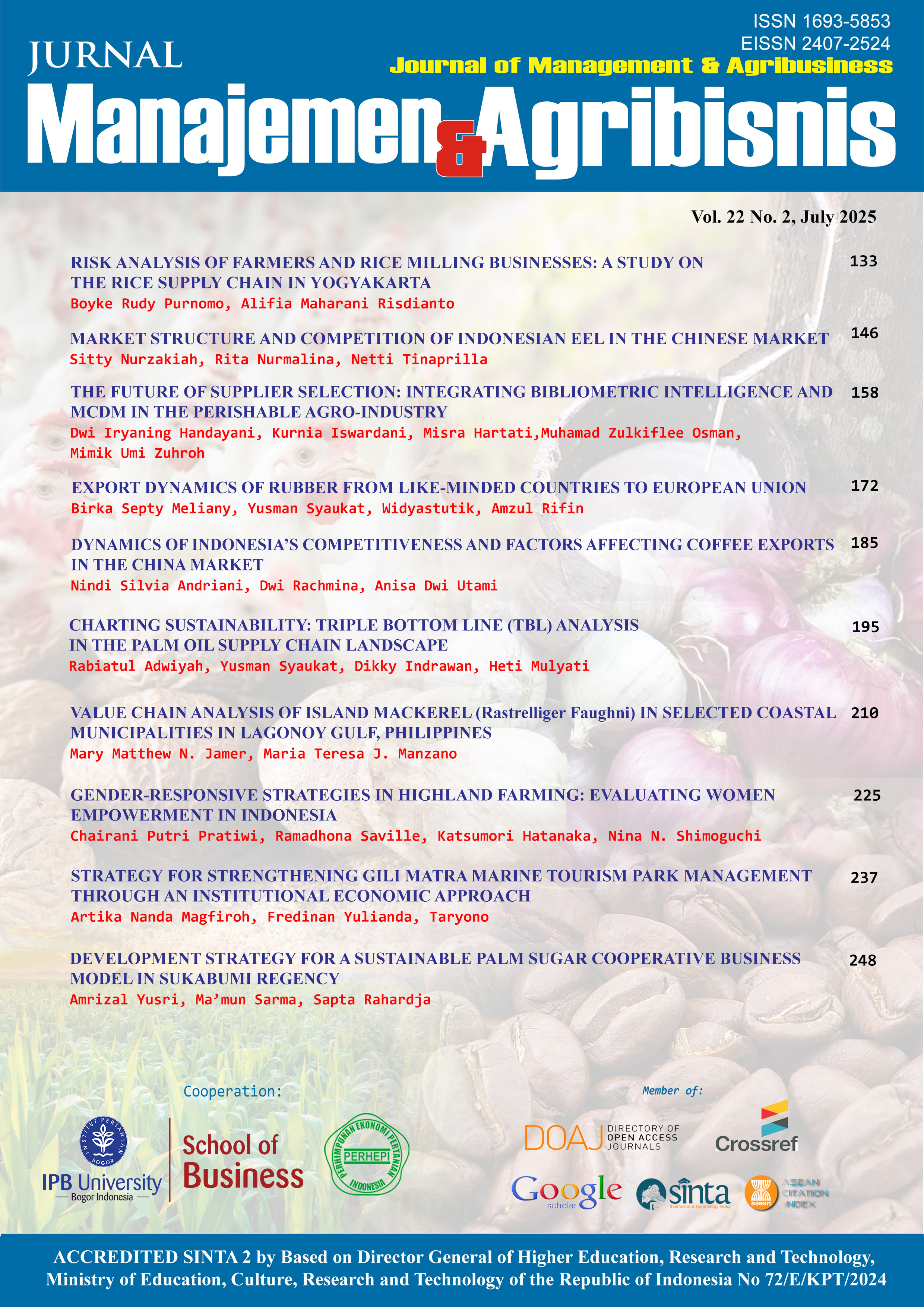
Strategy For Strengthening Gili Matra Marine Tourism Park Management Through an Institutional Economic Approach
DOI:
https://doi.org/10.17358/jma.22.2.237Abstract
Background: Gili Matra Marine Tourism Park (GMMTP) has the potential for marine ecosystems and high economic value through tourism; however, it has not been managed sustainably. Coral reef damage and institutional irregularities are the primary challenges.
Purpose: This study aimed to formulate a strategy to strengthen GMMTP management by using a community-based institutional economic approach that considers ecological and socioeconomic aspects.
Design/methodology/approach: A quantitative approach combining the Contingent Valuation Method (CVM) for the value of existing benefits, Payment for Ecosystem Services (PES) for the basic value of service costs, and Interpretive Structural Modeling (ISM) for mapping problems and institutional strategies.
Finding/Results: The PES value was set at IDR 333,062/person/visit, and the total WTP reaches IDR 60.5 billion/year. The main problem is institutional disagreement between government parties. Main strategies: Additional budgets and supervisory personnel.
Conclusion: The application of an institutional economic approach has been proven to support the sustainable management of conservation areas with a scientific basis for financing policies through PES.
Originality/value (State of the art): This study fills this gap by integrating ecosystem service valuation and institutional strategies based on economic data, which have not been widely applied in marine conservation areas in Indonesia.
Keywords: conservation, strengthening strategy, PES, CVM, ISM
Downloads
Downloads
Published
Issue
Section
License
Authors who publish with this journal agree to the following terms:
- Authors retain copyright and grant the journal right of first publication with the work simultaneously licensed under a Creative Commons Attribution License that allows others to share the work with an acknowledgement of the work's authorship and initial publication in this journal.
- Authors are able to enter into separate, additional contractual arrangements for the non-exclusive distribution of the journal's published version of the work (e.g., post it to an institutional repository or publish it in a book), with an acknowledgement of its initial publication in this journal.
- Authors are permitted and encouraged to post their work online (e.g., in institutional repositories or on their website) prior to and during the submission process, as it can lead to productive exchanges, as well as earlier and greater citation of published work (See The Effect of Open Access).
.png)