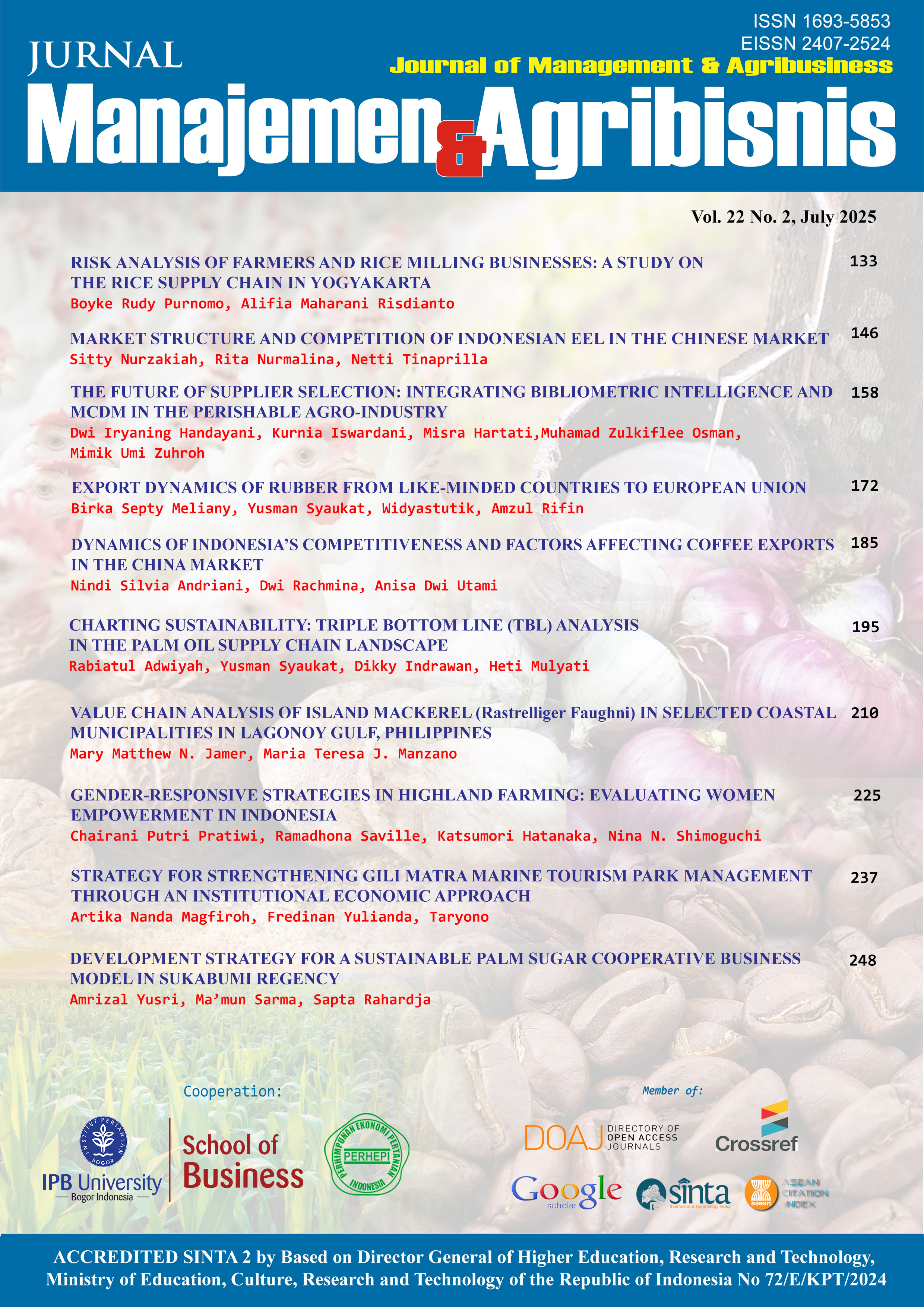
Risk Analysis of Farmers and Rice Milling Businesses: A Study on The Rice Supply Chain in Yogyakarta
DOI:
https://doi.org/10.17358/jma.22.2.133Abstract
Background: Rice is a staple food consumed by more than 98% of households in Indonesia. However, risks along the supply chain create an imbalance between high rice consumption and domestic rice production.
Purpose: In response to this circumstance, this study aims to identify the risks in the upstream sector of the rice supply chain involving rice farmers and millers, and then to develop a mitigation strategy for those priority risks.
Design/Methodology/Approach: A case study approach was adopted, and primary data were collected through in-depth interviews and questionnaires from farmers and rice millers in five different districts of Yogyakarta Province. Furthermore, the Failure Mode, Effect, and Criticality Analysis (FMECA) method was utilized for risk analysis.
Findings/result: The results showed that there are 19 types of risks encountered by farmers, where biological risks (weeds, pests, and diseases) are a priority risk with a moderate criticality level. In addition, the rice millers faced 17 types of risks, with the priority risk being the uncertainty of the raw material supply (rice and grain) with a high criticality level.
Conclusion: To manage biological risks, we suggest that farmers utilize applied technology and optimize extension management to improve quality and avoid the risk of decreasing crop yields. For rice millers, we propose the use of diversified supply sources, inventory management, and make-to-order production systems to reduce risk intensity and increase production effectiveness.
Originality/value (State of the art): This study is relevant to current affairs considering that rice production has an impact on national food security and that the risk of the rice supply chain is still inevitable. This study cascades the key risks in the rice supply chain, specifically in Yogyakarta, and assists relevant stakeholders in effectively addressing these risks.
Keywords: farmer risk, rice milling, supply chain, risk management, FMECA
Downloads
Downloads
Published
Issue
Section
License
Authors who publish with this journal agree to the following terms:
- Authors retain copyright and grant the journal right of first publication with the work simultaneously licensed under a Creative Commons Attribution License that allows others to share the work with an acknowledgement of the work's authorship and initial publication in this journal.
- Authors are able to enter into separate, additional contractual arrangements for the non-exclusive distribution of the journal's published version of the work (e.g., post it to an institutional repository or publish it in a book), with an acknowledgement of its initial publication in this journal.
- Authors are permitted and encouraged to post their work online (e.g., in institutional repositories or on their website) prior to and during the submission process, as it can lead to productive exchanges, as well as earlier and greater citation of published work (See The Effect of Open Access).
.png)