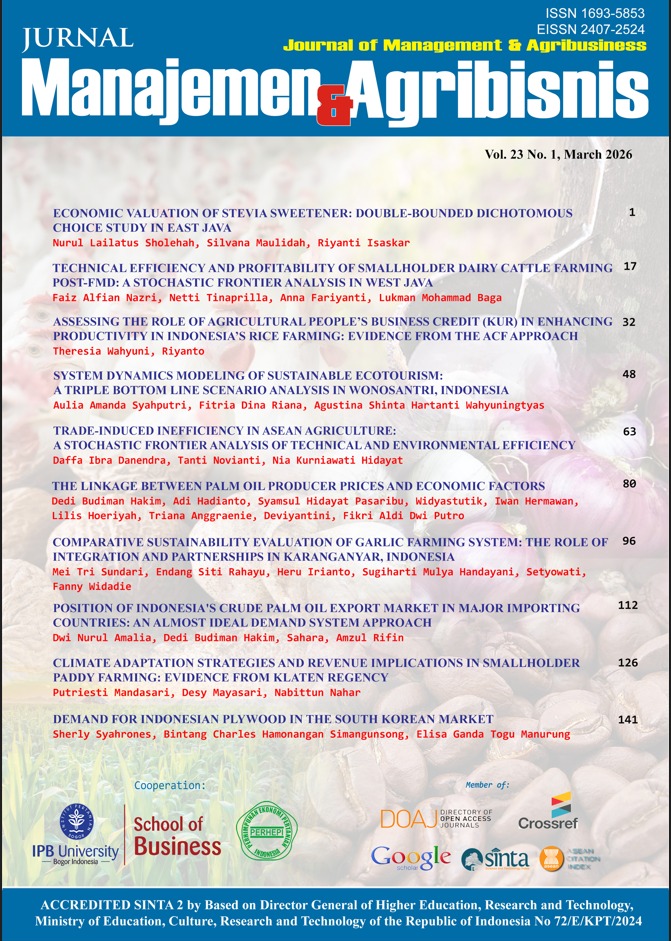
Technical Efficiency and Profitability of Smallholder Dairy Cattle Farming Post-FMD: A Stochastic Frontier Analysis in West Java
DOI:
https://doi.org/10.17358/jma.23.1.17Abstract
Background: The study is motivated by the persistent low productivity of dairy cattle farming in Bogor Regency, specifically within the Kawasan Usaha Peternakan (KUNAK), which has been further aggravated by the Foot and Mouth Disease (FMD) outbreak and inefficient input management in the area. The sector faces significant challenges, including the dominance of smallholder farms with poor feed management, shrinking land for forage, and heavy reliance on imports, all of which weaken local farmers’ bargaining power.
Purpose: This study aimed to analyze the factors influencing milk production, technical efficiency, and farm profitability in KUNAK. It seeks to evaluate how effectively farmers manage inputs, such as cattle and feed, to maximize output and determine the financial feasibility of these operations post-FMD.
Design/methodology/approach: Data were collected from 67 purposively sampled farmers in Cibungbulang and Pamijahan (January–April 2025) who owned cows in their second or third lactation. This study utilized a stochastic frontier translog production function estimated via Maximum Likelihood Estimation (MLE) to measure technical efficiency, alongside a revenue-cost (R/C) ratio analysis for profitability.
Findings/Result: MLE results indicated that lactating cows (0.656), concentrate (0.193), and tofu dregs (0.159) significantly affected milk yield. Conversely, labor's negative elasticity (-0.083) reflects severe overutilization. The farms operate under increasing returns to scale, with a high mean technical efficiency of 0.868. Efficiency improves with farmer age but declines as the number of family dependents increases. While economically feasible (R/C ratio=1.10), operations face tight profit margins of Rp207,951 per head per month.
Conclusion: Although smallholder dairy farming in the KUNAK cluster demonstrates high technical efficiency (0.868), this operational mastery does not translate into proportional economic welfare due to low market pricing and high input costs. Policy interventions must target labor reallocation and cooperative pricing reforms to bridge the gap between technical proficiency and economic sustainability.
Originality/value (State of the art): This study contributes a post-FMD analysis of smallholder dairy clusters, revealing a critical disconnect where high technical efficiency does not guarantee economic welfare due to external market and institutional failures.
Keywords: dairy cattle, production function, profitability, stochastic frontier, technical efficiency
Downloads
Downloads
Published
Issue
Section
License
Authors who publish with this journal agree to the following terms:
- Authors retain copyright and grant the journal right of first publication with the work simultaneously licensed under a Creative Commons Attribution License that allows others to share the work with an acknowledgement of the work's authorship and initial publication in this journal.
- Authors are able to enter into separate, additional contractual arrangements for the non-exclusive distribution of the journal's published version of the work (e.g., post it to an institutional repository or publish it in a book), with an acknowledgement of its initial publication in this journal.
- Authors are permitted and encouraged to post their work online (e.g., in institutional repositories or on their website) prior to and during the submission process, as it can lead to productive exchanges, as well as earlier and greater citation of published work (See The Effect of Open Access).
.png)