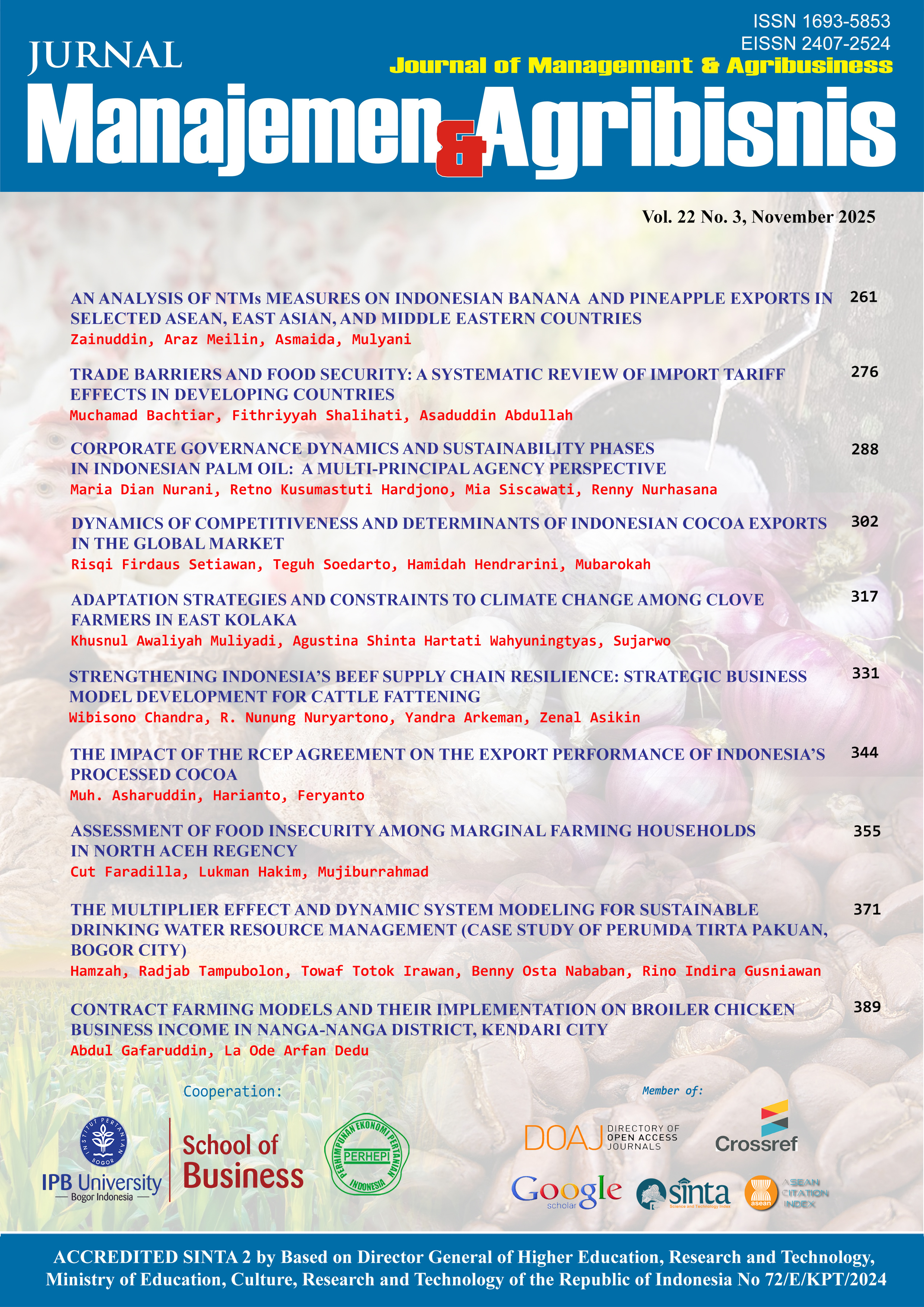
Trade Barriers and Food Security: A Systematic Review of Import Tariff Effects in Developing Countries
DOI:
https://doi.org/10.17358/jma.22.3.276Abstract
Background: Import tariffs are widely used in developing countries to manage food systems; however, their effects on the core pillars of food security under real-world shocks and institutional constraints remain debated.
Purpose: To evaluate how higher versus lower (including zero) import tariffs on major foods influence food availability, access, and stability, and to draw implications for diet quality (utilization).
Design/methodology/approach: A PRISMA-guided systematic literature review of Scopus-indexed, English-language journal articles (2020–2024). Twenty-five studies that met the predefined quality and relevance criteria were synthesized using a theory-driven narrative approach that describes how tariff settings shape trade and price channels, and, in turn, food security outcomes. Export restrictions are treated as exogenous stability shocks.
Findings/Results: Lower tariffs generally expand market-level availability, reduce consumer prices, and dampen routine domestic volatility through import diversification. Benefits are uneven without producer upgrading and fragile during global shocks. Utilization improves when barriers to nutrient-dense foods are removed; however, openness can accelerate ultra-processed food penetration without strong nutrition governance. The effects are conditioned by logistics performance, domestic competition and pass-through, governance quality, policy space, and commodity mix.
Conclusion: The most food-secure configuration is calibrated openness: liberalize where social welfare rises, pair reforms with farmer adjustment and productivity support, strengthen logistics and competition, preserve nutrition policy space, and operate a rules-based stability architecture.
Originality/value (State of the art): Provides an up-to-date, developing-country synthesis that centers import tariffs, integrates utilization and governance into the trade–food security nexus, and translates evidence into operational policy guidance.
Keywords: developing countries, food security, import tariffs, nutrition, trade liberalization.
Downloads
Downloads
Published
Issue
Section
License
Authors who publish with this journal agree to the following terms:
- Authors retain copyright and grant the journal right of first publication with the work simultaneously licensed under a Creative Commons Attribution License that allows others to share the work with an acknowledgement of the work's authorship and initial publication in this journal.
- Authors are able to enter into separate, additional contractual arrangements for the non-exclusive distribution of the journal's published version of the work (e.g., post it to an institutional repository or publish it in a book), with an acknowledgement of its initial publication in this journal.
- Authors are permitted and encouraged to post their work online (e.g., in institutional repositories or on their website) prior to and during the submission process, as it can lead to productive exchanges, as well as earlier and greater citation of published work (See The Effect of Open Access).
.png)