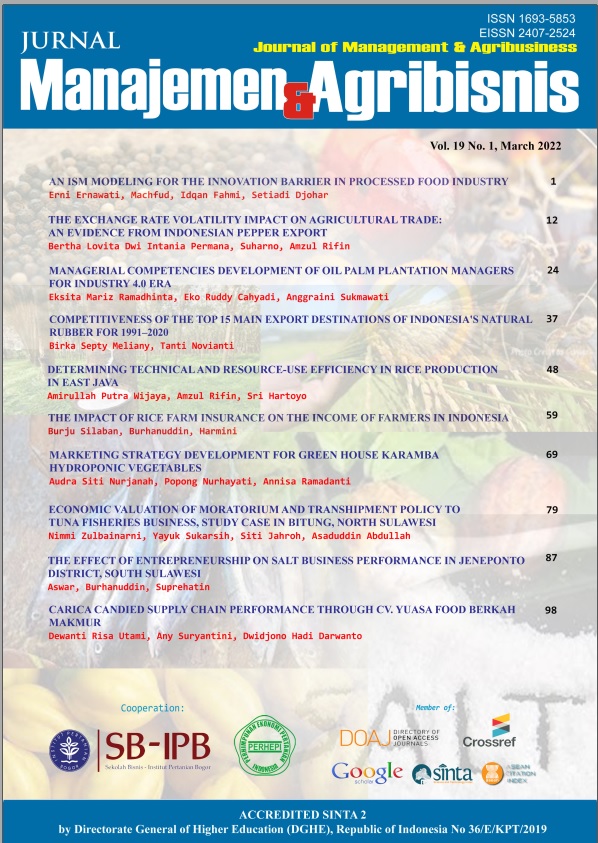
Economic Valuation of Moratorium and Transhipment Policy to Tuna Fisheries Business, Study Case in Bitung, North Sulawesi
DOI:
https://doi.org/10.17358/jma.19.1.79Abstract
The policy of moratorium on ex-welding vessels, according to Ministerial Regulation No. 56/2014, has an impact on tuna fishery conditions. Behind this policy is due to the heavy losses from the fisheries sector caused by the operation of these ex-foreign ships. This study evaluated the impact of policy by production surplus measurement techniques. The survey was conducted on capture fisheries companies, fish processing companies, and traditional processing groups. Data were analyzed by economic valuation using the extended cost-benefit analysis (ECBA) approach. The study results showed that as long as this policy is implemented, it will cause a decrease in the benefits of 9 tuna fisheries business actors by Rp1.23 trillion per year. Economic and social impacts of Rp 2.63 trillion per year, consisting of economic impacts of Rp1.35 trillion per year and social impacts of Rp1.28 trillion per year, which caused 19,972 people to lose their job.
Keywords: cost cost benefit analysis, economic impact, social iImpact, valuation
Downloads
Downloads
Published
Issue
Section
License
Authors who publish with this journal agree to the following terms:
- Authors retain copyright and grant the journal right of first publication with the work simultaneously licensed under a Creative Commons Attribution License that allows others to share the work with an acknowledgement of the work's authorship and initial publication in this journal.
- Authors are able to enter into separate, additional contractual arrangements for the non-exclusive distribution of the journal's published version of the work (e.g., post it to an institutional repository or publish it in a book), with an acknowledgement of its initial publication in this journal.
- Authors are permitted and encouraged to post their work online (e.g., in institutional repositories or on their website) prior to and during the submission process, as it can lead to productive exchanges, as well as earlier and greater citation of published work (See The Effect of Open Access).
.png)